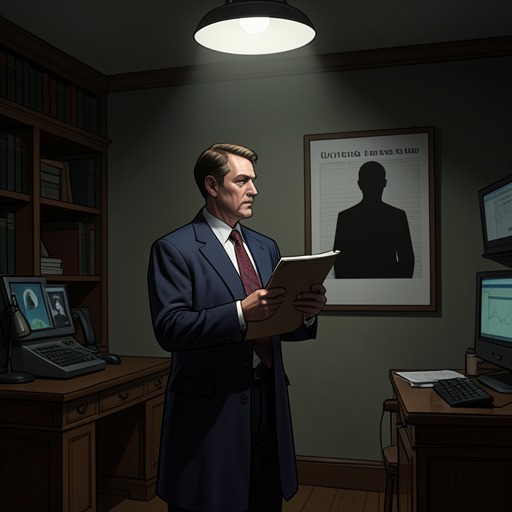
Alejandro Stern
Presumed InnocentAlejandro Stern is a defense attorney whose professional standing is established through both Carolyn Polhemus’s choice of counsel and his later representation of Rusty Sabich. In Rusty’s case, Stern turns the danger of the evidence into a reason for more scrutiny, not less: he insists on examining every witness and every item, including the technical points the prosecution may struggle to explain.
Identity and Professional Standing
When Carolyn Polhemus is asked who will defend her, she names Alejandro Stern. Her description presents him as a familiar choice for defendants of genteel upbringing: she says he seems to represent every such person charged with a crime in the state. The remark establishes his reputation through a client’s perspective, while placing him within the same professional world as the prosecutor’s office.
Stern also represents Rusty Sabich. The relationship is presented as an established attorney-client partnership: in Stern’s firm, Rusty works through the case materials delivered by Jamie Kemp, an employee of Stern’s office. Stern’s practice brings him into recurring contention with the prosecutor’s office, but the scenes show him maintaining professional reserve. He does not press Rusty to disclose even a minor confidence from that office, whose work Stern often contests.
Counsel to Rusty Sabich
At a meeting in Stern’s small conference room, Kemp brings a heavy cardboard box containing reports and documents in front and witness statements in back. The box, carried two blocks through the July sun, makes the case’s accumulated paperwork physically present. After Kemp steps away, Stern returns to the question of how well Rusty understands Nico Delia Guardia’s case and asks him for a concise account of the prosecution’s opening statement. His attention is directed not just to what the state alleges, but to whether his client can identify the structure of its argument.
Stern’s courtroom manner is composed and formal. He takes off his coat, calls for coffee, and sits with a cigar and a large crystal ashtray. These details accompany a measured conversation rather than a display of panic: he invites Rusty to explain the case, listens to his assessment, and then weighs what the defense may be able to do with it.
Defense Method and Significance
Stern acknowledges that Rusty has advantages and that questions about the evidence could matter to a reasonable person, especially in a circumstantial case. He also refuses to let reassurance become self-deception: he tells Rusty that the evidence overall is very damaging. That blunt assessment defines his approach. The defense must recognize the case’s strength accurately before it can test it effectively.
He therefore directs Rusty to identify every flaw and defect, and calls for a repeated, scrupulous review of each piece of evidence and each witness. The work is to begin immediately, not the next day. Stern specifically urges attention to technical weaknesses and to every point Nico Delia Guardia cannot account for, because each such gap increases the defense’s opportunity to secure an acquittal. His counsel turns the case from an overwhelming mass of damaging evidence into a set of claims that must be examined one by one. The method makes Stern’s role more than protective: he demands that Rusty become an active analyst of the prosecution’s case, while keeping both lawyer and client clear-eyed about the stakes.