Barbara
Presumed InnocentBarbara is Rusty Sabich’s wife and Nathaniel Sabich’s mother, a gifted mathematician whose private distress becomes central to the truth behind Carolyn Polhemus’s murder. Her decision to kill Carolyn grows out of her anger over Rusty’s affair and fear of losing him, but the plan turns against him: circumstantial evidence makes Rusty the accused, and Barbara’s care for him afterward cannot undo what she has done. Rusty eventually understands her guilt, yet conceals it, leaving their marriage neither restored nor fully ended.
Identity and Private Life
Barbara’s intellectual life has a history that Rusty only partly understood. In college she excelled in mathematics, taking advanced classes with very small groups and distinguished professors, but she had treated her abilities casually. Years later, while Rusty thought they might have another child, she applied to a mathematics Ph.D. program and took its examinations without telling him. He was surprised less by her ambition than by the discovery that mathematics had become a consuming interest about which she had said nothing for years. She interpreted his surprise as disapproval; he insists that he did not object to her pursuing work beyond the home.
Her dissertation becomes a prolonged source of discouragement. Rusty describes her looking from her desk toward a dwarf cherry tree that has failed to thrive in the clay behind their house, an image that links her stalled work to the desolation he perceives in her daily life. In Nearing, Barbara sometimes blames the move for her isolation and longs to leave; Rusty, by contrast, needs the distance from the city. Their shared home therefore offers different kinds of refuge to its two occupants, while neither seems able to make it a place of uncomplicated intimacy.
Marriage and Conflict
The marriage is marked by a widening gap between what Barbara feels and what Rusty can recognize. On an evening when he returns home, he finds her exercising alone and then receives her weary account of ordinary concerns, including a neighbor’s illness, a mechanic’s bill, and trouble involving her mother. He responds by appearing attentive, but describes an inward heaviness gathering as he avoids confronting the bitterness beneath their routine. The scene presents their domestic life not as open conflict alone, but as a repeated failure to reach one another.
Barbara’s anger is more immediate than Rusty’s. When he recounts a professional gathering, she presses him about whether he cried; when he resists, she asks whether his work on Carolyn’s case creates a conflict of interest because he had slept with the woman whose murder he is investigating. She points out that many other lawyers could handle the matter. Her challenge exposes both a legitimate professional problem and the personal wound beneath it: Rusty’s role in the investigation keeps his former affair present inside their home. Barbara also asks why Carolyn stopped seeing him. The question makes plain that she has not set the affair aside, even if Rusty has assumed she has already formed her own explanation.
Affair, Murder, and the Attempt to Frame Rusty
In his later account to Dan Lipranzer, Rusty reconstructs Barbara’s state of mind as divided between leaving the marriage and trying to preserve it. He believes she resented that Rusty had given his attention to Carolyn, whom Barbara regarded as manipulative, and feared that separation would simply send him back to his former lover. At the same time, he sees her as still longing for the life she and Rusty had shared. In his account, the wish for Carolyn’s death persists across both impulses: it could prevent Rusty’s return to Carolyn, while also removing the rival around whom the marriage’s pain had gathered.
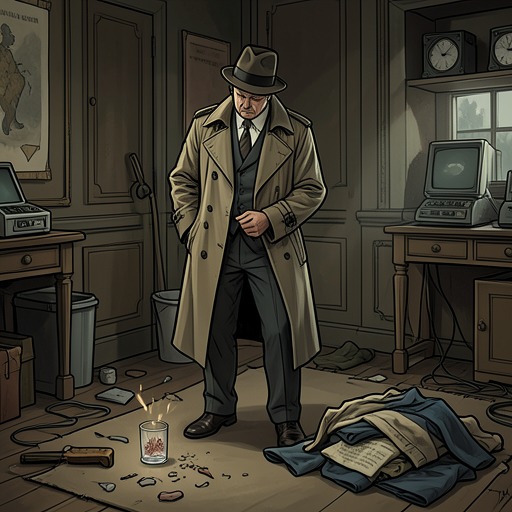
Rusty explains that Barbara prepared an alibi by logging into a computer at the university, then went to Carolyn’s apartment. He says she used a small garden tool, brought cord, left a glass to suggest a connection to Rusty, and planted a semen sample before leaving the doors and windows unlocked. These details are presented as Rusty’s reconstruction of her method, not as a public confession by Barbara. The plan depended on her anticipating what investigators would find, but it failed to account for evidence that could point back to her: fibers from the carpet in her home, her hair, a telephone call traced to the Sabich residence, and an additional fingerprint on the glass. The discovery that Carolyn had undergone tubal ligation also made the planted semen evidence suspect.
The investigation’s focus on Rusty magnified the consequences of Barbara’s attempt. Tommy Molto pursued details that Barbara had not expected investigators to connect, while Rusty found himself overwhelmed and unable to understand who had arranged the evidence against him. Barbara watched him endure the ordeal and, in Rusty’s interpretation, became ashamed and ready to tell the truth if necessary. By the time Rusty understands what happened, however, the prosecution has collapsed without her having to reveal it.
Guilt, Nathaniel, and the Unspoken Truth
When Rusty describes the murder to Lipranzer, he does so through a hypothetical wife, gradually making clear that the story is Barbara’s. He says that after recognizing her in the account, he could still look at her cooking for him and Nathaniel Sabich or touching him and disbelieve what he knew. At times he suspected that Tommy Molto had manipulated him into blaming Barbara. Eventually, though, he says the explanation no longer surprised him. His uncertainty is significant: knowledge does not immediately make the intimate person before him feel recognizable as the author of the crime.
Rusty refuses Lipranzer’s suggestion that Barbara should be exposed. He says he cannot put Nathaniel through another rupture and believes the boy is better off with his mother. In Rusty’s view, Nathaniel’s care helps draw Barbara back from her distress, and separating mother and son would harm them both. This choice protects Barbara from prosecution but also makes Rusty a custodian of the secret. He recognizes that their feelings have returned in some form while acknowledging that the crime, which he calls The Act, now stands between them. They cannot speak freely to one another about what happened, and Barbara cannot escape her guilt or her recollection of her own state of mind.
Separation and Narrative Significance
The couple do not resume their former household. Barbara’s work has gone well in Detroit, where she is living, and she is not likely to return to Nearing. Rusty visits on many weekends; when he cannot go, Barbara sends Nathaniel to him. During a later visit she suggests that Rusty stay with them, and the arrangement becomes a tentative reconciliation. Both understand it may not last, and Rusty imagines that one of them may eventually form another relationship. For the present, Nathaniel takes comfort in the fact that his parents remain married rather than divorced.
Barbara’s role complicates the distinction between domestic care and innocence. She nurses Rusty through the consequences of an act intended to implicate him, and her concern for him coexists with the guilt of having caused his suffering. Rusty’s decision to protect her does not erase the crime or restore their marriage; it binds them through a truth that neither can say aloud. As the novel closes, Carolyn’s murder remains unsolved, while Barbara and Rusty continue at a distance, connected by Nathaniel, renewed feeling, and the secret that has made reconciliation possible only in an uneasy, provisional form.