Carolyn Polhemus
Presumed InnocentCarolyn Polhemus is a deputy prosecutor and former probation officer whose murder sets the novel’s central investigation in motion. She is remembered as a skilled lawyer, a forceful advocate, and a woman whose professional and personal connections reach into the county’s prosecutorial and judicial circles. Yet the story gives no direct access to her thoughts: colleagues, lovers, and investigators reconstruct her from partial memories, disputed evidence, and the consequences of her choices. That distance makes her at once a consequential public figure and an unresolved private presence.
Identity and Professional Life
Carolyn began her working relationship with Raymond Horgan as a probation officer. She later joined his office as a deputy prosecuting attorney, where she worked for eight years. Horgan had hired her, and at her funeral he recalled her as intelligent, attractive, and exceptionally capable. His grief was mixed with the burdens of public office: her death had occurred only days earlier, and he was under pressure to find her killer while political opponents and the press scrutinized his response.
For several years, Carolyn headed the office’s Rape Section, which handled sexual-assault prosecutions, including child-abuse cases. The work exposed her to difficult and varied cases, and it made her a possible target for retaliation in the eyes of Dan Lipranzer, who initially suspected that someone she had prosecuted might have killed her. Rusty Sabich and Lipranzer agreed to review her docket for defendants whose crimes resembled the circumstances of her death. Rusty undertook to examine records in her office, while Lipranzer planned to compare her cases with state records of sexual offenders. The theory was an investigative possibility, not an established explanation, and the investigation’s uncertainty persisted.
A glimpse of Carolyn’s prosecutorial judgment comes in the Nagel case, involving a married couple accused of rape and sexual abuse. Carolyn wanted to resolve the case through a plea, with the wife receiving a reduced charge; Rusty considered that resolution acceptable but argued that the prosecution should include two counts. Their exchange places her within the ordinary work of negotiating charges and judging what a case should pursue. The novel also remembers her as an ardent courtroom advocate for Wendell McGaffen, a defendant Rusty describes as beleaguered. Her professional identity therefore combines forceful prosecution with a capacity to speak on behalf of people in distress.
Relationships and Rusty’s Obsession
Carolyn’s relationships with colleagues were entangled with the professional hierarchy of the prosecutor’s office. In September of the year before her death, Horgan believed she needed a partner and asked Rusty to work with her. Rusty later told Dr. Robinson that he had fallen in love with Carolyn. Their connection began within a working partnership, but his retrospective account describes a passion that quickly exceeded the bounds of professional collaboration and destabilized his marriage to Barbara.
Rusty presents the affair as intensely consuming rather than happy. He recalls that the idea of Carolyn occupied him constantly and that his desire became obsessive; even ordinary life with Barbara was crowded by the fixation. His language also turns Carolyn into an image as much as a person: he remembers being drawn to the legend of her glamour, courage, and ability to rise above suffering. At the novel’s end, he reconsiders that idealization. He recognizes that the strength she displayed did not mean she had escaped the pain of her past, and that his own longing had attached itself to an illusion as well as to a woman.
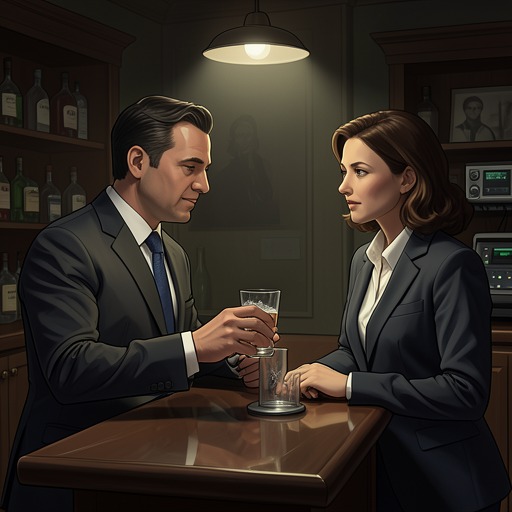
The relationship ended badly. Carolyn first saw Rusty less often, then stopped seeing him altogether: no lunches, calls, office visits, or meetings for drinks. Rusty tried to interpret the withdrawal as an assertion of independence, but the silence intensified his longing. He went repeatedly to a restaurant where he knew she sometimes ate; on one visit, he saw her there with Horgan and did not understand the possibility of rivalry. In time he stopped manufacturing professional excuses to approach her office and followed his impulse directly. The sequence reveals how the affair’s end left him vulnerable to jealousy and unable to accept separation as a settled fact.
Carolyn had also had a brief personal relationship with Horgan near the end of the previous year. During Rusty’s murder trial, Horgan acknowledged both that he had known her through her work and that they had briefly been involved personally. The disclosure placed their relationship before the jury and made Horgan’s position more complicated: he was at once a former employer, a political figure, a witness, and someone with a personal history with the dead woman. Rusty later reasons that Carolyn had left him for Horgan, but that account is his interpretation of her choice, not a motive independently established by the investigation.
Murder and the Investigation
Carolyn was murdered on April 1 in her apartment. At the funeral, Horgan spoke of the killing as a shocking intrusion and struggled to reconcile it with his memories of her. Rusty interrupted that account by insisting that nobody had broken in. His correction introduces an important feature of the case: the apparent scene could not simply be read as evidence of an unknown outsider’s entry. The police investigation, the office’s institutional interests, and the public demand for an arrest all developed around facts that were open to competing interpretations.
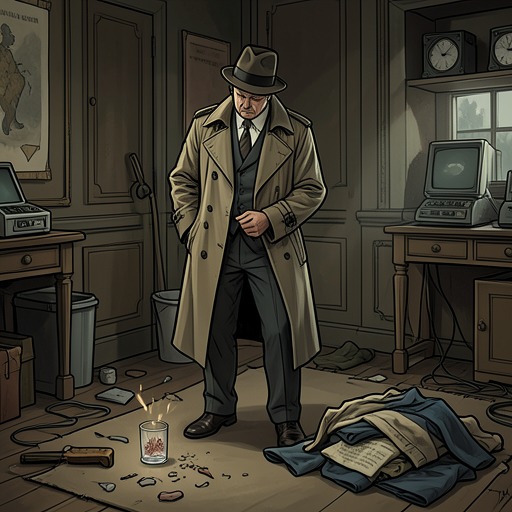
When Rusty later returned to the apartment with investigators, a bright notice sealed the crime scene by court order. The locks had been blocked, and the door had to be opened under controlled conditions. Inside, the furniture was still overturned, an outline marked the place where Carolyn’s body had been found, and a small inlaid box Rusty had once bought for her remained beside the sofa. These details made the apartment a record of the crime and of Rusty’s own involvement with its occupant. At the bar, he counted twelve tumblers. He knew that his fingerprints had been identified on one glass, but the set’s presence in the apartment would later become essential to his reconstruction.
Forensic testimony established that Carolyn had had consensual sex shortly before her death. The medical examiner also described evidence that led him to believe the scene had been arranged to suggest rape and conceal the killer’s identity. In his view, the unlocked doors and windows, together with other forensic findings, pointed toward an attacker familiar with investigative methods and Carolyn’s responsibilities in the prosecutor’s office. The testimony narrowed some possibilities while leaving the identity of the killer unresolved. It also showed why the staged appearance could not be treated as a straightforward account of what had happened.
The murder intersected with a separate thread of institutional corruption. Rusty eventually confronted Sandy Stern about the B file and Carolyn’s connection to Judge Larren Lyttle, including the claim that she had carried money to him. Rusty’s return to Carolyn’s apartment had also exposed Lyttle’s name among the contacts in her telephone directory. These details connect her legal and personal world to the alleged bribery at North Branch, but they do not by themselves settle every aspect of the dealings. Carolyn’s role emerges through files, names, and Rusty’s accusations rather than through a full account from her own perspective.
The Retrospective Reconstruction
After the trial, Rusty gradually concludes that Barbara killed Carolyn and arranged the scene to direct suspicion toward him. His explanation is explicitly a reconstruction: he says he worked over the details repeatedly and distinguishes an early suspicion from the moment he believes he understood. A telephone call from the Sabich home on the night of the murder first made him consider Barbara, but he thought Tommy Molto might have manipulated the phone records. The decisive recognition came when he saw the glasses in Carolyn’s apartment and realized that all twelve of her tumblers were still there.
Rusty connects the glass bearing his fingerprints to an earlier episode in which he had told Barbara about his affair with Carolyn. In his theory, Barbara kept a matching glass as a deliberate clue that would identify him as the person she meant to implicate. He also reasons that she used stored material and the knowledge she had gained from reading about artificial insemination to create misleading forensic evidence, and that a computer session at the university supplied an alibi. He believes she entered Carolyn’s apartment after arranging to visit, used a small black iron garden tool to kill her, bound her with cord, left the glass, and unlocked the doors and windows before leaving. These are Rusty’s conclusions, not findings reached in court.
The tool gives that conclusion a concrete and disturbing afterlife. In October, while repairing a fence, Rusty recognized the Whatchamacallit, an inherited black iron implement that had been used to kill Carolyn. After the trial he had noticed blood and a blond hair on it, then washed it in the basement while Barbara watched from the stairs. He recalls trying to appear cheerful as he did so. The gesture joins concealment to domestic routine: the object had been among the household equipment brought over after Barbara’s father died, and its ordinary usefulness had hidden its connection to the murder. Rusty’s recognition changes the meaning of an everyday possession without changing the official status of the case.
Legacy and Narrative Significance
Carolyn remains both a victim of a murder and the center of Rusty’s effort to understand what he wanted from her. At the end, he no longer describes his former fixation as active longing. Instead, he wonders why her suffering and her apparent triumph over it had seemed so compelling. He sees her public manner, her courtroom advocacy, and her display of determination as signs not that she had escaped the past, but that its weight remained with her. This is Rusty’s late interpretation of Carolyn, shaped by his own need to explain the affair as well as the person he lost.
The novel preserves the gap between that private understanding and public resolution. Carolyn’s murder remains officially unsolved; no one pursues a new case against Barbara, and Rusty regards a second prosecution for the same crime as practically impossible. A would-be jailhouse confessor is dismissed as unreliable. Rusty’s certainty therefore does not become a legal finding. Carolyn’s story ends in a double exposure: the evidence can be assembled into an account that satisfies Rusty, while the institutions that tried him leave the killing unresolved. Her professional history, her relationships with Rusty and Horgan, and the corruption surrounding Lyttle all remain relevant, but none supplies the missing public verdict.