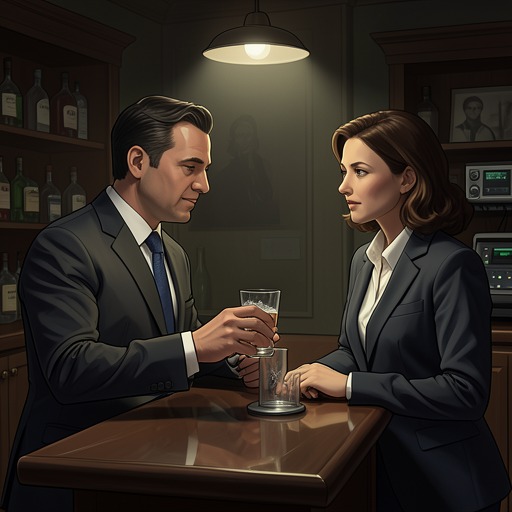
Carolyn's Drinking Glass
Presumed InnocentCarolyn's Drinking Glass is one of twelve tumblers kept on the bar in Carolyn Polhemus's apartment, and the glass from which investigators said Rusty Sabich's fingerprints had been lifted. Its importance changes sharply when it cannot be found for trial: the prosecution still has witnesses and laboratory results, but not the object those results concern. The disappearance turns an ordinary drinking glass into the focus of a fight over evidence, police care, and whether a defendant can fairly confront scientific testimony without examining its physical basis.
Identity and Forensic Role
The glass belongs to a set kept on the bar beside the kitchen in Carolyn Polhemus's apartment. When Rusty Sabich returns to the apartment with Jamie Kemp, he pauses three feet from the glassware and counts the tumblers on a towel. There are twelve, and he counts them twice. He knows from the police photographs that he is looking at the relevant set, but checks the scene himself. His fingerprints have been identified on one of its glasses. The care of the recount gives the object a particular force: it is at once one glass among twelve and the glass that links the accused to the murdered woman's home.
The investigation's account rests on a series of identifiable steps rather than on the glass alone. At trial, Harold Greer describes Carolyn Polhemus's body and the evidence technicians' work under his direction. He identifies a sealed plastic packet containing fibers lifted from her body, a larger packet containing her skirt, and the further fibers obtained from that garment. He also describes finding the glass on the bar and watching the technicians seal it in a Baggie. Tommy Molto and Greer smooth over the glass during their account of the scene. The glass is therefore part of a wider collection of physical evidence, but its evidentiary significance is distinctive: it is the surface associated with the fingerprint identification.
Inspection and Identification
The apartment inspection is also an effort to test what can be seen against what has been recorded. Rusty Sabich first thinks the police photographs may show him what he needs to know, then goes to the bar and checks the glasses directly. In court, he interrupts Sandy Stern's examination to ask for the photographs. Stern gives him a black look, but Rusty Sabich persists, finds the image of the bar, and uses it to direct attention to the scene where the glass was found. The photograph offers a visual record of the object in place; it cannot substitute for the object itself once the prosecution's fingerprint evidence is challenged.
When Sandy Stern asks Harold Greer where the glass is, Greer says it should be in the police evidence room, while acknowledging that locating it has become a problem. On the third morning of trial, as the first witnesses are about to be called, Nico Delia Guardia admits that the glass cannot be found. The disclosure is brief, but its timing makes the absence consequential: the prosecution is about to present the case, and one of its physical exhibits is already unavailable. The missing glass does not erase the testimony about its recovery or the reported fingerprint result. It does, however, leave the courtroom to weigh those claims without being able to inspect the item itself.
Disappearance and Courtroom Dispute
The failure to produce the glass becomes the first major legal battle of the trial. The next day, Nico Delia Guardia describes a six-hour, item-by-item search of the police evidence room. Both sides have prepared written briefs on whether testimony about the fingerprints can still be admitted. Jamie Kemp has written the defense brief after midnight; Nico Delia Guardia and Tommy Molto have searched the evidence-room warrens past one in the morning. The physical search has failed, and the question shifts to whether the testimony can survive that failure.
Sandy Stern argues that it is fundamentally unfair to make Rusty Sabich confront scientific testimony when the defense has had no opportunity to assess its basis through the glass itself. The prosecution responds that the chain of custody is uncontested. It maintains that testimony from Harold Greer, Dan Lipranzer, and laboratory supervisor Maurice Dickerman will together establish that the fingerprints were identified from lifts taken from the glass the day after the murder. The competing claims thus concern more than whether the glass was misplaced: they ask how much confidence the court can place in testimony about an absent exhibit, and whether the prosecution's account of its handling is enough to answer the defense's objection.
Ruling and Significance
Judge Larren Lyttle hears extended argument after reading both briefs. The law, as presented to the court, supports either ruling. His criticism of the police's carelessness gives the defense reason to hope that the fingerprint evidence may be excluded; the prosecution stresses the damage that exclusion would do to its case and the impropriety of ending a celebrated prosecution because of police negligence. Judge Lyttle ultimately rules against the defense, allowing the prosecution to proceed with the fingerprint testimony despite the glass's disappearance.
The ruling preserves the distinction between the missing object and the evidence drawn from it: the glass is gone, but the prosecution may still offer witnesses to establish how it was collected and what the laboratory found. That distinction is also the source of the exhibit's lasting tension. At Carolyn Polhemus's apartment, the glass can be counted, located on the bar, and associated with Rusty Sabich's prints; at trial, it becomes an absence around which both sides construct competing accounts of fairness and reliability. The case moves forward without the tangible exhibit, leaving the courtroom to judge a physical trace through testimony about an object no longer available for examination.