Carolyn's bar glass
Presumed InnocentCarolyn's bar glass becomes both a crucial piece of fingerprint evidence against Rusty Sabich and the absent object that makes that evidence impossible for the defense to test. Its disappearance from police custody does not stop the prosecution from presenting an expert comparison, but it changes the terms on which the jury is asked to judge that proof. Returned to Rusty only after the trial, the glass remains a physical reminder of the gap between evidence described in court and evidence a defendant can actually examine.
The Object and Its Forensic Role
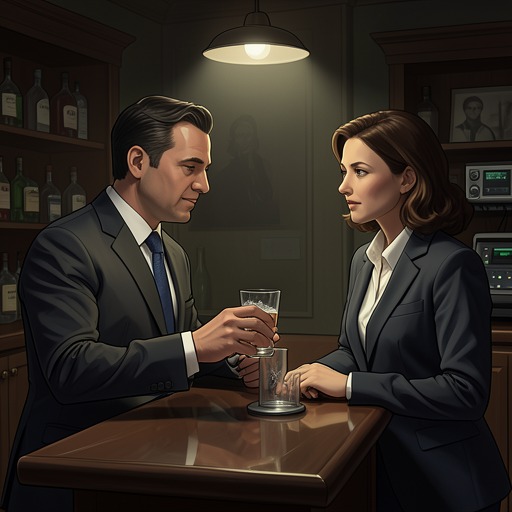
The glass is identified as the tumbler from Carolyn Polhemus's bar. In court, its importance lies less in its everyday use than in the fingerprints said to be on it. The prosecution's fingerprint expert, Maurice Dickerman, explains that fingerprints are residues of oils, and that whether a person leaves one can depend on how much the person sweats. He describes prints as unique, then uses photographs, slides, and enlargements to show the jury the comparison on which his testimony rests.
Dickerman presents photographs of the bar and the glass, along with lifts and enlargements made from Rusty's county employee file card. Red arrows mark the points of comparison between the prints attributed to Rusty and those identified on the glass. The display gives the jury a detailed visual account of the prosecution's claim, but it is not the exhibit itself: the defense has no opportunity to inspect the glass or make its own examination. The distinction between the photographed evidence and the missing object becomes central to how much weight the testimony can bear.
Disappearance and the Trial Ruling
The glass is missing from the police evidence room when the fingerprint evidence comes before the court. The defense objects to admitting testimony based on an object it has never been allowed to examine. Judge Larren Lyttle acknowledges that the defense has not had access to the physical exhibit and that the absence is attributed to the police evidence room. He also recognizes that the testimony is important to the prosecution's case, a consideration that weighs heavily in his decision.
Lyttle points to a broader problem in the handling of exhibits: police evidence-room custodians have, for years, kept slipshod records and mishandled evidence. He says that this knowledge comes from outside the trial record and influences his ruling. He does not decide that Nico Delia Guardia or Tommy Molto acted improperly, but notes that Molto appears to have had the glass last. Lyttle allows the testimony over the defense objection, while warning that if further evidence shows bad faith, the prosecution will end. His decision thus rests on a tension he states openly: the glass is too important to the case to exclude, yet its absence gives the defense a legitimate reason for skepticism.
The Limiting Instruction and Its Effect
Before testimony proceeds, Lyttle gives the jury a pointed instruction. Jurors must remember that the defense has had no chance to examine the glass, investigate the prosecution's scientific explanation, check for an innocent mistake, consider possible chicanery, or obtain another scientist's assessment of the prints. He does not tell them what conclusion to reach, but expressly says they may consider the prosecution's failure to make the glass available and that this fact alone may raise reasonable doubt requiring Rusty's acquittal.
The instruction does not remove Dickerman's testimony or erase the photographs. Instead, it makes the absent glass part of the evidence the jury must weigh. The prosecution can show comparison points and explain its methods, but the defense cannot independently test whether the marks are correctly identified or whether another examination would produce a different result. In this way, the missing exhibit limits the force of the fingerprints even as the expert's presentation makes the prosecution's claim visually specific. Lyttle's warning also places the police evidence room's failures within the trial itself: the object's absence is no longer merely an administrative lapse, but a circumstance the jury is permitted to treat as grounds for doubt.
Return After the Trial
After the trial, Dan Lipranzer gives Rusty a small white box. Inside it is a manila envelope wrapped with red-and-white evidence tape, containing the glass that had disappeared during the proceedings. Lipranzer burns a corner of the envelope in a sink and hands the glass to Rusty. The account does not explain how Lipranzer obtained it or why he returns it at that moment; the scene presents the handover without resolving those questions.
Blue ninhydrin powder still coats the tumbler, and three partial prints remain visible. Rusty studies the marks in the window light, trying to distinguish the tiny patterns that may be those of his right thumb and third right middle finger—the prints that had identified him in the prosecution's case. During trial, those marks reached the jury through Dickerman's demonstrations and marked-up photographs, while the glass itself remained beyond the defense's reach. Now the object is physically present, but its return cannot restore the lost opportunity for examination that Lyttle emphasized. Rusty's response is divided between the question of whether he ought to feel touched by Lipranzer's gesture and whether he ought to be angry. The glass's delayed return gives that conflict a concrete form: it is at once a personal object placed in Rusty's hands and evidence whose custody and availability have already shaped the trial.