Carolyn's B File
Presumed InnocentCarolyn's B File is a fragmentary case record that turns an obscure docket entry into a possible courthouse-corruption scandal. It contains an unsigned letter alleging that a deputy prosecutor took a bribe, but the allegation remains unverified; its importance lies as much in the record's disappearance and restricted circulation as in the account it preserves. The file connects Carolyn's investigative work to Raymond Horgan's office and gives the murder investigation a second mystery: what had been concealed, and by whom?
Classification and disappearance
While reviewing a computer printout of Carolyn's cases, Rusty Sabich notices a file designated B, the subsection of the state criminal code dealing with bribery of law-enforcement officials. Such files were Special Investigation cases under Rusty's supervision, although this one was listed under an unknown subject, a designation usually associated with a non-arrest investigation. There was no companion case, and Carolyn's ordinary workload rarely extended beyond her own area. The odd entry therefore stands out not as a routine charge but as an investigation whose subject and progress cannot be readily traced.
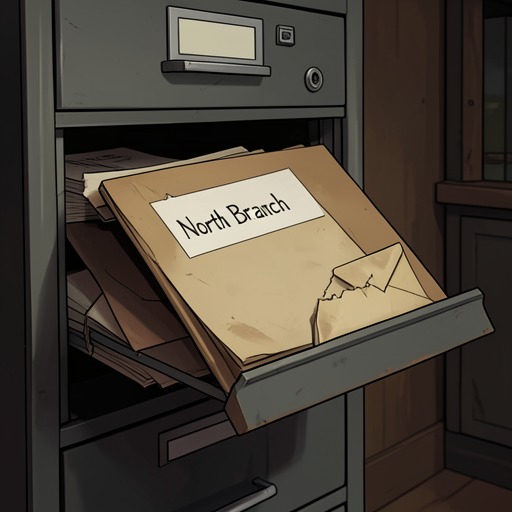
Rusty first suspects a computer error or an included charge. But he cannot find the file in his own printout of B cases, and the case appears to have been erased from the computer docketing system apart from Carolyn's call. He records the question of the missing file and raises it with Raymond. Raymond initially loses track of the explanation amid the movement of deputies and campaign business, but the possibility that a case is unaccounted for finally catches his attention. As he rushes between his office and other obligations, he gives Rusty a folder and promises they will talk. That hurried handover makes the file tangible again without explaining why it had become so difficult to locate.
Contents and allegation
The recovered folder is slight: a computer log-in slip, one sheet of sparse notes in Carolyn's handwriting, and a photocopy of a long typewritten letter. The copy is clean but looks unprofessional, with narrow margins and a single paragraph. Nothing establishes whether the office received an original or whether this photocopy is the only version. The record's thinness matters: there is no assembled investigative file to confirm the correspondent's account, only the intake trace, Carolyn's notes, and the letter.
The anonymous writer describes an acquaintance called Noel, not his real name, who had been arrested nine years earlier. According to the letter, Noel feared the embarrassment of his case becoming known and repeatedly spoke of paying someone off. The writer says they supplied $1,500 and accompanied Noel to the North Branch at Runyon and 111th. A secretary who appeared to know Noel led them downstairs to the RA's office, where Raymond Horgan's name was on the door. The correspondent says Noel went inside briefly and emerged with the sock in which he had carried the money now empty. The letter presents this as evidence that a deputy prosecutor accepted a bribe, while also describing the writer's fear that Noel might retaliate if identified.
The account is suggestive but not self-proving. The letter is unsigned, the subject is known only by an alias, and the episode had occurred years earlier. The writer acknowledges that Noel might have deceived them, even while insisting that the visit and the missing money appeared real. The age of the allegation raises the question of whether the statute of limitations has passed, but the correspondent also speculates that the incident could point to other, continuing corruption. Rusty recognizes that this is not yet proof of a bribery ring; it is a tip with enough concrete detail to make the possibility consequential and enough gaps to leave it uncertain.
Carolyn, Raymond, and the file's circulation
The route by which the letter reached the B file links the record to Carolyn's professional and personal access. Raymond later says she asked for it after hearing about it from Linda Perez, a paralegal who read incoming correspondence. He explains that he had considered the allegation unfounded, but that Carolyn wanted the case and he was sleeping with her. The file's assignment thus emerges from a convergence of office procedure, Carolyn's initiative, and Raymond's private relationship with her. His later explanation clarifies why she had the material; it does not settle whether his initial dismissal was justified or why the record was so poorly preserved.
The office routinely received anonymous complaints, many of them junk, and paralegals handled much of that correspondence. More serious allegations were passed along, which presumably explains how this one reached Raymond. Rusty nonetheless judges the letter to have the ring of a real complaint, while keeping open the possibility that the writer was deceived by Noel. The B File therefore remains an unsettled object: it records an allegation that may be true, false, or incomplete, and its survival depends on an unusual path through the office rather than a complete official case history.
Afterlife as evidence and narrative clue
The B File belongs to the wider body of information surrounding Carolyn's case, but it should not be confused with the physical evidence that prosecutors later present against Rusty. Their case is described as circumstantial, drawing on witnesses and scientific or documentary material, including fingerprints on a glass, telephone records, biological evidence, and fibers associated with Rusty's home. At trial, Maurice Dickerman explains fingerprint comparison and displays photographs and enlargements supporting the prosecution's identification. Under cross-examination, Alejandro Stern presses Dr. Kumagai on whether Carolyn knew she could not conceive, challenging an assumption tied to the prosecution's interpretation of the biological evidence. These proceedings show how apparently definite traces can become dependent on interpretation; the B File has a parallel uncertainty, but its weakness begins earlier, with the anonymity and incompleteness of its source.
Rusty's later account of the framing theory gives those other traces a different possible origin. He argues that Barbara Sabich left fibers and hair, that a call from their home could be traced through telephone records, and that a fingerprint on the glass could have been left carelessly; he also says the semen specimen was planted and that Carolyn had been sterilized. These are claims made in Rusty's reconstruction, not findings established by the B File. Their relevance is structural: the story repeatedly places evidence between an observable trace and a conclusion about who produced it. The B File likewise invites suspicion without resolving it.
As an object, the B File first appears to be a missing administrative record, then becomes a fragile container for a potential scandal. Its log-in slip, Carolyn's brief notes, and anonymous letter preserve the outline of an inquiry while withholding the corroboration that would make its accusation conclusive. Its disappearance from the docket and its rediscovery through Raymond give it a double significance: it raises questions about individual conduct at the North Branch court and about the institutions that determine which allegations remain visible. The file does not solve Carolyn's murder or establish the bribery it describes. It endures instead as a paper trail that makes concealment itself part of the investigation.