Delia Guardia recall election
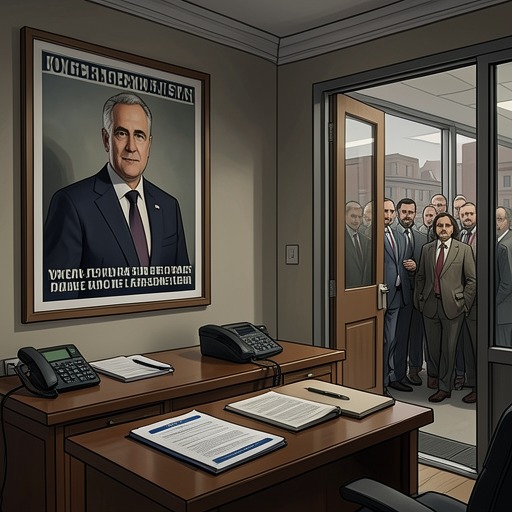
Presumed InnocentThe Delia Guardia recall election reverses the political succession that had displaced Raymond Horgan: Nico Delia Guardia nearly retained the prosecuting attorney’s office, but was recalled by about 2,000 votes. Its aftermath reaches beyond Nico’s removal. The contest draws former rivals into opposition to him, ends Tommy Molto’s tenure on the staff, and sets in motion the process that brings Rusty Sabich back to the office as its acting head.
Political Background
The recall follows a change in power that began with the contest between Raymond Horgan and Nico Delia Guardia. Horgan had led the office for more than a decade and remained widely expected to win the party primary; in Kindle County’s one-party political order, victory there was tantamount to election. Yet his campaign faced factional opposition and a weakening position. By Election Day, party support belonged to Nico, while Horgan’s allies were still hoping that favorable weather and a late recovery in momentum might close the gap.
The office’s political environment was bound up with party organization and personal loyalties. Under an arrangement Raymond had made with Bolcarro, many staff members were given Election Day off to perform party work, even though Raymond had discouraged his employees from campaigning for him. That uneasy division between the prosecuting office and the party machine forms part of the setting in which Nico’s later recall campaign unfolds. The book presents his removal not as an escape from local political pressures, but as a change in who holds office within a system still shaped by those pressures.
Petition and Campaign
In January, a petition drive prompted the City Council to authorize a recall election. Bolcarro could have prevented the election, but instead maintained what the narration describes as marked neutrality toward Nico. The account does not identify the petition’s organizers or specify what prompted the drive; it establishes the institutional decision that made a recall vote possible and Bolcarro’s choice not to block it.
Nico campaigned actively to keep his position and nearly succeeded. His effort makes the outcome a close political reversal rather than a foregone conclusion. The recall therefore differs from a routine transfer of office: Nico retained enough support to come close to surviving, even as prominent figures who had stood within Raymond’s political circle came out against him.
Opposition and Result
With about two weeks remaining in the campaign, Nico fired Tommy Molto. The account places the dismissal late in the contest but does not state that it caused the recall result. Raymond, Larren Lyttle, and Edgar Mumphrey were among the civic leaders who publicly opposed Nico. Their intervention gave the campaign a striking alignment: Raymond, whose own defeat had cleared the way for Nico’s administration, joined figures associated with his political world in resisting Nico’s effort to remain in office.
Nico was recalled by a margin of about 2,000 votes. The narrowness of the result underscores how uncertain the contest had been; the decisive fact is not that he failed to campaign, but that active campaigning and near success did not preserve his post. His removal ended his tenure as prosecuting attorney, though not his political ambitions. He planned to run for City Council from the South End, and Rusty expected him to win.
Aftermath and Significance
After the recall, Bolcarro formed a citizens’ commission to recommend a new prosecuting attorney, and Raymond served on it. That process led Raymond to approach Rusty about the job. Mac had reportedly been the first choice, but declined to leave the bench. Rusty accepted, and on March 28—four days short of the anniversary of Carolyn Polhemus’s murder—became acting Kindle County prosecuting attorney. He agreed not to run for re-election, and the press described him as the caretaker prosecutor.
The recall thus clears a path to an appointment without restoring the political world that preceded Nico. Rusty takes office amid strained relationships and a public reputation shaped by the murder case and its aftermath. Nico, meanwhile, remains a prospective political force rather than disappearing from the story. The election’s consequence is therefore both immediate and provisional: one officeholder is removed, but the county’s contests for influence continue.