Fear of Father-Son Separation
Presumed InnocentFear of Father-Son Separation is the private stake that overwhelms Rusty Sabich as he awaits trial. He considers prison and the damage to his reputation, but names the prospect of losing Nathaniel Sabich’s remaining childhood as the fear that breaks through them all. The distinction shapes his crisis: the threat is not only confinement, but the severing of a relationship that gives his imagined future its meaning.
The Fear Beside the Trial
In the anxious hours before trial, Rusty weighs what is worst about his predicament. The village women’s stares, the damage to his reputation, and the prospect of finding work as an attorney if he is acquitted all seem secondary. What he cannot set aside is the emotional erosion of sleeplessness and manic anxiety. At night, terror arrives before he can gather himself, like groping for a light switch in darkness without knowing whether it will be found. The image makes uncertainty physical: even the hope of reassurance remains out of reach for an instant.
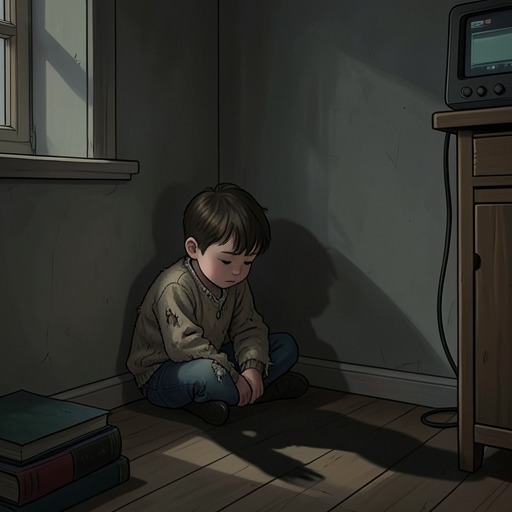
The trial also threatens a more immediate separation. On Sunday, Nathaniel is to be sent by train to Camp Okawaka near Skageon for the three weeks the trial is projected to last. Rusty quietly goes to his son’s darkened room and listens for the rhythm of his breathing, then tries to make his own breathing follow it. The separation has not yet happened, but its approach alters an ordinary night into an encounter with what he may lose.
Nathaniel as an Irreducible Bond
Watching Nathaniel sleep, Rusty briefly tries to comprehend him as a collection of material parts: atoms, molecules, skin, veins, muscle, and bone. That scientific account fails. He understands his son instead through the intensity of his feelings, as someone who cannot be parsed into components or reduced to a finite description. The passage presents fatherhood not as an abstract duty but as a bond that resists detachment and analysis.
Rusty’s gratitude for having felt such tenderness sits beside the fear that it may be taken from him. Nathaniel appears to him as gentle and beautiful in sleep, and the thought of separation makes his heart feel sore and breaking. The contrast is exact: the sleeping child is present, but the legal future makes that presence vulnerable. Rusty’s attention to his son’s breath becomes a small act of closeness against a possible absence.
Prison, Exile, and the Prospect of Escape
Rusty imagines conviction leading to many years in prison, even under Judge Larren Lyttle. Yet he says he feels little conscious fear of prison itself. Confinement can unsettle him, and he knows Rudyard State Penitentiary from visits to interview witnesses, but the physical hardships he associates with imprisonment rarely occupy his thoughts as much as exile from Nathaniel. His greatest dread is missing the remainder of his son’s young life.
The thought of running surfaces suddenly in the dark. Rusty had once wondered, as a prosecutor, why defendants stayed to face trial and sentencing; now he understands the impulse to flee. But escape is not a workable solution to the separation he fears. He has only $1,600 in his checking account and no other money. Taking money from Barbara’s trust might make departure possible, but he believes that doing so would destroy his main motive for freedom: the chance to see Nathaniel.
He imagines distant alternatives, including spending summers with Nathaniel in Rio or Uruguay, places he associates with not being extradited for murder. He cannot picture how he would survive without a familiar language or a skill those cultures would recognize. Another imagined escape is to disappear into Cleveland or Detroit, become someone else, and never see his son again. These possibilities expose the contradiction in flight: he might evade the trial, but a life without contact with Nathaniel would not preserve what he most wants to protect.
The Meaning of Separation
The prospect of prison gives Rusty’s fear a legal cause, but his own account distinguishes punishment from loss. He does not dwell on physical confinement as the worst consequence; it is the forced distance from his son that shatters him. The fear is therefore also a measure of attachment: Nathaniel is not one concern among many, but the relationship by which Rusty judges whether an imagined future could still count as life.
After considering flight, Rusty recognizes that none of its imagined destinations resembles a life he wants. In the darkness, he still wants what he wanted when he arrived at the village green in Nearing, though the passage does not itemize those wishes. That return to an earlier point in his life does not resolve the danger or promise that father and son will remain together. Instead, it clarifies the limit of escape: even at his most frightened, Rusty cannot make a future meaningful by removing Nathaniel from it.