Horgan Turns Against Rusty and Testifies for the Prosecution
Presumed InnocentRaymond Horgan’s decision to testify for Nico Delia Guardia turns a former professional alliance into an open prosecution conflict. In a meeting with Rusty Sabich and Sandy Stern, Raymond says he will describe Rusty’s conduct of Carolyn Polhemus’s murder investigation and their private conversations. The exchange brings an old disagreement over who wanted Rusty on the case into the present, while Raymond’s account of Rusty’s behavior makes the investigation itself part of the accusation against him.
The witness and the stakes
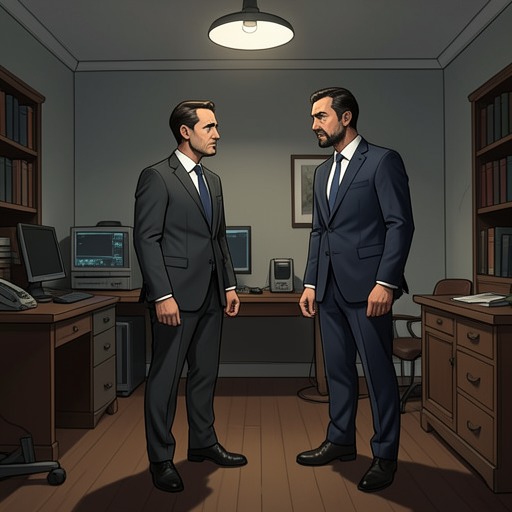
The meeting begins with Sandy Stern explaining why he and Rusty have come: Raymond’s name appears on Nico Delia Guardia’s witness list. Raymond accepts that he will appear by subpoena. He also says he has spoken with the prosecutors, including Tommy Molto, more than once, though he has not signed a statement. For Rusty, the absence of a formal statement is not reassuring. He reads the repeated meetings and the lack of a signed account as signs that Raymond is receiving special treatment because he is an important witness, with fewer written commitments for the defense to test against his testimony.
Sandy probes what Raymond expects to discuss, asking about topics and areas rather than demanding an exhaustive account. Raymond identifies Rusty’s conduct of the investigation as a subject: he intends to say that Rusty expressed interest in handling the case. He also plans to describe a later conversation about his personal life. The proposed testimony therefore reaches beyond what Rusty did as an investigator. It connects the assignment, the murder inquiry, and a private discussion whose significance is not yet clear to Sandy.
Competing recollections of the assignment
Rusty immediately disputes Raymond’s version of how he came to handle the investigation. Rusty remembers Raymond asking him to take the case; Raymond says there was a conversation but does not remember it that way. As Raymond recalls it, they spoke a day or two before Carolyn’s funeral and ended with the understanding that Rusty would handle the case. He says he was receptive but surprised by the outcome, and believes the idea came more from Rusty than from himself.
That difference matters because the proposed testimony recasts the assignment as evidence of Rusty’s initiative. Rusty’s recollection makes it a task given by his superior; Raymond’s makes Rusty the person who wanted access to the investigation. Neither account is independently resolved in the meeting. Instead, their incompatible memories become part of the larger question of whether Rusty’s professional actions can be separated from his personal connection to Carolyn.
Raymond’s accusations
The argument breaks open when Raymond asks what Rusty was trying to do to him and points to Rusty’s fingerprints on Carolyn’s glass. He says he will testify that Rusty wanted the case, that Raymond had repeatedly reprimanded him for not pressing the investigation, and that Rusty seemed more interested in learning who else had been involved with Carolyn than in finding her killer. He also intends to tell the jury that Rusty assured the office he had not been near Carolyn’s apartment on the night she died.
These are Raymond’s announced claims, not findings established by the conversation. Their force lies partly in the way they assemble separate matters into one prosecutorial narrative: the disputed request to handle the case, the pace of the investigation, Rusty’s questions about Carolyn’s private life, and the fingerprints on the glass. Raymond presents them as evidence of a pattern. Rusty hears a former mentor converting workplace disagreements and private disclosures into testimony against him. Sandy advises Rusty not to respond, leaving Raymond to state the accusations without an answer from his client.
Raymond’s anger is personal as well as professional. His accusation that Rusty concealed his relationship with Carolyn from him gives the proposed testimony a history of perceived betrayal. Raymond says Rusty never told him that they had both been involved with Carolyn, even when the conversation might have been friendly or when Raymond assigned Rusty to the investigation. In Raymond’s view, Rusty’s questions about his personal life came too late to be innocent inquiries between colleagues. His announced account thus makes the timing of Rusty’s disclosures, not only their content, part of the case.
The private revelation and its aftermath
After the meeting, Sandy tells Rusty he had not known that Raymond had an affair with Carolyn or that Rusty had discussed the subject with him. Rusty says the relationship took place just after Carolyn stopped seeing him. The disclosure changes Sandy’s assessment of the prosecution’s position: Raymond’s connection to Carolyn may give Nico a motive to emphasize, and Sandy recognizes that the prosecution is coming closer to one. The detail also exposes how much Rusty had not told his own lawyer, leaving Sandy to evaluate the testimony without information central to Raymond’s personal history with Carolyn.
Rusty interprets Raymond’s hostility through the damage the murder has done to Raymond’s public life. In Rusty’s understanding, Raymond sees himself as disgraced by the indictment of his chief deputy, by the compromised investigation he had allowed Rusty to conduct, and by the prospect of having his own indiscretions aired in court. Rusty believes Raymond thinks the murder was meant to bring him down and that he himself was another intended victim. This is Rusty’s reading of Raymond’s grievance, not proof of Raymond’s account of the murder or of Rusty’s guilt.
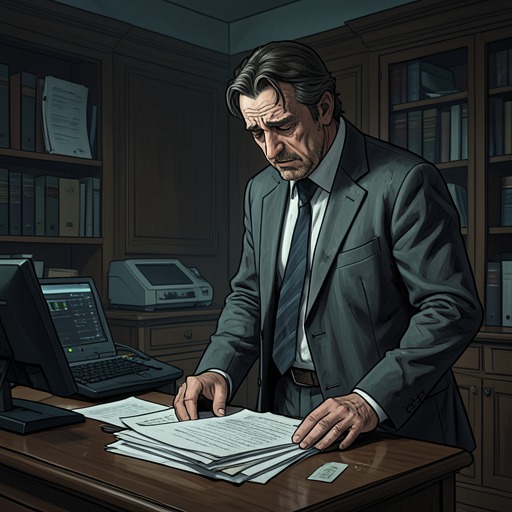
Sandy leaves to attend to court business, visibly displeased that Rusty withheld the relationship and that the meeting became so confrontational. Alone afterward, Rusty struggles to think clearly and fears that the case is overwhelming him. Raymond’s promised testimony now threatens him on several fronts at once: as a challenge to his version of the assignment, as an attack on his investigative conduct, and as a revelation of personal information that could furnish the prosecution with a motive. The encounter ends not with a resolution of those disputes, but with Rusty shaken by the prospect of facing them in court.