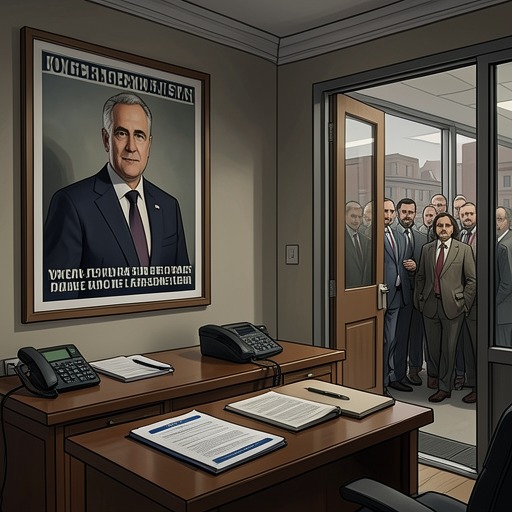
Kindle County Prosecuting Attorney Election
Presumed InnocentThe Kindle County Prosecuting Attorney election marks the end of Raymond Horgan’s hold on the office and the beginning of Nico Delia Guardia’s administration. For Rusty Sabich, the contest is not only a political defeat but an abrupt rearrangement of the workplace and career he has known: the election’s projected result soon becomes an early handover.
A campaign sustained by hope
On the night before Election Day, Raymond met in his office with aides and supporters, still looking for grounds to believe he could win. The latest poll, commissioned by the newspaper and Channel 3 on the day Bolcarro endorsed him, put Raymond five points behind. One campaign supporter thought the situation had improved since then, arguing that Raymond had regained momentum as an underdog. The men held to that possibility even as Rusty recognized how much their optimism depended on imagining a reversal.
The election also exposed the uneasy relationship between the prosecutor’s office and the local party organization. During Raymond’s twelve years in office, he had discouraged staff from active campaigning and had never solicited campaign donations or help from them. But administrative employees hired before his election retained obligations to party sponsors who had helped secure their jobs. A decade earlier, Raymond had agreed with Bolcarro to give most of the staff Election Day off, allowing party workers to canvass, distribute leaflets, drive elderly voters, and watch polling places. This year, those activities served Nico’s campaign.
Election Day at the office
The weather was bright, but the office felt unsettled. Rusty stayed at work, describing himself as the first mate aboard a sinking ship, while some lawyers handled briefs and trials or cleared their desks. About two dozen younger deputies worked with the U.S. Attorney’s office on a vote-fraud patrol. Their assignments mostly concerned minor complaints: malfunctioning voting machines, a reported gun at a polling place, an election judge wearing a campaign button, or excessive assistance to elderly voters. Rusty received updates and told reporters there was no indication that the democratic process was being tampered with.
At about 4:30 p.m., Dan Lipranzer called with the first decisive news. A contact at Channel 3 had seen exit polls projecting Nico ahead by eight to ten points if the pattern held. The polls would remain open for another hour and a half, and the early television coverage had emphasized heavy turnout; nevertheless, the projected margin made Rusty believe the loss was real. Looking from his office toward the courthouse columns, the downtown rooftops, and the river, he found a familiar view suddenly strange.
The result reshapes the office
After the election, the consequences became immediate. Rusty saw Nico sitting in Raymond’s chair, composed in a manner Rusty recognized as affected, while Tommy Molto sat beside him. Raymond explained that the meeting now belonged to Nico and that he had offered him the chair. Mac had moved her chair to the window and kept apart from the scene. Rusty understood that Nico would take over, Mac would join his staff until she took the bench, Tommy would have Rusty’s job, and Rusty himself might struggle to meet the mortgage.
Raymond said he had spoken the previous night with the mayor and did not wish to remain in office in light of the voters’ preference. The mayor had suggested that Raymond discuss an early start with Nico; Nico agreed. With the County Board’s concurrence, Raymond would leave on Friday. The speed of the departure surprised Rusty, and Raymond’s strained manner suggested how difficult the decision was for him. The election thus did more than settle who had prevailed: it accelerated the transfer of power and made the campaign’s personal and professional losses visible inside the office itself.
Significance
The contest is presented through a sharp shift in expectation: a campaign meeting still entertaining the possibility of recovery gives way to an exit-poll projection, then to Nico occupying Raymond’s chair. The transition is not delayed until a distant formal endpoint. Raymond’s decision to leave early turns the voters’ preference into an immediate institutional change, while Rusty’s reaction registers the private cost of that change within the prosecutor’s office.