Kindle County Prosecuting Attorney’s Office
Presumed InnocentThe Kindle County Prosecuting Attorney’s Office is the central workplace of the novel’s legal and political drama, but it is never merely a setting for prosecutors to do their jobs. Its hiring arrangements, divisions of labor, loyalties, and changes in leadership shape who investigates, who prosecutes, and who acquires authority. Rusty Sabich’s rise within the office, Carolyn Polhemus’s prosecutorial career, and the rivalry between Nico Delia Guardia and Tommy Molto all converge there; after Rusty is accused of murder, the institution’s own personnel history becomes part of the case against him and his defense.
Political Institution and Workplace
Before Raymond Horgan’s tenure, the office’s employees had been associated with party work and political patronage. Horgan discouraged staff from active political involvement and, during his twelve years in office, did not ask employees for campaign donations or even for campaign assistance. That policy did not dissolve the older obligations of administrative employees whose jobs had been secured by party sponsors. The office therefore operated through an uneasy accommodation between Horgan’s professional standards and the local party organization’s continuing claim on some of its staff. The accommodation had a practical expression on Election Day. Roughly a decade before the election that threatens Horgan’s hold on office, he agreed with Augustine Bolcarro that most employees would receive the day off. Staff with party obligations could canvass, distribute leaflets, drive elderly voters, or watch polling places. When the office’s employees did so during the election, their political work was for Nico Delia Guardia, not for their outgoing employer. The scene captures a distinction central to the office: official work could be separated from campaigning, but the personnel and political arrangements surrounding the institution could not be cleanly separated from party power.
Careers, Divisions, and Professional Work
The office also sorts its lawyers into different kinds of prosecutorial work. Raymond Horgan favored an elite group of young lawyers whose law-school credentials he valued, then gave them apprenticeships in Special Investigations. They handled bribery and fraud cases, lengthy grand-jury inquiries, and trials requiring sustained argument over law and evidentiary nuance. Rusty became one of Horgan’s trusted senior deputies. When the chief deputy, Mr. Sennett, left for San Diego, Horgan turned to Rusty to fill the position, placing him in a post of considerable authority and influence. Nico Delia Guardia and Tommy Molto came through a different professional route. In Rusty’s view, they had not risen beyond the demanding prosecution of street crimes in homicide courtrooms and branch courts. He regards their experience as having trained them in a rougher style of advocacy, where the temptation to use courtroom tricks could blur the boundary between persuasion and deception. This judgment reflects Rusty’s perspective, not a neutral assessment of the office; nevertheless, the distinction helps explain why the prosecutors’ later conduct is understood through their shared institutional past as well as through their conduct at trial. Carolyn Polhemus’s career shows another route through the office. She had worked as a probation officer before studying law and had served in the branch courts before moving into prosecution. She sought assignment to the Rape Section, a demanding unit handling cases in which it could be difficult to determine whose account was closer to the truth. Carolyn performed well enough there that Horgan put her in charge of those trials. He also sent her to Sunday-morning public-service television programs to represent the office’s attention to women’s issues. Her public visibility and professional ambition attracted comment, but colleagues also recognized her ability and toughness as a prosecutor. Her work could involve difficult judgment calls rather than simple agreement between colleagues. In discussing the Nagel case with Carolyn at her desk, Rusty was willing to accept a plea but argued that the case required two counts. Carolyn’s prosecutorial work thus appears not just in her reputation but in the practical decisions made inside the office: how to charge a case, what resolution to seek, and how to assess the strength and character of the evidence.
Leadership Change and the Murder Investigation
The office’s changing leadership becomes a turning point after Carolyn’s murder. When Horgan tells Rusty that he will step aside, he explains that Nico and Tommy have raised questions about the Polhemus investigation and are not satisfied with Rusty’s handling of it. They are to examine the matter according to their professional judgment. Rusty realizes that he himself is under criminal investigation. The office has shifted from the place where he exercised authority to the institution whose new leadership is scrutinizing him. The transition is visible in its ordinary rooms and routines. Rusty finds Mac meeting with Nico in Horgan’s office, while Tommy has inherited Rusty’s position. Reporters who had followed Nico into the office disperse after filming him and Tommy waiting in hard wooden chairs to meet Horgan. The scenes mark an abrupt change in hierarchy: Nico is now the incoming head, Mac is on his staff until she takes the bench, and Tommy has advanced into Rusty’s job. The office’s personnel decisions carry immediate consequences for Rusty’s livelihood and for the direction of the murder inquiry. That transition also turns employees into witnesses. Eugenia Martinez, who had worked for Rusty for two years, testifies that she once answered the wrong phone line and heard Carolyn and Rusty discussing a meeting at Carolyn’s home. By the time she gives this evidence, she works for Tommy Molto. Sandy Stern establishes that Molto advanced to Rusty’s influential position after Rusty was forced to take leave. The testimony therefore places the affair within the office’s chain of employment and succession: Eugenia’s account concerns a private relationship, but the witness and the prosecutor are connected by a promotion made possible by the investigation.
The Office on Trial
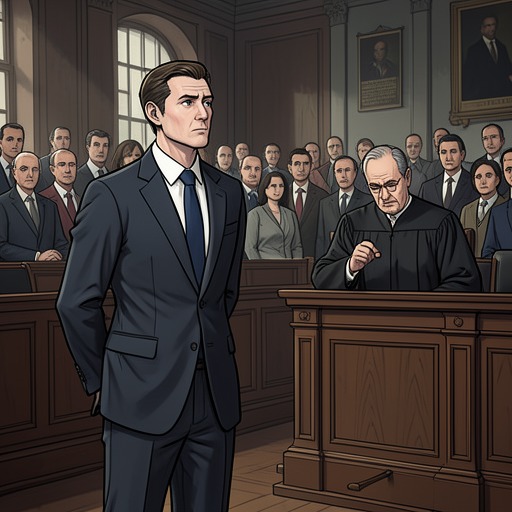
At Rusty’s trial, the office’s internal culture becomes part of the competing explanations of the prosecution. Stern questions Horgan about Rusty’s professional record, beginning with law school and following his achievements through the years. Horgan had relied on Rusty to replace the departing chief deputy; Stern uses that history to frame the conflict over the Polhemus investigation as a disagreement between experienced prosecutors rather than proof that Rusty was unfit or insubordinate. The office’s record of trust in Rusty becomes material for judging the state’s account of his conduct. The same workplace history sharpens the contrast between the prosecution’s lawyers. Rusty sees Nico as burdened by the demands of preparing a major case in three weeks while also running the office. He considers Tommy disciplined, clever, and well prepared, but believes that Tommy’s experience in branch courts has encouraged an excessive reliance on tactical devices. These are the observations of a former colleague now facing the office in court; their importance lies partly in the reversal itself. The prosecutor who once belonged to the institution can read its habits, while his former colleagues now present the case against him. The trial’s movement also brings office personnel and office advantages into the defense’s preparations. Rusty suggests examining Tommy’s police-department personnel file for complaints about Dr. Kumagai, and Sandy Stern orders subpoenas for that file and for Pathology Lab records. The defense also seeks records connected to Carolyn’s doctors and to the telephone company. In this way, Rusty’s experience as a prosecutor remains useful to his lawyers: he knows which institutional records might matter and how the prosecution could learn of investigative steps. The office’s investigative methods and the defense’s efforts to anticipate them are set against one another.
Return, Custodianship, and Unfinished Business
After Nico Delia Guardia is recalled, a citizens’ commission formed by Augustine Bolcarro recommends candidates for a new prosecuting attorney. Horgan serves on the commission and contacts Rusty. Mac was reportedly the first choice, but she refused to leave the bench. On March 28, four days short of the anniversary of Carolyn’s murder, Rusty becomes acting Kindle County prosecuting attorney. His return to authority reverses his forced removal, but it does not restore his former standing: he accepts the position on the understanding that he will not run for re-election and is publicly described as a caretaker. Rusty acknowledges that his relations with many people remain strained and that he has accepted this condition by staying in Kindle County. He does not present the job as proof that the office, the case, or his reputation has been repaired. Instead, he expects to remain a public relic, known through competing claims about whether he was set up and whether others protected the prosecutors who pursued him. The office gives him a position, but not a clean break from the case that has defined his public life. Carolyn’s murder remains unsolved. Rusty says that no one discusses pursuing the case, and when a jailhouse prisoner later attempts to confess, he sends Dan Lipranzer to take the statement; Lipranzer reports that it is not credible. The office’s final connection to the murder is therefore not a resolution but the administration of an unconvincing lead. Rusty has returned to its head, yet the institution cannot turn his authority into a settled account of what happened. Its enduring significance lies in that contradiction: it is at once a place of professional judgment and political succession, and the workplace whose unresolved loyalties and decisions remain entangled with an unresolved crime.