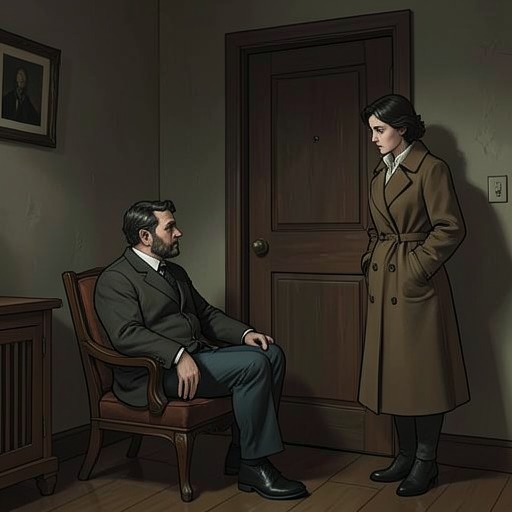
Legal Acquittal and Factual Guilt
Presumed InnocentLegal Acquittal and Factual Guilt describes the gap between Rusty Sabich’s release by the court and the private truth he eventually speaks aloud. His murder trial ends not with a jury’s acquittal but with Judge Larren Lyttle dismissing the case because the evidence is inadequate; the novel later makes clear that Rusty is nevertheless responsible for Carolyn Polhemus’s death. Law settles what can be proved in court, while Rusty’s confession and continuing silence expose what the legal outcome cannot settle.
The Case and Its Evidentiary Limits
The distinction takes shape through a trial in which the evidence is both consequential and incomplete. Seventy-five prospective jurors enter the courthouse, and twelve will ultimately decide Rusty’s fate. During jury selection, Larren Lyttle emphasizes the presumption of innocence, making the legal starting point explicit: suspicion cannot substitute for proof. The case’s eventual dismissal turns on the distance between the prosecution’s suspicions and the evidence it can reliably put before the jury.
The sharpest early dispute concerns Carolyn’s missing glass. The prosecution cannot find it after a six-hour, item-by-item search of the police evidence room, yet seeks to introduce testimony about fingerprints taken from it. The defense argues that Rusty cannot fairly confront scientific evidence when the physical object on which the analysis depends is unavailable for examination. The prosecution responds that the chain of custody is uncontested and that witnesses can establish that the prints were identified from lifts made the day after the murder. The glass’s disappearance therefore becomes more than a missing exhibit: it exposes the weakness of the procedures meant to preserve and verify evidence.
Lyttle allows the fingerprint testimony, but his ruling is expressly uneasy. He acknowledges that the defense has not had the chance to examine the glass and identifies longstanding failures in the evidence room’s record keeping and handling. He allows the testimony partly because of its importance to the case and because he assumes, despite his reservations, that the prosecution has not acted in bad faith. He warns that further evidence of bad faith could end the prosecution and promises a strongly worded instruction to the jury. The ruling demonstrates how a court can act within its discretion while still recognizing serious defects in the process on which a prosecution depends.
Dismissal Rather Than a Jury Verdict
After reflecting on the case, Lyttle concludes that the evidence is too inadequate to let the jury deliberate. He says there is no proof of motive, no concrete evidence establishing an intimate relationship, and no effective proof that Rusty had sexual relations with Carolyn on the night she died. He also finds no direct proof that Rusty murdered her. The state might be entitled to infer that Rusty was present, he allows, but presence and suspicion do not supply the missing proof. The absent glass remains part of that uncertainty: Lyttle says he might have greater confidence in the case if the prosecution had found it.
Nico Delia Guardia disagrees with the ruling but accepts it and moves to dismiss the case, explicitly declining to portray the judge’s decision as unlawful. Lyttle discharges Rusty and apologizes for what has happened, calling the prosecution a disgrace to justice. The case ends without a jury verdict. That difference matters: Rusty is freed because the judge stops the proceedings and the prosecution accepts dismissal, not because jurors weigh the evidence and formally find him not guilty.
The outcome does not erase uncertainty about what a jury might have done. Sandy Stern tells Rusty that Lyttle’s handling of the case was evenhanded overall and that the ruling fell within legitimate judicial discretion. Three jurors later tell reporters they would not have voted to convict, but Rusty and Stern recognize that the views of three people do not determine what the other nine would have decided. The legal closure is therefore firm in one respect—Rusty cannot be tried again for the same murder—but incomplete as an account of what the whole jury would have concluded.
The Public Story and the Private Evidence
After the dismissal, public interpretation supplies a different explanation for the case’s collapse. Press attention turns local failures into a major scandal. Critics call for a special prosecutor to investigate Tommy Molto, and the Kindle County Bar Association opens an inquiry into whether he should be disbarred. A common account holds that Nico, ambitious for higher office, pushed too hard and that Molto manufactured evidence with Painless Kumagai. Nico’s decision to dismiss the case is widely read as an admission that the prosecution was corrupt. A newspaper article mentions the B file and the earlier atmosphere around North Branch Courthouse, but the reference leads nowhere further.
Rusty does not correct that public account, but neither does he disclose what he knows. He acknowledges privately that the semen specimen came from him, that the fingerprints on Carolyn’s glass were his, that carpet fibers found in the investigation came from his home, and that the recorded calls were made from his telephone. These facts explain why the prosecution’s case could appear persuasive, even though the missing glass and other evidentiary limits left it unable to prove murder in court. Rusty’s silence also leaves the public’s suspicion of misconduct intact: he refuses to exculpate Nico, Molto, or Kumagai by revealing that some evidence was genuinely his.
His silence has a material and social afterlife. He continues receiving checks from the prosecutor’s office despite making no effort to return to work. When his stipend is negotiated to end, he demands a year of reparations; the agreement provides nine months. At a public ceremony for Mac’s induction as a judge, Rusty is introduced as someone who knows a great deal about justice, and the assembled audience applauds. He becomes a local hero, compared in public sympathy to Dreyfus, but the acclaim cannot remove his sense of being marked by the trial. His public innocence and private guilt coexist rather than resolving into one another.
Confession, Responsibility, and the Meaning of Acquittal
Rusty’s account of his responsibility emerges in private, not as a legal correction to the record. Near the end, reflecting on his life and his father’s inheritance of a grim view of human cruelty, he admits that he reached for Carolyn deliberately and that the act was what he wanted. Speaking to Barbara, he apologizes and tells her that Carolyn was never more important to him than she was. He acknowledges his obsession and his failure to believe that he could find elsewhere what he sought in Carolyn. The confession does not offer an excuse: Rusty explicitly rejects justification even as he tries to explain the conditions of his desire and the way a contemplated act can become increasingly compelling before it is carried out.
The account complicates the legal case without turning the court’s dismissal into proof of innocence. Lyttle’s ruling addresses whether the evidence is sufficient for a jury to decide, not whether Rusty’s private account is true. Conversely, Rusty’s confession establishes his own understanding of his guilt but was never the basis on which the court acted. The legal record and the narrator’s later admission answer different questions, and the novel keeps them in tension.
Rusty also tests the boundary between legal protection and public truth in a conversation with Dan Lipranzer. He says that, having been tried and acquitted, he could publish a confession without being tried again for murder because of the Double Jeopardy Clause. His wording treats dismissal as acquittal in practical effect, even though the trial ended before a jury verdict. When Rusty observes that people do not admit such things, Lipranzer tells him to forget it. The exchange leaves the confession contained between the two men rather than transformed into a public statement or renewed prosecution.
The concept’s force lies in this separation. The court can discharge Rusty because the state’s case does not meet the standard Lyttle believes justice requires; it cannot thereby make him factually innocent. Rusty can possess a legal defense against another trial and still understand himself as guilty. His concealment preserves the official ending, while his late admission prevents that ending from becoming the story’s final measure of truth.