Maurice Dickerman
Presumed InnocentMaurice Dickerman’s fingerprint testimony is both the prosecution’s clearest technical presentation of prints linking Rusty Sabich to Carolyn Polhemus’s apartment and an opening for the defense to show how little those prints establish by themselves. A careful professional who explains the science plainly, Dickerman identifies a match on one glass; under cross-examination, the limits of that match and the failure to compare other prints become central to the dispute over the evidence.
Identity and approach
Dickerman is an angular New Yorker with large, dark-framed glasses and a strong interest in fingerprints. Rusty recalls that Dickerman used to like him because he would sit and listen while Dickerman talked. The portrait suggests a specialist whose enthusiasm for his subject could hold an audience, rather than an investigator offering a broad account of what happened in the apartment.
The testimony also places Dickerman among the varied capabilities of public service. Rusty contrasts him favorably with Painless Kumagai, describing Dickerman as a capable professional. His role at trial is correspondingly specific: he explains and identifies fingerprints, not the circumstances that produced them.
Testimony for the prosecution
At the witness stand, Dickerman uses photographs and slides to explain how fingerprints are formed from residues of skin oils. He tells the jury that people do not leave prints consistently: some leave none, while most leave them at some times but not others, depending on how much they sweat. A print, when left, is unique. This explanation gives the jurors a framework for understanding both the potential force of a match and the uneven presence of prints at a scene.
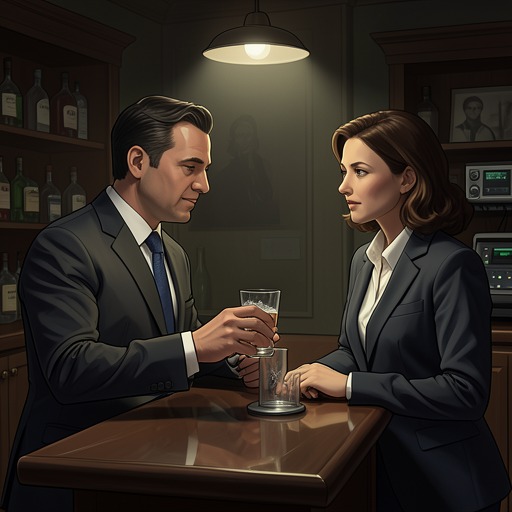
Dickerman then presents photographs of the bar and glass, the lifted prints, and enlargements of prints from Rusty’s county employee file card. Red arrows mark the matching points of comparison. The preparation is exacting, and the visual demonstration makes the prosecution’s case concrete: the prints on the glass match Rusty’s. But the match is tied to a particular object, not to a general pattern of his prints throughout the apartment.
Cross-examination and evidentiary limits
Sandy Stern concentrates on that distinction. Dickerman confirms that Rusty’s prints were not found on the other locations under discussion, including the table and windows. The one identified location for Rusty’s prints is the glass, which can no longer be found. The glass therefore carries substantial weight for the prosecution while also presenting a problem for the jury: the object at the center of the comparison is unavailable for examination in court.
Stern also asks about five other identifiable prints belonging to someone other than Rusty or Carolyn: one on the latch, one on the window, two on liquor bottles, and one on a cocktail table. The questioning turns from the existence of those prints to whether they had been compared. Dickerman says the work could be done overnight. His answer makes the omission consequential: the relevant comparisons were feasible, yet Molto had not asked him to make them.
When Stern asks why Molto had not requested the comparison, Dickerman assumes that Molto did not care. He is trying to minimize what the omission implies, but the response leaves an uneasy impression, as though the investigation’s attention had not been directed toward establishing the full significance of the available evidence. Dickerman’s own remit remains limited; he is there to identify prints, not to explain why the other investigative work was not pursued.
Narrative role
Dickerman’s testimony stages a conflict between forensic precision and evidentiary completeness. The prosecution can show matching points, marked and enlarged for the jury, but the match concerns a missing glass and sits beside other identifiable prints that were not fully compared. Stern does not need to disprove Dickerman’s technical work to make the evidence vulnerable. He draws attention instead to what the examination cannot establish and to the investigative questions left open.
That tension gives Dickerman’s professional competence an important, unintended effect. His orderly explanation makes the fingerprint evidence intelligible, while his answers help the defense expose the boundaries of the prosecution’s case. The testimony is therefore not simply a contest over whether Rusty’s prints are on the glass; it is also a contest over what the glass, the other prints, and the unfinished comparisons can reasonably prove.