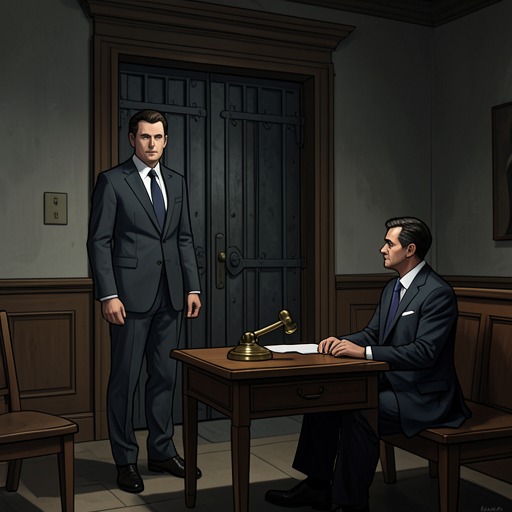
Nico Delia Guardia and Tommy Molto's friendship and political alliance
Presumed InnocentNico Delia Guardia and Tommy Molto’s friendship and political alliance connects personal loyalty with the struggle for control of the prosecuting attorney’s office. Molto is identified as Nico’s best friend and former second-in-command in the Homicide Section; during Nico’s campaign against Raymond Horgan, he disappears from the office and is suspected of helping Nico investigate Carolyn Polhemus’s murder outside the official inquiry. The relationship’s significance lies in that overlap: a private friendship appears to become a political asset, while its uncertain role in a homicide investigation deepens mistrust inside the prosecutor’s office.
Friendship and Political Setting
Molto had worked in the Homicide Section and served as Nico’s second-in-command before Nico left. Afterward, Molto became acting head of the section. Horgan declined to appoint him permanently, suspecting that a departure of this kind might eventually occur. The narration does not establish precisely when Nico and Molto’s close friendship began, but it makes clear that their personal bond outlasted their earlier professional arrangement and remained important as the campaign intensified.
The campaign made that bond politically consequential. With the party primary eighteen days away, Nico was widely expected to lose, while Horgan’s supporters believed the incumbent could still secure the party endorsement and preserve his office. In a county where victory in the primary was effectively equivalent to election, any alliance that could alter the contest mattered. Molto’s position within the Homicide Section, his friendship with Nico, and his sudden absence offered a story that could be read both as a personal choice and as political maneuvering.
Molto’s Disappearance and the Campaign Rumor
Molto had been absent from work for three days without calling in, and his desk had been cleared. Around the same time, a journalist asked Horgan’s office about a high-level defection from the Homicide Section. The press was beginning to connect a senior deputy’s death with the departure of another official who might otherwise have been involved in the investigation. Horgan’s office recognized the danger of that framing: it could make the institution appear to be coming apart during a politically sensitive moment.
One expectation within the office was that, after public attention to Carolyn’s death eased, Nico would make a media announcement that Molto had joined his campaign. Such an announcement was anticipated to produce headlines about a Horgan deputy backing Nico. The episode shows how the friendship could be understood as a campaign resource, but the account presents the announcement as a belief about what Nico might do, not as a confirmed event. When Rusty Sabich challenged Nico about Molto, Nico’s apparent innocence did not resolve the question of what role, if any, Molto was playing.
A reporter then floated a more dramatic possibility: that Nico had sent Molto to pursue the murder investigation independently and might claim credit for finding the killer. Rusty regarded the theory as uncertain, even while recognizing its political appeal. A private investigation could obstruct the police inquiry, and any such conduct would carry risks; nevertheless, the proposal sounded plausible to Rusty as a piece of political theater. The friendship therefore magnified suspicion without, at that point, proving the suspicion true.
Covert Investigation and Institutional Distrust
Later, Rusty concluded that Nico had Molto shadowing the official investigation. He suspected that Molto was collecting information by contacting former colleagues in the police department and obtaining reports unofficially. Rusty also wondered whether laboratory work had been slowed, but admitted that he could not prove it and was not sure what the two men were trying to accomplish. He left open the possibility that they believed he was incompetent and were trying to solve the murder themselves before Election Day.
That uncertainty is central to the relationship’s effect on the case. Molto’s friendship with Nico gave an apparent private inquiry a possible political purpose, but Rusty could not distinguish clearly between gathering information, undermining the official investigation, and pursuing a solution. The relationship thus became part of an atmosphere in which professional responsibilities and private loyalties seemed difficult to separate. A note on a report handled by Painless Kumagai also referred to Molto, connecting his name to a strand of the investigation without clarifying the full extent of his involvement.
The alliance operated amid a wider political contest. Horgan’s campaign relied on a close circle of longtime associates and had to adapt to losing momentum; on Election Day, the party belonged to Nico, and office employees with continuing party obligations worked on Nico’s behalf. These circumstances do not establish that Molto’s friendship determined the campaign’s outcome. They do explain why his absence and suspected investigative activity could be treated as more than a personnel matter: each could affect the appearance of order, competence, and political control.
Rupture and Aftermath
Nico ultimately fired Molto with about two weeks remaining before the recall election that followed a petition drive. The firing marked a visible break in the alliance, but it did not erase its earlier importance. Various civic leaders, including Horgan, Larren Lyttle, and Edgar Mumphrey, opposed Nico; voters recalled him by a margin of about two thousand. Rusty later characterized Nico as having protected Molto, suggesting that he saw their connection as continuing to matter even after Molto lost his position. That is Rusty’s assessment, not an independently established account of every act between the two men.
Nico did not abandon political ambitions after the recall and planned to run for City Council from the South End. The available account does not say whether Molto remained his friend or collaborator afterward. Instead, it leaves the relationship at a consequential break: a close friendship that had become entangled with a campaign and a contested murder investigation, followed by a firing and Nico’s political defeat.
Narrative Significance
The alliance is presented through uneven information: Molto’s absence is observable, his friendship with Nico is stated, and the supposed purpose of his activities remains partly conjectural. This gap keeps the relationship from serving as a simple explanation for the investigation. It instead shows how personal allegiance can generate institutional suspicion even when the evidence does not settle what the allies intended.
Their connection also exposes the vulnerability of official procedures to political interpretation. If Molto was only gathering information, that activity could still look like interference; if Nico hoped to claim a breakthrough, the investigation could become a campaign instrument. The text does not resolve these possibilities into a single proven motive. Its emphasis falls on the consequences of the alliance’s appearance: newsroom speculation, mistrust within Horgan’s office, and a murder inquiry shadowed by the competition for public power.