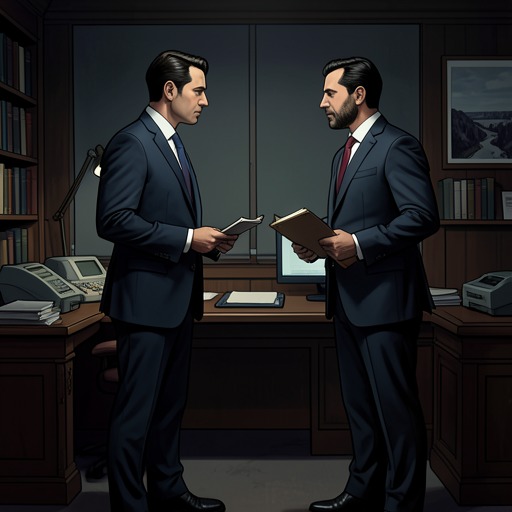
Nico and Molto's Covert Investigation of the Polhemus Case
Presumed InnocentNico Delia Guardia and Tommy Molto’s covert investigation of the Polhemus case runs alongside the official inquiry led by Rusty Sabich, turning a murder investigation into a contest over information, institutional loyalty, and political advantage. Its precise purpose remains uncertain to Rusty, but the signs he uncovers suggest that the parallel effort is not simply an independent search for the killer: it may also let Nico monitor the official investigation and decide when to attack it publicly.
Institutional Background
After Nico left the office, Tommy Molto, previously his second-in-command, became acting head of the Homicide Section. Raymond Horgan declined to give him the position permanently. Rusty understands that Horgan suspected Molto would eventually take some action of this kind, although the evidence does not establish exactly when or how Nico and Molto arranged their inquiry.
The parallel investigation becomes visible first as a matter of political and press attention. Reporter Stew Dubinsky asks whether there has been a high-level defection from the Homicide Section. Rusty gives no substantive comment, wary that information reaching Nico could furnish another opportunity to attack the office. The question itself signals that the story may already be moving beyond internal department talk and toward public scrutiny.
Rusty sees the danger in the story’s potential shape: one senior deputy has been killed, while another official expected to lead the investigation has apparently stepped away from it. Presented that way, the developments could make the prosecutor’s office appear close to chaos. The covert inquiry therefore carries consequences even before its findings are known. Its existence can destabilize confidence in the official investigation and provide political material for Nico.
The Parallel Inquiry Comes into View
Dubinsky’s information is incomplete, but he suspects that Molto is involved and that Nico has sent him to investigate Carolyn Polhemus’s murder independently. Rusty considers the theory implausible because a private inquiry could interfere with police work and expose its participants to accusations of obstruction. Yet he also recognizes the political appeal of the possibility: Nico might present himself as the candidate who solved the case while the official investigation failed. The speculation is not confirmation, but it gives Rusty an early framework for reading Molto’s unexplained activity.
Later, Rusty raises the issue with Painless Kumagai, whose handling of the forensic report has already made him suspicious. When Rusty asks what Molto thinks, Kumagai does not answer directly. Rusty notices that the report is dated five days earlier and bears a handwritten note with Molto’s telephone number, 762-2225. The number supplies a concrete connection between the forensic work and Molto, though by itself it does not prove the full scope of the parallel investigation.
Rusty takes the report as evidence that Molto has access to material from the case while Rusty is not being given the same account of the forensic findings. He tells Kumagai to ask Molto and Nico to contact him, and warns that he may pursue a tampering case. His anger is directed not only at suspected political interference but at the imbalance in the flow of information: the official investigator believes that information is reaching his rival while important interpretation is being withheld from him.
Information, Loyalty, and Political Surveillance
Rusty suspects that Molto is gathering information through former departmental associates and obtaining reports informally. He also considers whether the laboratory work may have been slowed, but acknowledges that he cannot prove it. His account therefore distinguishes what he has observed—the report, its date, and the note connecting it to Molto—from what he fears may be happening behind the scenes. Kumagai, Rusty and Horgan agree, probably held back the results rather than changing them; they see little practical value in asking an assistant to review the work at that stage.
Horgan sharpens the interpretation of Nico’s motives. In his view, Molto’s assignment is not principally a rival attempt to solve the murder but a form of surveillance. By tracking the official investigation, Nico can judge how vulnerable the office is and increase his public criticism when it makes a mistake. Rusty has entertained the possibility that Nico genuinely wants a solution before Election Day; Horgan argues that such a motive would also serve as a convenient explanation if the covert operation were challenged. His account is a political reading, not proof of Nico’s private intention, but it reframes the inquiry as a means of calibrating pressure rather than merely collecting clues.
The impending poll threatens to deepen the division. Rusty and Horgan expect that, once its results are known, police officers who had previously shown loyalty to Horgan will begin supplying information to Nico and investing in the likely future leadership. The covert investigation thus takes place within an institution where personal connections and anticipated advancement shape access to information. Rusty sees the police department’s factional loyalties as a condition that makes the parallel inquiry possible, not an exception that can be resolved simply by appealing to formal procedure.
Consequences and Narrative Significance
The episode leaves the central question unresolved: whether Nico and Molto are trying to solve the murder, undermine Rusty’s work, or pursue both aims at once. Rusty suspects a mixture of information gathering and subversion; Horgan is more certain that surveillance is the strategic purpose. Their competing explanations preserve the uncertainty surrounding the covert operation while showing how the same acts can be understood as investigative initiative or political sabotage.
For Rusty, the most immediate consequence is the loss of confidence that the official investigation controls its own evidence and information. The marked report suggests that Molto is closer to the forensic process than Rusty is, while the prospect of shifting police loyalties makes that disadvantage seem likely to grow. For Horgan, the inquiry offers Nico a way to watch for errors and turn them into public pressure. The case is therefore being investigated on two fronts: one directed toward Carolyn’s murder, the other toward the credibility and political survival of the office handling it.