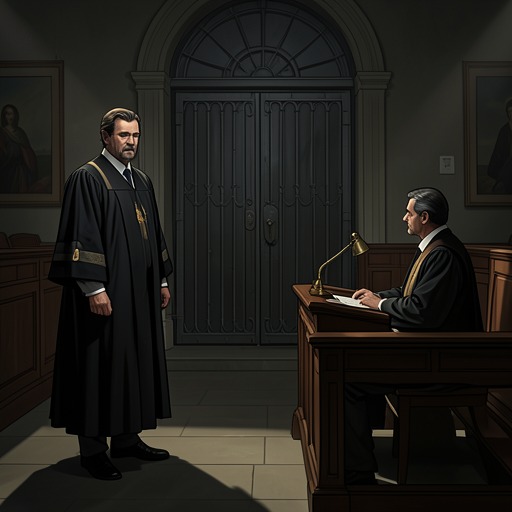
North Branch courthouse corruption
Presumed InnocentNorth Branch courthouse corruption is the account of a compromised local court in which bribery and favors were not isolated from ordinary legal work. Leon Wells identifies Judge Larren Lyttle as the judge paid in his case, and Sandy Stern describes the North Branch Courthouse as a setting where illicit dealings extended across the legal system. The scandal links one judge’s conduct to an institutional climate while preserving a consequential distinction: Lyttle’s later work on felony cases was regarded by Raymond Horgan as professionally distinguished.
A courthouse shaped by illicit dealing
Sandy Stern places Lyttle’s misconduct within both personal upheaval and institutional failure. Lyttle had left a prominent, financially rewarding legal practice for the bench, then found himself assigned to the North Branch Courthouse, which Stern characterizes as a politically punitive posting. The court’s daily business concerned relatively minor matters, and Stern describes a pattern in which defendants returned home under varying dispositions, from dismissal to supervision or probation. In his account, the work’s repetitive character and the courthouse’s corruption formed part of the setting in which Lyttle went astray.
Stern’s description reaches beyond the bench. He identifies bondsmen, police officers, probation officers, and lawyers as participants in a broader web of illicit dealing, and treats the courthouse as a place where corruption had become one of the city’s persistent public secrets. His question about whether Lyttle was the first North Branch judge to fall suggests that the scandal cannot be reduced to one person, even though the evidence here does not establish the conduct of other judges.
Leon Wells and the dismissal order
The case of Leon Wells gives the corruption a specific judicial trace. Rusty Sabich tells Dan Lipranzer that Wells paid the judge, and Wells confirms the identification. He recalls recognizing the judge’s voice in court but struggles to supply the name. Rusty checks the dismissal order and recognizes Lyttle’s distinctive signature, which he says he has seen many times over the preceding two months. The order connects Wells’s account to a formal court document and makes the judge’s identity legible through a mark on the case record.
This episode is distinct from Raymond Horgan’s later account of an earlier payment involving Carolyn Polhemus and Lyttle. The evidence does not establish that the two payments followed the same arrangement. Together, however, the accounts place bribery within the court’s operation: one concerns Wells’s identification of the judge and a dismissal order; the other describes money reaching Lyttle through a probation officer’s intervention.
Carolyn Polhemus, Lyttle, and the earlier payment
Horgan recounts that Carolyn Polhemus, then a probation officer, advocated for people on bond after hearing their circumstances. In one instance, a man she had helped gave her a hundred-dollar payment. She brought the money to Lyttle, and Horgan says the two treated the episode lightly and spent it on dinner. He presents the incident as the beginning of a personal relationship between Polhemus and Lyttle, while describing Lyttle as drinking heavily during that period. The episode joins a discretionary favor in court to private conduct, showing how the boundary between professional influence and personal benefit could be crossed.
Horgan also says he hired Polhemus knowing of the earlier incident. He offered to double her salary and initially expected her to remain a deputy rather than gain broader influence; he believed two other deputies could monitor her. Instead, she proved effective in the work. Horgan acknowledges her intelligence while judging her scruples poorly, and says he eventually transferred Lyttle downtown. These details complicate a simple account of institutional response: Horgan knew of the conduct, retained Polhemus, and later moved Lyttle, but the supplied account does not describe a formal investigation or discipline arising from that episode.
Personal collapse and professional distinction
Stern explains Lyttle’s conduct through circumstances without presenting them as an excuse. He cites Lyttle’s divorce, heavy drinking, gambling, relationship with Polhemus, and the loss of his former professional standing. Stern’s account connects those pressures with Lyttle’s dissatisfaction at being assigned minor cases in a courthouse he regarded as deeply corrupt. Yet Stern expressly condemns the conduct, calling it a disgrace that damages public institutions; he says that proven cases of such wrongdoing would warrant lengthy prison sentences.
Horgan’s account supplies a contrasting later judgment. After Lyttle was transferred downtown, Horgan says, he performed with distinction and insists that Lyttle’s handling of felony cases should not be impugned. He also recalls that Polhemus and Lyttle eventually became so respectable in their professional lives that they scarcely spoke. The contrast does not erase the bribery or settle the larger corruption question. Instead, it shows how the scandal holds together personal misconduct, institutional tolerance, and a later record of competent judicial work—facts that resist both easy absolution and a wholly uniform portrait.