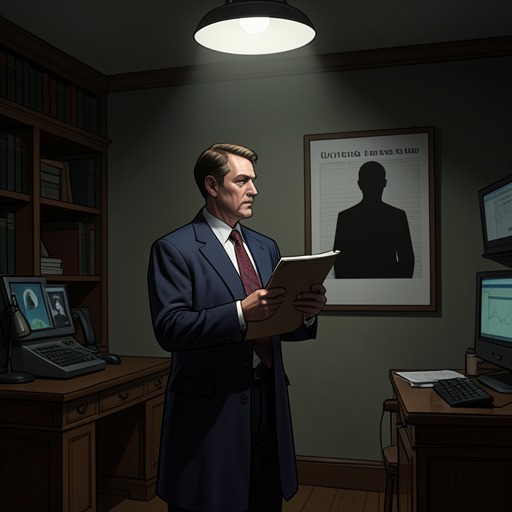
Prosecution of Rusty Sabich
Presumed InnocentThe prosecution of Rusty Sabich makes a legal victory coexist with an unresolved murder: Rusty survives the case, but the truth he believes about Barbara Sabich never becomes part of his defense. In a late conversation with Dan Lipranzer, the two men test competing explanations of the case. Rusty does not accuse Barbara in court or tell his lawyers what he suspects. After the prosecution has ended, the murder of Carolyn Polhemus remains officially unsolved, and the private truth remains difficult to establish even between friends.
Background and Stakes
The case had placed Rusty, a prosecutor familiar with the workings of the justice system, under suspicion for Carolyn’s murder. Lipranzer’s reconstruction is that Barbara wanted Carolyn dead and expected Rusty to be imprisoned for the crime. In his view, her plan depended on the case passing to investigators who knew Rusty well enough to see him as a plausible suspect. The irony, as Lipranzer sees it, is that Rusty’s responsibilities as chief deputy prosecutor led him to take over the investigation himself. Barbara could have anticipated an ordinary homicide investigator, Lipranzer argues, but not Rusty’s unexpected role in the case.
Lipranzer also connects the suspected plan to knowledge accumulated through years of intimacy and observation. He points to Barbara’s possible familiarity with Rusty’s habits and home, and to the chance that an investigator who knew him personally would regard their marriage and his connection to Carolyn as evidence against him. This is Lipranzer’s interpretation, not a proven account of Barbara’s plan. Rusty allows that it is possible and says Barbara had told him events did not go as she expected, but he cannot say what she meant by that.
Lipranzer’s Reconstruction
The conversation turns on a tension between suspicion and friendship. Lipranzer had only recently suspected Rusty himself; now he argues that Barbara may have intended to make him the apparent killer. His account gives the prosecution’s outcome a bitter reversal: the person expected to investigate Rusty became the person prosecuted, while the person Lipranzer now suspects was never charged. The case’s personal stakes sharpen this reversal. Lipranzer had worked beside Rusty and knows details of his life that could make a planted or misread clue seem persuasive.
Rusty does not accept Lipranzer’s explanation as settled fact. He distinguishes between believing Barbara committed the murder and believing she regretted it. He continues to believe both, while acknowledging that her explanation of what went wrong did not clarify matters for him. The prosecution therefore leaves the two men with different kinds of uncertainty: Lipranzer offers a coherent theory of motive and intended framing, while Rusty holds to a private judgment about Barbara’s guilt and remorse that he cannot verify publicly.
The Defense Rusty Refused
Rusty confirms that he did not tell either lawyer what he suspected. He had thought that Sandy Stern might have discerned the truth, especially when Stern considered calling Barbara as a witness, but Rusty felt that Stern did not genuinely intend to put her on the stand. Jamie Kemp, too, had noticed that something was wrong with the telephone records. Neither inference became an accusation from Rusty.
His silence was bound to his family as well as to his legal strategy. He would not force his lawyers to choose between him and Barbara, and he could not accept a defense that required taking his son away from his mother. He also believed that accusing Barbara could make the case against him more persuasive. In Rusty’s imagined version of Nico Delia Guardia’s argument, the prosecution could portray him as a prosecutor who understood how to stage a crime, a husband in an unhappy marriage, and a man whose attachment to his son gave him a reason to frame his wife as a fallback suspect. Rusty feared that jurors might believe such a theory even though he insists it was false.
Outcome and Aftermath
The exchange does not produce a confession, a new prosecution, or a publicly established solution. Rusty says he believes Barbara killed Carolyn and was sorry, but he also believes that telling the lawyers would not have helped him. His decision leaves a divide between what he privately accepts and what could have been argued in court. Dan Lipranzer answers that Rusty did not kill Carolyn; Rusty confirms this, although Lipranzer remains unsettled by the gap between assertion and proof.
In the aftermath, Rusty reports that Carolyn’s murder remains unsolved. No one is pursuing it with him, and he regards a second prosecution for the same crime as practically impossible. When a jailhouse prisoner later tries to confess, Rusty sends Lipranzer to take the statement; Lipranzer quickly judges it worthless. The attempted confession changes nothing about the case’s status. Rusty remains in Kindle County as a caretaker prosecutor, publicly marked by the prosecution and by the belief that he was set up, while the identity he privately assigns to Carolyn’s killer remains outside any official resolution.
Narrative Significance
The prosecution’s ending separates legal outcome from knowledge. Rusty’s refusal to accuse Barbara protects his son and avoids making his own defense depend on a claim he thinks could be turned against him. At the same time, that choice prevents his private account from being tested in court. Lipranzer’s theory gives the reader a possible explanation, not confirmation; Rusty’s certainty that Barbara was responsible likewise remains a personal belief rather than an adjudicated finding.
The final conversation also puts trust under pressure. Lipranzer moves from suspecting his longtime friend to defending him, but Rusty recognizes that belief does not erase the possibility of doubt. The murder remains unsolved not because the characters lack theories, but because their knowledge, loyalties, and willingness to speak do not converge into evidence that can settle the case. The prosecution ends, while the distinction between being cleared and knowing what happened persists.