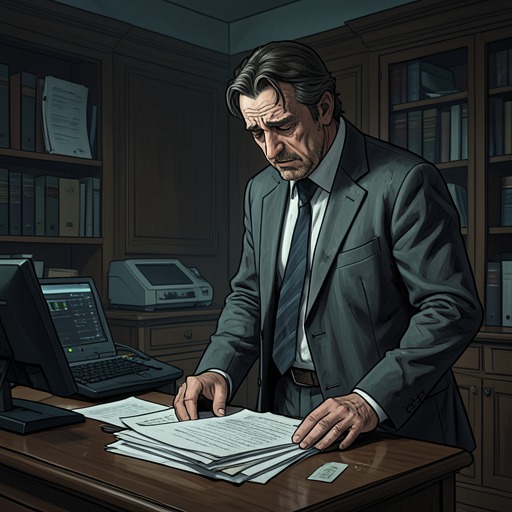
Raymond Horgan’s reelection campaign faltering
Presumed InnocentRaymond Horgan’s reelection campaign falters under the combined weight of a difficult personal period, a challenger who has made law enforcement the central political issue, and a campaign unable to recover its momentum. The turning point is a poll published eight days before the primary: Nico Delia Guardia leads, and Raymond tells Rusty Sabich that defeat is coming. His concession is not simply an electoral forecast. It marks the end of a long tenure whose ambitions, in Raymond’s own assessment, have been constrained by a criminal-justice system that no prosecuting attorney can remake alone.
A campaign begun in weakness
Those around Raymond have come to regard him as looking unwell. Twenty months after his separation from his wife of thirty years, he has gained weight and acquired a habitual grimness. A year before the election, people doubted that he had either the stamina or the desire to run again; he did not announce his candidacy until four months before the primary. The narrator attributes his decision chiefly to his hostility toward Nico, once a fellow deputy prosecutor, rather than to any settled confidence in another term.
Raymond’s campaign tries to turn his solemn appearance into an asset. Consultants determine the image used on campaign materials, including advertisements placed on the backs of one in every four city buses. The photograph gives Raymond a carefully coaxed smile intended to suggest tough humor, but Rusty thinks it makes him look foolish and out of step. The mismatch between the manufactured image and Raymond’s visible weariness becomes a small emblem of the campaign: the effort to control public perception cannot conceal how far the incumbent seems to have fallen behind events.
The contest is consequential in a county where the primary is effectively the election. Kindle County has one and a half million registered voters, and Raymond has won their support for more than a decade. Yet he has not secured his party’s endorsement, largely because of an old factional dispute with the mayor. His political team expects that favorable public polling might persuade party leaders to pressure the mayor into changing sides. That expectation depends on a recovery the campaign has not yet produced.
Nico turns the campaign against him
Nico presents Raymond as too soft and too tired to enforce the law. He argues that effective law enforcement begins at the top, making the incumbent’s record—not merely his personality—the object of attack. His criticism draws on the political vulnerability of Raymond’s long administration: Nico portrays its approach as lax and uses Carolyn Polhemus’s death to suggest that even members of the prosecutor’s own staff are not safe. The accusation is politically useful to Nico, though the account also notes that his own hiring as a deputy prosecutor by Raymond complicates his effort to cast himself as wholly separate from the administration he condemns.
Their rivalry has a history predating the campaign. Raymond had hired Nico as a deputy prosecutor more than a decade earlier, and the two had once worked in the same office. By the time Raymond made Rusty chief deputy and Nico head of the Homicide Section, however, Nico was openly trying to force Raymond from office. Nico sought prosecution in a case where Rusty considered his legal position unsound, cultivated news coverage of his disagreements with Raymond, and used high-profile jury arguments as political performances. Raymond left Nico’s dismissal to Rusty, who delivered the decision with a pair of inexpensive running shoes and a note wishing him luck. Now Nico’s campaign converts that former colleague’s break with the office into a direct challenge to its leader.
Nico’s confidence is evident in his assessment of the race. He believes voters have forgotten the reasons they once supported Raymond and now see him as indistinct, while Nico offers a sharper message. He also tells Rusty that he had been relieved when Raymond announced, because Rusty might otherwise have become the candidate: a professional prosecutor, a dependable figure, and the official credited with breaking up the Night Saints. The exchange shows that Raymond’s campaign is weakened not only by Nico’s appeal but by the possibility that a different successor might have presented a stronger alternative.
The poll and Raymond’s concession
With eight days remaining in the campaign, Raymond brings Rusty the results of a Channel 3-Tribune poll showing Nico ahead. The figures are 43 percent for Nico, 39 percent for Raymond, and 18 percent undecided. Rusty initially treats the numbers as unreliable and points to the undecided voters as room for a comeback. Raymond replies that the poll is the work of a national organization and that his own campaign’s numbers are poor; the campaign has not had enough money to conduct a comparable effort. Raymond, his advisers, and Rusty had all believed the situation was less dire, but there is little in the reported data to support that belief.
Rusty connects the setback to the way Nico has used Carolyn’s murder, while Raymond agrees that it hurt the campaign and adds that the broader loss of momentum is decisive. He then tells Rusty plainly that they are going to lose. The statement ends the interval of hopeful calculation: the incumbent no longer expects his status or the remaining undecided voters to reverse the direction of the race. Raymond’s acceptance contrasts with Nico’s radiant confidence and with the campaign image designed to make the incumbent seem vigorous. Behind the competing public performances, the race has become a question of whether Raymond can still command events; he concludes that he cannot.
The limits of the office
Raymond’s defeat appears to Rusty as the ending of a political project that began with Raymond’s promise to revolutionize law enforcement. After twelve and a half years, Raymond has withdrawn from the struggle and left the problem to his successor. Rusty reflects that the county’s difficulties are not readily solved by a prosecutor’s principles: there are too many crimes, too few jails and courtrooms, insufficient legal resources, political requests for favors, and judges whose appointments can reflect party service rather than legal merit. The campaign’s clash over toughness thus sits within a larger account of institutional scarcity and political patronage.
That assessment does not exempt Nico from the same conditions. Rusty anticipates that Nico’s administration will face the same excess of crime, shortage of resources, demands for political favors, misery, and continuing harm, regardless of the ideals advertised during the campaign. Raymond’s faltering therefore carries an irony: the challenger may win by distinguishing himself from the incumbent, but succession will not remove the structural pressures that have limited the office. Raymond’s concession closes his campaign while leaving those pressures—and the unresolved work of governing—intact.