Rusty Sabich
Presumed InnocentRusty Sabich is a prosecutor whose public authority rests on the act of identifying an accused person and asking others to judge the evidence. His own murder trial reverses that gesture: he stands behind the defense, while the truth he withholds remains beyond the court’s reach. He is legally freed when the case is dismissed, but his private account ultimately reveals that he killed Carolyn Polhemus and chose to protect Barbara rather than expose what he believed she had done. His story turns the prosecutor’s confidence in proof into a question of how much truth a person can bear to tell.
Identity and Professional Formation
Rusty is a career prosecutor in Kindle County. Nearly twelve years before the trial, on his first day in the office, the sheriff took his fingerprints and the chief judge swore him in. John White, then the chief deputy prosecutor, brought him to watch his first jury trial. Rusty remembers White’s practical lesson about the prosecutor’s opening gesture: the advocate must point to the defendant and have the courage to ask for a conviction. That instruction becomes an image of professional certainty, but also a measure against which Rusty’s later conduct can be judged. He learns how to identify a defendant in public; he eventually cannot bring himself to identify the person he believes actually committed the crime.
His professional life is bound up with ambition as well as duty. When White gave him that lesson, Rusty had not yet formed even a private ambition to take White’s job. Years later, he becomes a chief deputy in the Kindle County Prosecuting Attorney’s Office, a position that places him within the institution’s political and investigative machinery. After the murder accusation, he recognizes that his own career and his former colleagues’ judgments are entangled with the case. On trial, he is not merely a defendant confronting evidence: he is a former prosecutor watching other prosecutors make a public case about his character and conduct.
Work, Judgment, and Friendship
Rusty’s work is marked by attention to the practical choices embedded in prosecution. In a discussion with Carolyn about the Nagel case, he says he can accept a plea but believes the case should include two counts. The exchange presents him as a colleague willing to differ over how a prosecution should be framed; Carolyn’s calm response keeps the disagreement professional. His brief insistence is a small counterpoint to the later case, in which the meaning and reliability of evidence become matters of life-changing consequence.
His long friendship with Dan Lipranzer is one of the few relationships he describes with uncomplicated admiration. At a college reunion, asked to name his best friend, Rusty writes down Lipranzer’s name. He describes him as a short, slight police officer with a distinctive hairstyle, heavy smoking habits, and an appearance that can suggest a petty menace. Yet Rusty emphasizes that Lipranzer is exceptionally good at his work. They have known one another since Rusty was assigned to the Violence Section and Lipranzer began in Homicide, and they have worked on a dozen cases together. Rusty still regards him as a mystery and even a danger, in part because Lipranzer moves through the underworld of information alone, building contacts among people who can keep him informed. The friendship rests not on likeness but on hard-earned trust in Lipranzer’s ability.
Carolyn Polhemus and the Private Conflict
Rusty’s relationship with Carolyn is both professional and intimate. When Dr. Robinson observes that Rusty fell in love with her, he first falls silent and then admits that he did. That acknowledgment gives emotional force to the contradiction at the center of his conduct: Carolyn is not simply the colleague whose murder becomes a case, but someone to whom Rusty was deeply attached. During a conversation about her death, Raymond Horgan describes the shock and grief surrounding it and imagines an intruder as the killer. Rusty answers that no one broke in. The assertion is pointed, but he is slow to explain how he knows; the distinction between a prosecutor’s inference and a concealed personal truth begins there.
Rusty later describes his feelings for Carolyn as an obsession, not as a love that can excuse what he did. He tells Barbara that Carolyn was never more important to him than Barbara, while also admitting that he believed Carolyn possessed something he could not find elsewhere. He says he would not have overcome the attachment while Carolyn remained alive. These explanations are not offered as justification. Rather, they show Rusty trying to name the weakness and desire that coexisted with his marriage, while refusing to pretend that understanding those feelings makes his act defensible.
His bond with Lipranzer survives the strain of suspicion. During the period of investigation, Lipranzer tells Rusty that the police have received Carolyn’s telephone records, though the results have not produced an obvious breakthrough. Later, when Lipranzer directly asks whether Rusty killed Carolyn, Rusty denies it and sees that his answer reaches his friend. That denial is consequential: it preserves their relationship in the moment, even though Rusty’s final disclosures to Lipranzer establish that he has withheld the truth from him as well.
Indictment, Trial, and Public Reversal
The indictment charges Rusty with first-degree murder, alleging that on or about April 1 he intentionally killed Carolyn. Nearly two months later, on August 18, he stands at the opening of his trial in a packed courtroom. Alejandro Stern and Jamie Kemp appear for the defense; Tommy Molto and Nico Delia Guardia appear for the prosecution, with Tom Glendenning serving as investigator. Rusty stands behind his lawyers while Judge Larren Lyttle presides. The scene transforms his professional role: the man who once learned to point toward a defendant is now the defendant whose guilt the courtroom must decide.
During the prosecution’s opening, Rusty notes that Nico has chosen jealousy as a motive rather than leaving the state with no motive at all. He recognizes the tactical value of that choice but believes the facts will have to be stretched to support it. His perspective combines legal fluency with personal danger: he can assess the prosecution’s argument from inside its methods, while the argument concerns a crime whose actual perpetrator he is not revealing.
After an eight-day trial, Judge Lyttle dismisses the murder charges and criticizes the prosecution’s case. Newspaper coverage presents the decision as a rebuke of Nico Delia Guardia and reports the judge’s view that some evidence may have been manufactured. The public story casts Rusty as a man framed by a political opponent. The dismissal ends the trial, not the private crisis. Although the press makes much of Nico’s failure, it does not capture the complications Rusty understands, including the possibility of decency within an adversarial prosecution and the truth he himself has kept out of court.
Confession, Concealment, and Aftermath
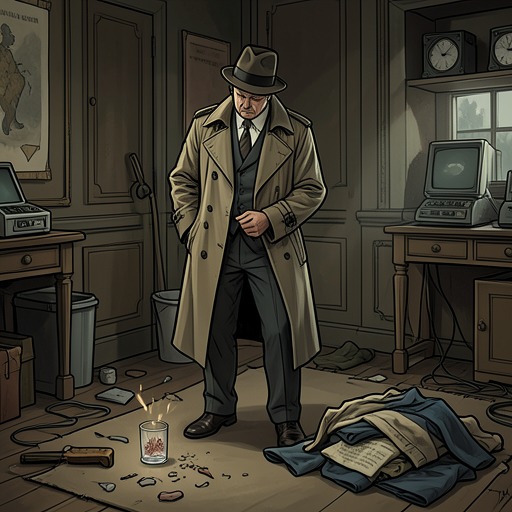
After the trial, Rusty recognizes the Whatchamacallit, a black iron yard tool inherited from Barbara’s father, as the weapon he used to kill Carolyn on April 1. He had noticed blood and a blond hair on one of its teeth and washed it in the laundry tub. When Barbara came downstairs and saw him, he tried to appear cheerful and began whistling. The domestic setting makes the concealment concrete: an object among the household tools holds the evidence of the crime, and Rusty’s ordinary gesture helps hide it from the person he believes knows what happened.
Rusty eventually speaks to Barbara about the killing. He apologizes, says there is no justification or excuse, and describes how dwelling on a plan can make the imagined act feel exciting before the boundary between thought and action is crossed. He insists that he reached for Carolyn deliberately. His account does not turn the crime into an accident or a momentary misunderstanding; it is an effort to confront his own agency while admitting that he cannot fully explain the forces that led him to kill.
In a later conversation with Lipranzer, Rusty says he believes Barbara killed Carolyn and was sorry afterward. He also explains why he did not tell his lawyers: he would not put them in the position of choosing between his defense and accusing his wife, and he would not take Barbara away from their son, Nathaniel Sabich. Rusty believes the state could have presented a persuasive case against him if he had accused Barbara, given his unhappy marriage, his knowledge of the legal system, and his hostility toward Carolyn. His silence therefore protects Barbara, but it also keeps the case unresolved and leaves the man who killed Carolyn legally cleared.
The marriage does not return to ease. Barbara leaves, and Rusty says that he would have been willing to try to continue their life together; he also believes Nathaniel is better off with Barbara and refuses to split them apart. His account holds love, guilt, and self-protection together without resolving them. Rusty later becomes acting prosecuting attorney on March 28, four days before the anniversary of Carolyn’s murder, on the understanding that he will not seek re-election. He accepts the role and remains in Kindle County, aware that public suspicion has fixed him as a political relic and that people will continue to describe him as framed. Carolyn’s murder remains officially unsolved; a jailhouse confession investigated by Lipranzer is dismissed as false. Rusty ends not with a public confession or a completed investigation, but with the knowledge that his legal vindication rests beside a truth he has chosen to keep private.