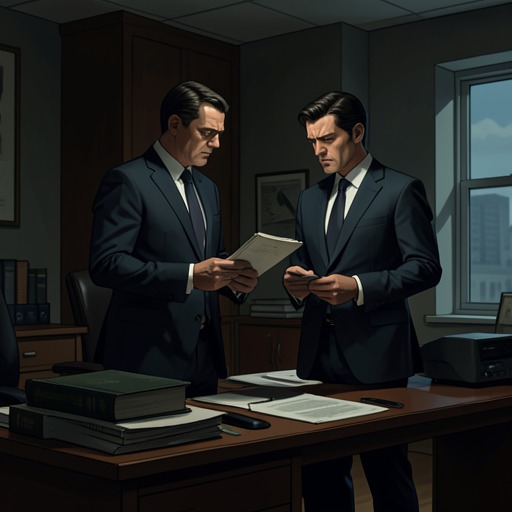
Rusty Sabich and Dan Lipranzer’s friendship
Presumed InnocentRusty Sabich and Dan Lipranzer’s friendship endures through a reversal that makes loyalty difficult to separate from doubt. As longtime friends and investigative partners, they share knowledge of the case and of each other; but when Lipranzer returns the missing glass from Carolyn Polhemus’s bar, the evidence exposes not only what the prosecution lost, but what Lipranzer has privately wondered about Rusty. His final question is not an acquittal or an accusation. It is the test their friendship has reached.
An established bond under pressure
Lipranzer’s importance to Rusty is visible in the ease of their exchanges and in the fact that their association reaches beyond formal investigative work. When Lipranzer phones with news about Leon Wells, he does not give his name. Rusty recognizes him anyway, and the terse reference to “that matter” is enough to make the lead’s significance clear. Lipranzer’s manner is discreet; the call establishes a channel of communication at a moment when the case’s unresolved business still presses on Rusty.
That contact is followed by a late-night visit to Rusty’s home. Lipranzer arrives after midnight, lively and unusually good-humored, while Barbara greets him in her nightclothes. Rusty has been waiting, unable to sleep. The visit takes place during a rare interval of domestic ease: he and Barbara have spent hours over coffee, talking about Painless Kumagai’s death and Nathaniel’s scheduled return. The arrival of a possible development in the case enters a household briefly imagining a renewed life. Lipranzer is not merely a source of information who appears at an office; he is admitted into the private space where Rusty’s hopes and family concerns meet.
The Leon Wells lead
Lipranzer brings reports circulating downtown: Raymond Horgan has heard from Tom Glendenning that Nico Delia Guardia may dismiss the case, while Tommy Molto is resisting and trying to devise another approach. Rusty says that the possibility is real. Barbara takes hold of his arm at the mention of a dismissal, making the political news carry immediate personal weight. Lipranzer’s account gives Rusty and Barbara access to developments beyond their own household, but its value also rests on the confidence that he will pass along what he has heard.
The earlier call identifies the other important part of the news: Leon. Lipranzer says that he and Rusty may have found something on that matter, then asks whether Rusty can talk. The clipped wording conveys both urgency and caution without specifying the result over the telephone. In the later visit, Lipranzer’s behavior shifts from buoyant to visibly uncomfortable. Although the August night is still warm, he hunches his shoulders and zips his windbreaker tight. Rusty knows this as a sign of discomfort, perhaps fear, and jokes with him as they climb the concrete stairs. Lipranzer answers that he does not like this situation. Their familiarity permits the teasing, but it does not make the danger disappear; instead, the exchange shows how private ease and professional risk coexist between them.
The missing glass and the question of guilt
The most consequential test comes after the trial, when Lipranzer presents Rusty with Carolyn’s bar glass, the tumbler that went missing during the proceedings. It is crumpled inside a small white box, wrapped in a manila envelope marked with red-and-white evidence tape. Lipranzer burns a corner of the envelope in the sink and hands Rusty the glass. Blue ninhydrin powder still covers it, revealing three partial prints. Rusty studies the marks, including the prints that had been treated as telltale signs of his own right thumb and middle finger. The object is at once returned evidence and a physical reminder of the case built against him.
Rusty’s response is divided. He tells Lipranzer there is a genuine question about whether he should feel touched or angry. The gift-like presentation has care in it, but it cannot undo the glass’s disappearance or the implications of the prints. Lipranzer has also learned that the officials involved in the trial never understood where the glass went; Rusty and Lipranzer can laugh at the account of Nico Delia Guardia tearing apart his office, even having the tacked-down carpet lifted. The humor briefly restores their familiar rhythm, but it gives way to silence. Rusty names the injury directly: Lipranzer thought he had killed Carolyn.
Loyalty without certainty
Lipranzer does not answer Rusty’s complaint with a denial. Instead, he asks, “Did you?” The question makes plain why he has brought the glass. Had he wanted only to show solidarity, Rusty reasons, Lipranzer could have taken it on one of their fishing trips and dropped it in Crown Falls near Skageon. By returning it, he has placed the evidence—and the question it carries—in Rusty’s hands. The gesture joins them in the unresolved matter, but it does not declare Rusty innocent.
This exchange defines the friendship at the edge of the available story. Lipranzer’s discretion, his visit to Rusty’s home, and his return of the glass all demonstrate sustained involvement; his question demonstrates that involvement is not the same as unquestioning belief. Rusty can be hurt that his friend suspected him and still recognize the significance of what Lipranzer has risked bringing back. Their bond is neither simple trust nor a clean break. It is a relationship in which companionship makes the doubt more painful, and the evidence more intimate. The glass cannot settle what happened, and Lipranzer’s question cannot settle what he believes. Their friendship remains present in the act of facing that uncertainty together.