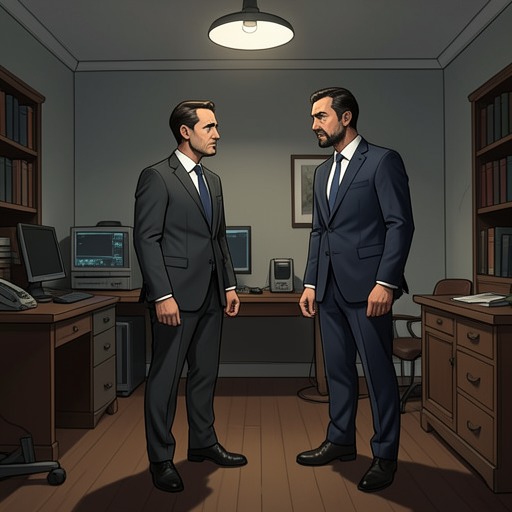
Rusty Sabich and Raymond Horgan’s mentorship and betrayal
Presumed InnocentRusty Sabich and Raymond Horgan’s mentorship and betrayal trace the passage from professional admiration to a breach of trust that neither political necessity nor a murder acquittal can erase. Raymond elevates Rusty into his favored circle and gives him consequential work, but when the concealed history of the B file comes into view, Rusty sees that the same loyalty which once bound them has also made him vulnerable to Raymond’s political calculations. Their relationship ends neither in simple reconciliation nor complete separation: it remains strained, yet Raymond later helps Rusty return to the prosecutor’s office.
Mentorship and Political Ascent
By Rusty’s fourth year as a deputy prosecutor, Raymond had brought him into the inner group of trusted associates and selected him to lead a large police and grand-jury investigation of the Night Saints. The assignment gave Rusty his first substantial public exposure: reporters followed the investigation, which occupied almost four years of his life. By Raymond’s next reelection campaign, prosecutors had convicted 147 identified gang members, a result widely celebrated as a political success, although more than 700 members remained on the street. The episode establishes the scale of Raymond’s confidence in Rusty, while also showing how a prosecution could serve both as law enforcement and as a campaign centerpiece.
Rusty’s admiration extended beyond the work. He regarded Raymond as a leader and an old idol, and he was acutely aware of Raymond’s long history in office. Raymond had spent more than twelve years promoting a transformed approach to law enforcement; Rusty had served within that administration and identified himself with its ambitions. Yet their professional bond did not place Rusty among the political people who managed Raymond’s fortunes. As the party primary approached, Raymond’s campaign depended on endorsements, polling, and the calculations of allies, while Rusty remained a subordinate whose usefulness could be defined by others.
The contrast became especially visible at a campaign-financing meeting. In earlier, less contested campaigns, Raymond had refused to solicit contributions, concerned that fundraising might compromise his independence. Facing a stronger challenge, he set those scruples aside and appeared before potential donors as the same polished instrument of justice they remembered. Rusty’s assigned role was to provide Raymond with a reason to leave the gathering and return to the office. In the room, he was treated as a functionary rather than a member of the influential circle. The scene makes their difference in status concrete: Raymond could use their working relationship to serve the campaign, while Rusty remained outside the private network that shaped it.
Shared Work and Growing Distance
Their professional partnership operated within an office and a justice system burdened by political obligations, thin resources, and divided loyalties. Rusty had spent nineteen months working in a branch courtroom, where crowded proceedings and hurried negotiations made the immediate demands of criminal cases unmistakable. Later, while Raymond’s prospects weakened, Rusty became increasingly reluctant to bring problems to him, believing that Raymond was apt to search for someone to blame. When Tommy Molto’s unexplained absence raised a staffing and political problem, Rusty and Mac weighed the consequences of dismissing him against the advantage that Nico Delia Guardia might draw from the dispute. They placed Molto on unauthorized leave; Rusty admitted that he would have felt safer if someone he trusted had actually seen Molto alive. That reservation reflects a relationship in which Raymond was no longer the person Rusty instinctively relied on for reassurance.
The police and prosecutorial institutions around them further complicated the idea of professional loyalty. A fingerprint-comparison request stalled because the only computer was controlled by another section, whose staff treated it as their own resource. More broadly, Rusty came to understand the police department as a network of private obligations, in which officers protected colleagues, acquaintances, and political contacts rather than simply following formal rules. This atmosphere did not prove that Raymond directed every obstruction, but it gave Rusty reason to suspect that public investigations could be shaped by loyalties invisible in the official record. His growing distrust of the institution therefore widened into distrust of the mentor who had once represented its purpose to him.
Raymond’s political decline made the change in their relationship harder to avoid. When polling showed that the campaign was in worse shape than his allies had believed, Raymond acknowledged that they were likely to lose. Rusty watched the man he had admired accept that the office would soon belong to someone else. Raymond’s resignation was not only an electoral reversal: it weakened the professional arrangement that had connected Rusty’s standing to his mentor’s administration. After twelve years of Raymond’s leadership, Rusty recognized that institutional pressures would persist under a successor, but he also saw how much of his own career had been tied to Raymond’s power.
The B File and the Breach of Trust
The decisive personal rupture concerned the B file and Raymond’s account of its significance. In their later confrontation, Rusty accused Raymond of misleading him when he handed over the file, described Carolyn Polhemus as having requested it, and dismissed the allegation as unfounded. Rusty’s anger was sharpened by the consequences: he had been charged with murder and had stood trial, while the information connecting the file to the North Branch matter had not been made clear to him.
Raymond’s explanation complicated, but did not repair, the accusation. He said he had given Carolyn the file without knowing what it contained and had told her to investigate while remembering that others might look over her shoulder. By then, he acknowledged, he was seeing her. Raymond also described receiving a call from Larren Lyttle after Carolyn’s body was found; Lyttle characterized the file as politically sensitive and asked Raymond to retrieve it. Raymond said he then gave the file to Rusty when asked. Rusty answered that Raymond had had no choice, but had still tried to mislead him. The disagreement was not simply about whether the file changed hands. It concerned what Raymond knew, what he chose not to explain, and whether personal friendship with Lyttle had outweighed his duty to be candid with Rusty.
For Raymond, Lyttle was a friend; for Rusty, that friendship was evidence of the private loyalties surrounding a case in which he had expected fair treatment. Rusty asked whether Raymond had considered the possibility that Lyttle might manipulate the trial to keep the corruption matter concealed. The conversation leaves Raymond’s precise knowledge and intent contested, but it makes the cost of his omissions plain. A mentor who had once entrusted Rusty with a high-profile investigation had become someone whose assurances Rusty could no longer accept without question.
Trial, Acquittal, and Confrontation
The trial’s outcome did not settle the private argument between them. After Rusty’s acquittal, Sandy Stern urged him to accept the legal meaning of the verdict and move forward. Stern took responsibility for judgments that might later trouble either of them and reminded Rusty that he had once been considered one of Raymond’s finest prosecutors. He also observed that Raymond might have made different political arrangements the previous year and allowed Rusty to succeed him. The praise recalled the earlier bond while underscoring the lost possibility of succession.
Rusty nevertheless confronted Raymond directly about the betrayal. He told him that he had endured years of service only to feel that Raymond had been trying to remove him. Raymond acknowledged the difficulty of the situation, but Rusty returned to the central charge: Raymond had lied about the B file, Carolyn’s request, and the allegation attached to it. Raymond responded that other people were not heroes either and insisted that their conduct had nothing to do with Rusty being charged. Rusty’s counterargument concerned his right to a fair trial and the possibility that Lyttle’s interest in keeping the matter quiet could have affected it. Their exchange exposes the gap between Raymond’s defense of his actions as part of a wider, morally compromised political world and Rusty’s demand that his own treatment be judged on its consequences.
The later discovery of what happened to Carolyn Polhemus’s bar glass added another instance of institutional failure to the aftermath. Dan Lipranzer explained that he had collected the glass after laboratory testing, but the evidence receipt showed it as returned when he had no proper case location in which to file it. He had kept it in a drawer, and Molto had signed evidence receipts without checking them against the items. This account helps explain the procedural disorder surrounding the trial, but it does not erase Rusty’s grievance against Raymond. The case left behind not one clean explanation but a record of weak controls, concealed information, and fractured trust.
Continuing Ties and Uneasy Return
Despite the confrontation, Raymond remained connected to Rusty’s later career. After Nico Delia Guardia was recalled by a margin of about 2,000 votes, a citizens’ commission was formed to recommend a new prosecutor. Raymond served on it and called Rusty. He told him that support had been sounded out and that he would receive broad backing. On March 28, four days short of the anniversary of Carolyn’s murder, Rusty became acting prosecuting attorney for Kindle County. He accepted the role on the understanding that he would not seek reelection.
This appointment does not establish that the earlier betrayal was forgiven or that their private relationship returned to its former intimacy. Rusty remained publicly stigmatized by the murder case and understood that many relationships around him carried peculiar strains. But Raymond’s role in the appointment shows that their connection retained practical force after trust had broken down. Their history is therefore defined by a persistent contradiction: Raymond helped make Rusty’s career, and later helped restore him to office, while his omissions about the B file left Rusty to confront the possibility that political friendship had taken precedence over candor and protection. The mentorship survived as history and influence; the certainty that had once sustained it did not.