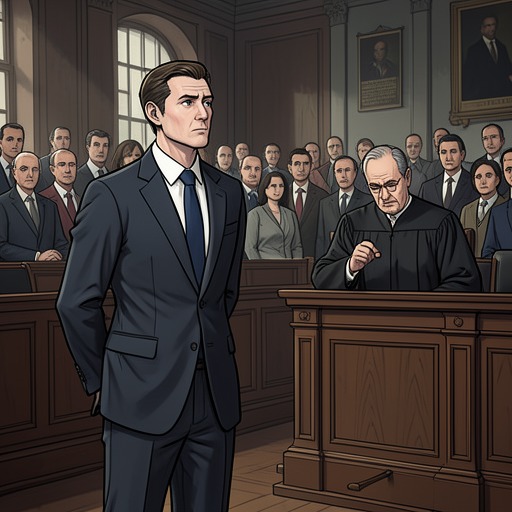
Rusty Sabich’s public stigma after the murder trial
Presumed InnocentRusty Sabich’s public stigma after the murder trial is the lasting social penalty of a case that made a prosecutor accused of murdering his former lover into a public spectacle. The public story shifts—from lurid scandal, to a courtroom ordeal, to the popular belief that he was framed—but his return to public favor does not restore his former ease in the community. The trial ends; the hesitation in other people’s greetings, and his sense of being marked by it, endure.
From prosecutor to public spectacle
The scale of the publicity first becomes clear when Rusty reads the coverage himself in the library in Nearing. His case supplies the tabloids with a potent combination of sex, politics, and violence: a chief prosecutor charged with murdering the woman with whom he had an affair. Local newspapers and television report it, and national outlets take it up. The New York Times treats the case in dry, factual terms, while Time and Newsweek make it more sensational. Both magazines use the same photograph, taken by a photographer who had watched the house from the bushes. Camera crews reportedly wait outside for a week while Rusty and his family are away near Skageon.
The spectacle cannot be escaped simply by leaving home. Rusty has spent twelve years prosecuting major cases, and television stations and newspapers already have enough footage of him to make his face familiar. In Nearing, that recognition alters the smallest encounters: people pause before greeting him, losing a few seconds in which a welcome might have been effortless. The few attempts at consolation are awkward, and a cleaner’s brief expression of sympathy and a teenage gas-station attendant’s question about whether he is the man in the papers only underline how completely his private crisis has become public property.
During the proceedings, Rusty remains a deputy prosecutor on indefinite administrative leave with pay, on Alejandro Stern’s advice. The library becomes a refuge from the attention, in part because its rules enforce silence. There, among the older patrons and people seeking shelter from the day, he reads accounts of his own alleged misconduct. The setting offers no answer to the publicity; it only gives him a place to confront it without having to perform a response for anyone else.
The inward cost of public judgment
Rusty describes the change as a fall from the position of model citizen to that of a pariah. Anger and disbelief come in waves, alongside stretches of numbness and a sense of taking refuge from events that have overwhelmed him. His concern for Nathaniel Sabich is real, but he also recognizes that his attention repeatedly returns to himself as the person most directly struck by the case. The contrast between his former public standing and his new exposure makes the punishment feel at once intensely personal and difficult to explain.
That dislocation reaches beyond reputation into his sense of ordinary movement. He finds himself watching his shoes as he crosses the pavement, surprised that he is walking somewhere and that life continues amid the crisis. The public accusation has not only made him recognizable; it has unsettled his confidence that daily experience follows any intelligible order. His withdrawal to the library and his scrutiny of the ground register a life narrowed to the next manageable act.
Acquittal without an immediate return
After the trial, Rusty initially feels that his life has been expiated and that society has judged him without further punishment being due. The relief is powerful, but it does not hold. He also feels anger and bitterness at having endured an ordeal that, in his view, brought disgrace and damage without an adequate purpose. His experience as a prosecutor had taught him to read acquitted defendants’ tears as relief and guilt; now he understands the disbelief that can accompany the end of a trial, when the ordeal has left its own injury behind.
The return to ordinary life is slow. Calls and congratulations arrive from people who had not spoken to him for months, but he spends much of his time alone and wants to be outside as summer wanes and fall begins. He keeps Nathaniel home from school for a day of fishing together in a canoe; they say almost nothing, yet Rusty is content to be with his son and feels that the boy understands. He also walks for hours in the forest. These quiet intervals contrast with the emotional storm that had filled the previous four months, and mark a gradual return of attention to the world beyond the case.
A reputation rewritten, not erased
At Mac’s induction to the bench, Rusty makes his first public appearance since the trial. Edgar Mumphrey introduces him as someone who knows a great deal about justice, and several hundred people rise to applaud. He has become a local hero, likened in public feeling to Dreyfus; some people appear to regret the pleasure they took in watching his public humiliation. Yet applause does not dissolve his alienation. The trial still feels like a shell around him, leaving him unable to reach outward as he once might have done.
The changed public climate appears again when Rusty encounters Nico Delia Guardia on Kindle Boulevard shortly after Thanksgiving. Rusty considers avoiding the meeting, but Nico has already seen him and approaches with an offered hand. The brief contact brings Rusty a sudden rush of pain and grief, which quickly passes; he then stands facing the man who, in practical terms, had tried to take his life from him. A passerby stops to stare at the encounter, while the rest of the crowd simply parts around them. Public attention still gathers around Rusty, but now even a private reconciliation or its failure can be read as a scene.
When Rusty later becomes acting Kindle County prosecuting attorney, he accepts the position on the understanding that he will not run for re-election. The press calls him the caretaker prosecutor, while local talk settles on a different account of the case: that he was set up and that Nico protected Tommy Molto. Rusty does not correct that interpretation, though he knows that evidence associated with Carolyn’s murder—including the semen sample, fingerprints, carpet fibers, and telephone records—points back to him. He refuses to disclose what he knows, and the popular belief in his framing becomes another public identity he allows to stand.
Remaining in Kindle County means accepting that he will continue to be regarded as a kind of museum piece, and that the strains surrounding him reach both work and ordinary errands. His public image has not returned to its pre-accusation state: it has changed from trusted prosecutor, to disgraced suspect, to local symbol of a perceived frame-up. Carolyn Polhemus’s murder remains unsolved, while Rusty resumes a public role inside the same community that judged him. His stigma therefore persists not as a single settled verdict, but as the unresolved gap between what people believe happened, what he knows, and what he is willing to tell.