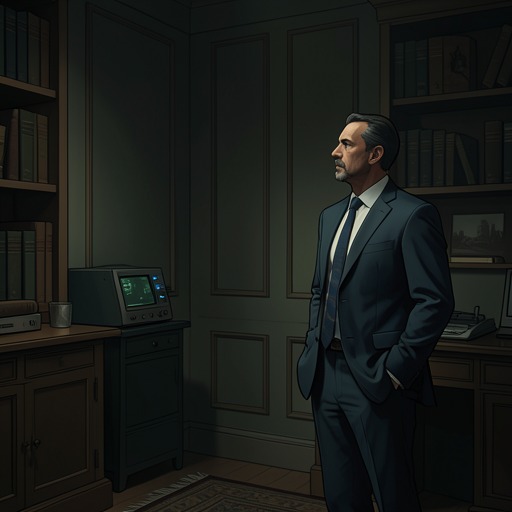
Rusty Sabich's acquittal
Presumed InnocentRusty Sabich’s acquittal comes not through a jury verdict but through the judge’s decision that the prosecution has not produced enough evidence to justify further deliberation. Judge Larren Lyttle ends the trial and discharges Rusty Sabich, while the prosecutor accepts the ruling and moves to dismiss the case. The legal release closes the immediate threat of conviction, but leaves the experience of the prosecution—and the question of what happened to Carolyn Polhemus—unresolved.
The Court Ends the Trial
After Nico Delia Guardia announces that the state rests, Judge Larren Lyttle tells the jurors that their service in the case is over. He does not first send them out of the courtroom; instead, he lets them remain if they wish. Rusty Sabich initially fails to understand what the judge has said. The embrace of Jamie Kemp, followed by one from Sandy Stern, makes the consequence clear: the trial is over.
Rusty Sabich weeps, lowers his head to the table, and then raises it to listen as Larren Lyttle explains the ruling. The scene turns on the difference between expecting an ordinary next step and hearing that there will be no next step at all. The judge has been considering the case for twenty-four hours. Rather than let the jury decide whether the evidence meets the demanding criminal standard, he concludes that the case should not proceed on the record before him.
Why the Evidence Is Insufficient
Larren Lyttle frames the decision as a duty owed both to the jurors and to Rusty Sabich. A defendant, in his view, should not be put through trial unless the evidence is sufficient for fair-minded jurors to find guilt beyond a reasonable doubt. He acknowledges that the prosecutors have suspicions, and that he might previously have considered those suspicions reasonable. After the preceding day’s proceedings, however, he is no longer persuaded that suspicion can carry the case forward.
The judge identifies specific gaps. He finds no proof of motive, no concrete evidence of an intimate relationship, and, after the latest testimony, no effective proof that Rusty Sabich had sex with Carolyn Polhemus on the night she died. Nor is there direct evidence that he killed her. The prosecution may be entitled to argue that Rusty Sabich was present that night, Larren Lyttle allows, but presence as an inference cannot repair the missing proof. The missing glass matters to his assessment: had the prosecutors found it, he might have been more confident in their case. With the evidence as it stands, he refuses to make the jury bear a case he considers clearly inadequate or to leave Rusty Sabich under the threat of deliberation any longer.
Dismissal and Release
Nico Delia Guardia rises to respond. He disagrees with the ruling but says he does not consider Larren Lyttle to have acted outside the law, and does not want to appear to be searching for an excuse. He then accepts the judge’s decision and moves to dismiss the case. The exchange makes the ending more than a unilateral judicial declaration: the prosecution does not continue to press the case after the ruling.
The motion is allowed. Larren Lyttle stands, tells Rusty Sabich that he is discharged, and apologizes for what has happened. He says that seeing Rusty Sabich free cannot compensate for what he calls a disgrace to justice, wishes him well, and brings the proceeding to a close by dismissing the case. The jurors do not return a verdict. The outcome is acquittal in its practical consequence—freedom from the prosecution—but its route is a judicial termination based on insufficient evidence, not a jury’s finding of innocence.
Freedom and Its Afterlife
In the fall, Rusty Sabich describes the release as a deliverance he experiences in sudden, recurring bursts. The terror of the trial is over, and he feels free; for instants, that realization brings an almost physical exhilaration. The relief is sharpened by the future he had imagined while awaiting trial: days of mindless labor, nights spent preparing habeas corpus petitions alongside other inmates, and fearful half-sleep on a prison bunk. The ruling removes that imagined future from immediate reach.
Freedom does not make the consequences disappear. Rusty Sabich anticipates smirks, unspoken accusations, contempt, and scorn, including the judgments made behind his back. His sense of release is repeatedly overtaken by anger, bitterness, and depression when the damage of the ordeal returns to mind. The acquittal ends the state’s case, but it cannot compensate for the public disgrace and private harm that the trial has already inflicted.
The Meaning and Limits of Acquittal
Rusty Sabich also revises his understanding of acquitted defendants. As a prosecutor, he had watched defendants weep after victory and interpreted their tears as relief mixed with guilt, believing that the guiltier they were, the harder they cried. After his own trial, he recognizes another possible source: disbelief that a person has endured an ordeal with no apparent point beyond disgrace and damage. His release therefore changes not only his legal status but his understanding of what a courtroom victory can feel like from the defendant’s side.
The ruling settles whether the prosecution may continue on this evidence; it does not resolve the underlying murder. Larren Lyttle’s reasoning is about the insufficiency of proof, and the case’s dismissal does not establish who killed Carolyn Polhemus. The ending holds legal outcome and factual uncertainty apart: Rusty Sabich is free, while suspicion, stigma, and the unresolved crime remain. That divide gives the acquittal its double force—a decisive end to the trial and no complete restoration of the life the trial damaged.