Rusty's home telephone records
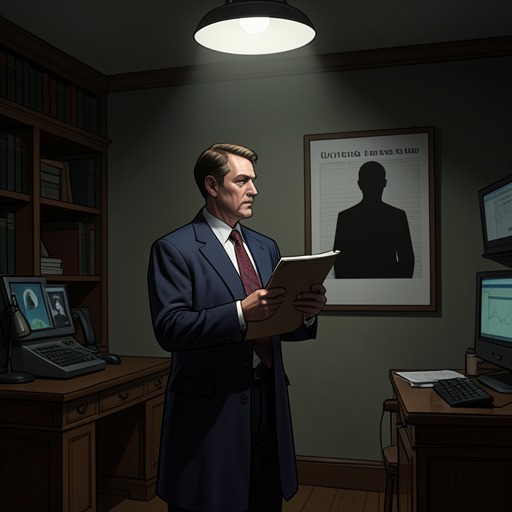
Presumed InnocentRusty's home telephone records are a set of documentary evidence whose force in the trial comes not only from what they contain, but from the history of how they were sought, withheld, and ultimately used. The records turn an investigative choice into a public contradiction: Rusty had issued a subpoena for telephone records, yet later told Jamie Kemp not to pursue backup data for calls from his home. When the prosecution reads the records into evidence, their content becomes a crushing part of its case, although the narrative does not enumerate the calls themselves.
Nature and Place in the Case
The records enter the defense's discussion as a possible source of backup data on the MUDs from Rusty's house. Jamie Kemp reminds Rusty that he had wanted to subpoena the phone company for this material. Rusty promptly tells him not to do so. The moment is brief, but the hesitation gives the proposed subpoena a significance beyond routine evidence gathering: Rusty does not look up, while Kemp's startled reaction registers that the instruction is unexpected.
That exchange concerns a further request for backup data, not the entire history of telephone evidence in the case. During trial, Sandy Stern produces the original subpoena duces tecum to the phone company and establishes that Rusty issued it. The distinction matters. The records were not simply discovered by the prosecution without connection to Rusty's own investigative work; a subpoena bearing his authority had already helped make their acquisition possible. Later, when Tommy Molto and Nico Delia Guardia wanted the records, they relied on that subpoena, a point Stern brings out through Dan Lipranzer's testimony.
How the Records Reach the Jury
Dan Lipranzer's testimony makes the records' procedural history part of the prosecution's presentation. Nico Delia Guardia asks whether Rusty had told him about a personal relationship with Carolyn Polhemus. After an objection and the judge's ruling, Dan Lipranzer answers that Rusty had not told him. Rusty reflects that the narrow wording leaves unasked what might have been mutually understood or suggested between them. The exchange demonstrates how evidentiary rules can confine what is said even when a broader question remains in the air.
Nico Delia Guardia also draws out Dan Lipranzer's account of Rusty's instruction not to collect the MUD records from his home. He connects that testimony with earlier occasions on which Dan Lipranzer had to remind Rusty to request computer analysis of fingerprints found on Carolyn Polhemus's glass and elsewhere in her apartment. The records thus appear within a pattern of investigative omissions, rather than as an isolated technical dispute. Nico Delia Guardia then establishes that Dan Lipranzer and Rusty had worked together on cases and formed what could be described as an investigative team, giving the jury a reason to consider the witness's loyalties as well as his answers.
The Defense's Reframing
Sandy Stern's cross-examination tries to separate Rusty's decision from any effort to conceal relevant calls. He leads Dan Lipranzer through the account that Lipranzer himself raised the question of Rusty's home number, regarded the records as irrelevant, and heard Rusty acquiesce. Stern also elicits that Rusty had not asked Lipranzer to avoid the records for the reason suggested by the prosecution. He then uses the original subpoena to remind the jury that Rusty, not a later prosecutor, had issued it.
The defense's emphasis on the subpoena culminates in Stern's contention that Rusty is now being tried on the basis of evidence he himself subpoenaed. The argument makes the records look less like the product of a hidden scheme and more like a consequence of Rusty's own investigative process. Yet the performance does not fully resolve the difficulty. Rusty's narration acknowledges that Stern's friendly-witness cross-examination lets Dan Lipranzer support the defense's explanation without much resistance. In Rusty's assessment, that visible cooperation risks making the witness appear willing to be misled, and the exchange fails to explain why Rusty did not volunteer information about the calls, particularly the call on the night of the murder.
Disclosure and Consequence
After Dan Lipranzer's testimony, the prosecution uses stipulations to present evidence without calling each technical witness. Nico Delia Guardia reads the telephone-record stipulation himself. Its actual content lands with force: Rusty describes the revelation as crushing and feels the jurors weighing the facts. The narrative does not disclose the individual entries, so the records' precise contents cannot be reconstructed from this episode. What is clear is their effect in court: the jury receives the evidence directly, in an understated presentation that leaves little room for cross-examination to soften it.
The records are read alongside a lengthy stipulation concerning carpet fibers. Rusty notes that the fibers did not match any of his clothing, but sees how readily that favorable point can be answered: the clothes he wore that night could have been discarded with the murder weapon or might not have shed fibers. The juxtaposition places the telephone evidence within a broader shift in the trial. After the prosecution has taken time to build its case, the stipulated facts gather momentum and restore the direction the jury had initially expected.
The records therefore function as more than a record of calls. They preserve a chain of decisions: Rusty's original subpoena, his later refusal to seek additional MUD backup data, Dan Lipranzer's account of that refusal, and the prosecution's use of the subpoena to obtain material that can be read against him. The defense can expose that Rusty helped create the evidentiary route, but it cannot make the records' courtroom impact disappear. Their power lies in this double edge: the same documentary trail that confirms his participation in the investigation also intensifies suspicion about what he chose not to pursue.