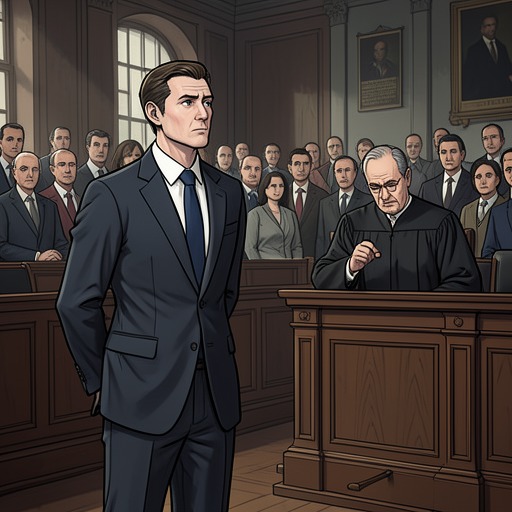
Rusty’s psychological crisis under the murder accusation
Presumed InnocentRusty Sabich’s psychological crisis under the murder accusation is marked by the collapse of his public standing, an increasingly unstable effort to make sense of events, and fear for his son’s future. As a former prosecutor now treated as a suspected murderer, he experiences disgrace not as an abstract legal problem but as a change in how people look at him, how he understands himself, and whether ordinary life can still seem real. His distress reaches its sharpest point when the case’s consequences for Raymond Horgan become newly clear to him; even then, fear and helplessness do not entirely extinguish brief moments of hope.
From public standing to social stigma
The accusation reverses Rusty’s former place in the community. After twelve years prosecuting major cases, news outlets already have enough footage to make his face familiar. He finds that he cannot walk around Nearing without being stared at, and that even routine greetings acquire a pause. Attempts at consolation can feel clumsy, while a young gas-station attendant’s recognition of him through the news makes the public attention unmistakable. The library offers a limited refuge because its rules keep people from talking.
The exposure extends beyond local encounters. While Rusty and his family are hiding near Skageon, television crews remain outside their home, and national news magazines use the same photograph of him. On Sandy Stern’s advice, Rusty eventually agrees to let a photographer take a picture on the condition that the photographer leave afterward. This small negotiation does not restore his privacy: the essential change is that his face and the accusation have become public property. The man once associated with prosecuting prominent cases is now watched as the subject of one.
Anger, numbness, and the limits of explanation
Rusty describes no single, steady emotional response. His spirits swing between anger and disbelief, corrosive anxiety and numbness. At times he feels remote from events; at others, frustration and a sense of incompetence become difficult to bear. He tries to understand why the accusation and its surrounding events have happened, but recognizes that his reasoning has limits. Speculation approaches a frightening territory of paranoia and rage, and he pulls back rather than follow it further. He worries about what the case will produce and longs for life before his involvement with Carolyn Polhemus and everything that followed, but the wish cannot undo the intervening events.
The crisis also alters Rusty’s perception of ordinary movement. Crossing the pavement and watching his shoes, he can be struck by the fact that he is still going somewhere and doing something. Life’s continuation amid misfortune seems astonishing rather than reassuring. This attention to a basic act does not resolve his circumstances; it shows how radically the accusation has unsettled his sense of normality. His father’s fatalism, which Rusty recognizes in himself more strongly than expected, offers no explanation for the case. It gives him instead a way to endure a life that he cannot make conform to reason or order.
Nathaniel and the fear of lasting harm
Rusty’s concern for Nathaniel Sabich is one of the crisis’s most persistent stakes. He worries about how the accusation may shape his son’s future and whether Nathaniel can be protected from shame. The prospect that his son may, for practical purposes, be left half an orphan makes Rusty feel acutely powerless. His distress is therefore not confined to his own fall from public respect: he fears that a proceeding he cannot control will leave damage in his child’s life as well.
That fear sharpens the distance between Rusty’s wish to return to the past and the reality of the present. He wants the events that began with Carolyn Polhemus and continued into the accusation never to have occurred, yet his attention keeps returning to what will happen next, particularly to Nathaniel. The conflict between wishing for reversal and trying to protect his son gives the crisis a forward-looking pressure: even when Rusty retreats from speculation, the question of his son’s future remains.
Raymond Horgan and a moment of acute fear
A further blow comes when Rusty recognizes how his case has affected Raymond Horgan. Rusty feels ashamed that he failed to foresee the consequences for his former mentor and superior. Raymond, a public figure deeply invested in his reputation, must confront the indictment of his chief deputy, the collapse of an investigation he had allowed Rusty to lead, and the prospect of testifying about his own indiscretions. Rusty understands that Raymond’s anger is not simply a judgment about guilt or innocence. Raymond believes Rusty intended to bring him down by killing Carolyn, and sees the changed course of his election and career as part of that injury. Rusty expects Raymond’s hostility to matter at trial and recognizes that Raymond has planned vengeance. The realization combines guilt, fear of the testimony, and the knowledge that the prosecution has damaged more than one life.
After this encounter, Rusty feels close to falling apart. His thoughts about the possible effects of Raymond’s testimony become disordered, and he turns, despite his disbelief, to the childhood habit of prayer. He asks for release from the situation, expressing how frightened and overwhelmed he is without arriving at any explanation for why it has happened. The episode makes the crisis more than a private cycle of rumination: the courtroom conflict, Raymond’s anger, and Rusty’s own sense of vulnerability converge in a moment when he can no longer sustain his composure.
Brief hope without resolution
Numbness and fear do not define every moment. Rusty recalls that, once or twice in recent weeks, an extraordinary hope has settled over him without any clear reason. It gives him enough courage to look ahead. The feeling is temporary and does not promise acquittal, restored reputation, or repaired relationships; the available account does not resolve those uncertainties here. Its importance lies in its contrast with Rusty’s usual remoteness and dread. He remains unable to explain the accusation or control its consequences, yet for a moment he can face the future rather than only wish the past away.