The Murder Case of Carolyn Polhemus
Presumed InnocentThe Murder Case of Carolyn Polhemus begins with her death on April 1 and quickly becomes a test of how personal loyalties and political rivalry shape an investigation. Carolyn had worked for Raymond Horgan, who had hired her before she graduated from law school. As colleagues and the press demanded answers, Horgan spoke of both the professional loss and the pressure surrounding the still-unsolved killing.
Background and Immediate Response
Three nights after Carolyn’s death, Horgan described a strained atmosphere: his political opponent, Nico Delia Guardia, was suggesting that Horgan himself had committed the murder, while reporters pressed for news of the killer. Horgan’s account also recalled Carolyn’s history in his office. He had known her first as a probation officer and later as a lawyer he had hired; her death therefore touched both the investigation and his former working relationship with her.
The initial findings established that Carolyn died from a skull fracture and the resulting hemorrhage. The pathologist, Dr. Kumagai, reported that the scene might suggest strangulation but that there was air in her lungs; he could not identify the object used, describing it only as heavy and hard. Investigators searched the apartment thoroughly for a weapon but found no immediate answer in the search.
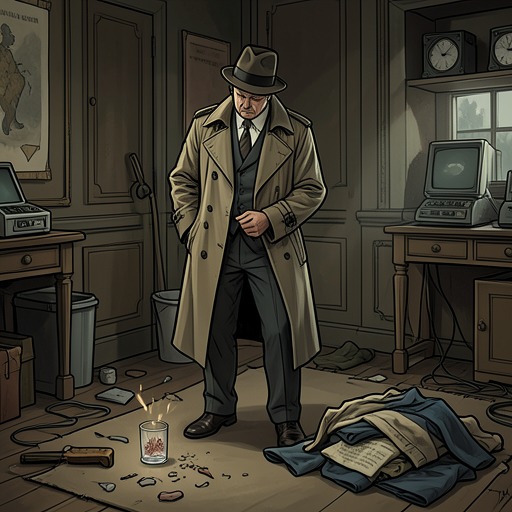
The apartment was a waterfront loft converted from a former warehouse, furnished with Chinese screens, heavy rugs, and a mixture of modern and classical touches. Carolyn had been killed in the living-room space beside the kitchen. Photographs showed a coffee-table top displaced from its brass supports and a modular seat overturned, although the room did not appear to show extensive signs of a struggle. Rusty Sabich’s immediate interpretation was that no one had broken in, a detail that complicated the simplest account of an unknown intruder and kept attention on the circumstances of Carolyn’s private life.
The Photographs and Competing Interpretations
Rusty Sabich tries to approach the photographs as evidence, first urging himself to remain professionally composed. That distance does not hold. He recognizes that his response includes a troubling sense of satisfaction, which he cannot dismiss simply by condemning himself for it. The images shift Carolyn Polhemus in his mind: beyond the poised, capable woman he knew, he sees someone who appears to need his pity and help. The investigation thus becomes inseparable from his own compromised feelings, even as he attempts to read the scene as an investigator.
Dr. Kumagai later offers a theory rather than a confirmed account: he believes Carolyn’s killer was a lover who came to her apartment for drinks and sex, then killed her in anger and arranged the scene to suggest rape, removing her diaphragm. His interpretation makes the apparent circumstances of the killing point toward someone with private access to Carolyn, but the evidence presented does not establish that account as fact. It sharpens the central uncertainty: the scene may have been deliberately staged, and the person responsible may have been known to her.
Political Context
The investigation unfolded against the deterioration of Raymond Horgan’s political fortunes. After thirty years of marriage, he had separated from Ann twenty months earlier, and observers around him remarked on his weight and increasingly grim expression. Although many had doubted that he would run again, he did not announce his campaign until four months before the primary. The narrator judges that Horgan’s strongest motive was his hatred of Nico Delia Guardia, his former deputy in the prosecutor’s office and now his opponent. Campaign money went to agencies and media consultants, who circulated a carefully managed portrait of Horgan on the backs of one in every four buses in the city. The forced smile, intended to suggest a toughened wit, instead seemed to the narrator to make him look foolish and out of step. This public image sharpened the contrast between the campaign’s effort to project control and Horgan’s own sense that events were slipping beyond him, as Carolyn Polhemus’s killing became bound up with the contest for political power.
Uncertainty and Narrative Significance
The evidence does not settle who killed Carolyn or establish Dr. Kumagai’s reconstruction as fact. The search produced no identified weapon, and his later suggestion that the scene had been arranged to misdirect investigators remains a theory. That gap between observable evidence and an explanatory story is central to the case: details invite competing interpretations without confirming either an unknown intruder or someone from Carolyn’s private life. Through Rusty Sabich’s effort to examine the photographs, the investigation also exposes the difficulty of separating professional judgment from personal feeling. The case is therefore both an unresolved inquiry and a measure of how loyalties, suspicion, and private responses can shape what investigators believe they see.