CERN
Project Hail MaryCERN, the European Organization for Nuclear Research, stands as one of humanity's most advanced scientific institutions and became an indispensable asset in the race to understand Astrophage. Its researchers unlocked the fundamental secret of how the alien microbe stores energy, a breakthrough that not only explained Astrophage's baffling properties but also guided the engineering of the Hail Mary's radiation shielding. Without CERN's contributions, the mission's feasibility would have remained in doubt.
Discovery of Astrophage's Energy Storage Mechanism
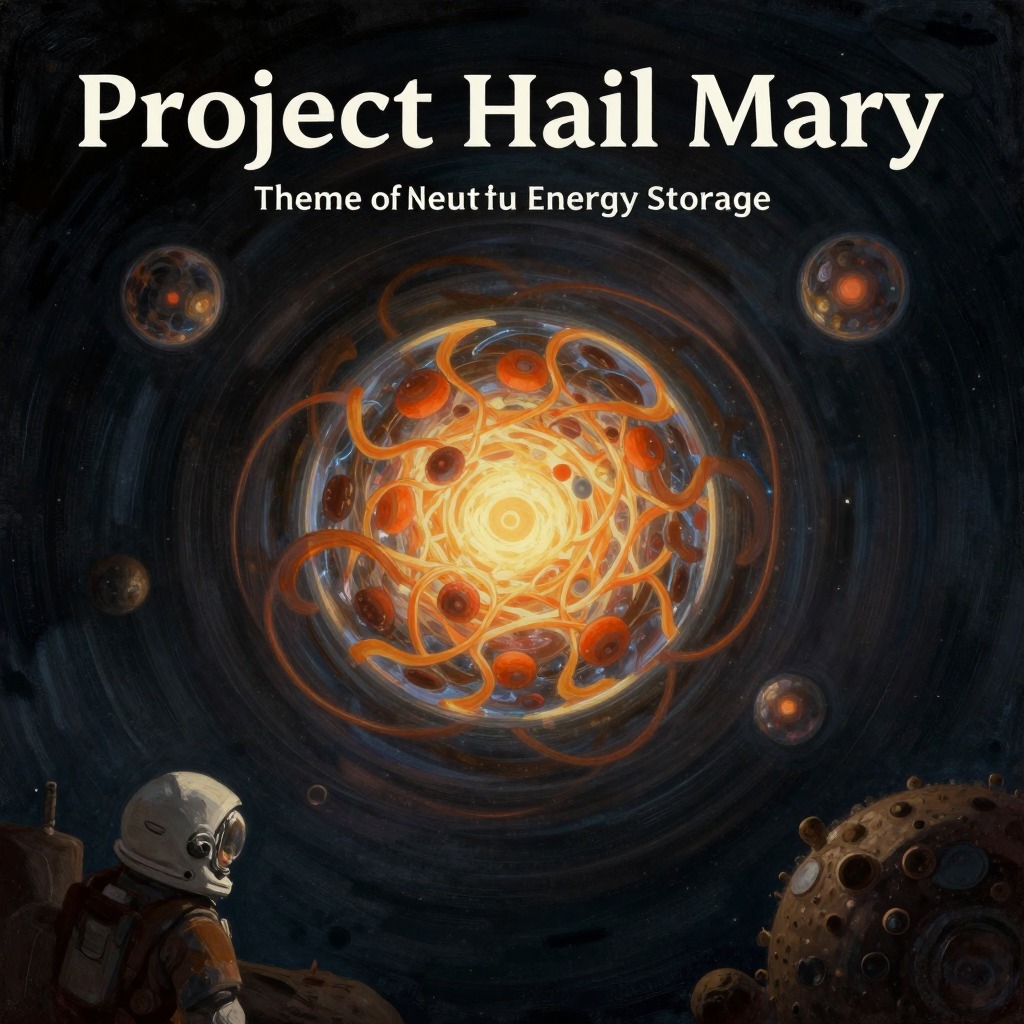
CERN's most pivotal contribution came when its scientists, working with samples of dead Astrophage, determined that the organism stores energy by converting heat into mass through neutrino pair production. Dr. Lokken, a Norwegian scientist who later joined the Hail Mary project, explained to Ryland Grace that CERN had observed a large neutrino burst every time an Astrophage cell was killed. They took samples to the IceCube Neutrino Observatory and punctured them in the main detector pool, obtaining a massive number of hits. The analysis revealed that Astrophage contains a high concentration of free hydrogen ions—raw protons with no electron—zipping around just inside the cell membrane. When these protons collide at sufficient velocity, their kinetic energy is converted into two neutrinos with opposite momentum vectors. This process, a form of pair production previously unknown at such scales, allows Astrophage to absorb and store enormous amounts of energy, explaining its ability to maintain a constant temperature of 96.415 degrees Celsius regardless of external conditions. The discovery also clarified why the organism emits light at the specific Petrova wavelength: when two neutrinos collide, they annihilate and become two photons of that exact frequency.
Validation of Astrophage's Radiation-Blocking Properties
Beyond energy storage, CERN conducted off-the-books experiments at Dr. Lokken's request to test whether Astrophage could block radiation. The results were definitive: even particles moving near the speed of light could not penetrate a living Astrophage cell, and none of the radiation seemed to kill it. This finding confirmed that Astrophage exhibits what scientists termed "super cross-sectionality"—the ability to interact with all matter and energy that tries to pass through it, regardless of how unlikely such an interaction should be according to conventional particle physics. This property made Astrophage an ideal material for radiation shielding, leading to the design decision to line the Hail Mary's hull with a one-millimeter-thick layer of Astrophage slurry. The fuel itself would serve as insulation, protecting the crew from galactic cosmic rays and solar particles during their interstellar journey.
Role in the Hail Mary's Design and Construction
CERN's discoveries directly influenced the Hail Mary's engineering. Dr. Lokken, who had leveraged her contacts at CERN to obtain the experimental data, used the findings to advocate for the centrifuge design that would allow the ship's lab equipment to function in Earth-like gravity. She presented the radiation-protection scheme to Grace, who confirmed its viability: the entire radiation load would be halted by a layer of Astrophage slurry thick enough to guarantee that at least one cell would be in the path of any incoming particle. Grace calculated that the reserve fuel in the hull could power New York City for twenty thousand years, underscoring the absurd scale of energy involved. CERN's work thus bridged pure particle physics and practical spacecraft engineering, ensuring that the crew would survive the radiation environment of deep space.
Significance in the Broader Scientific Effort
CERN's involvement exemplified the global mobilization of scientific resources under Eva Stratt's authority. The laboratory's willingness to conduct off-the-books experiments reflected the urgency of the crisis and the unprecedented cooperation among nations. By solving the mystery of Astrophage's energy storage and confirming its radiation-blocking capability, CERN provided two of the foundational pieces of knowledge that made the Hail Mary mission possible. The laboratory's work also deepened the scientific community's understanding of neutrino physics, revealing a natural mechanism for mass-energy conversion that had never been observed before. In the context of the story, CERN stands as a symbol of human ingenuity and the power of collaborative science in the face of existential threat.