Dimitri Komorov
Project Hail MaryDimitri Komorov is the Russian physicist who heads the Russian Federation's research into Astrophage and whose discovery of the microbe's mass-conversion energy storage makes the Hail Mary's interstellar voyage feasible. He is introduced as a warm, enthusiastic scientist who immediately bonds with Ryland Grace over their shared fascination with Astrophage's mysteries, and his work provides the critical theoretical foundation for the entire mission.
Identity and Role
Dimitri Komorov is introduced as the head of the Russian Federation's research into Astrophage, a position that places him at the center of humanity's most urgent scientific effort. He is first mentioned by Eva Stratt during a meeting on a Chinese aircraft carrier, where she gestures to him and says, "Dimitri heads up the Russian Federation's research into Astrophage." He immediately corrects her formality, asking Grace to "please call me Dimitri," establishing his approachable, collegial demeanor. His role is not merely administrative; he is the scientist who has cracked the central mystery of how Astrophage stores energy, a discovery that Grace has been desperately seeking.
Key Discovery: Mass Conversion and Neutrino Energy Storage
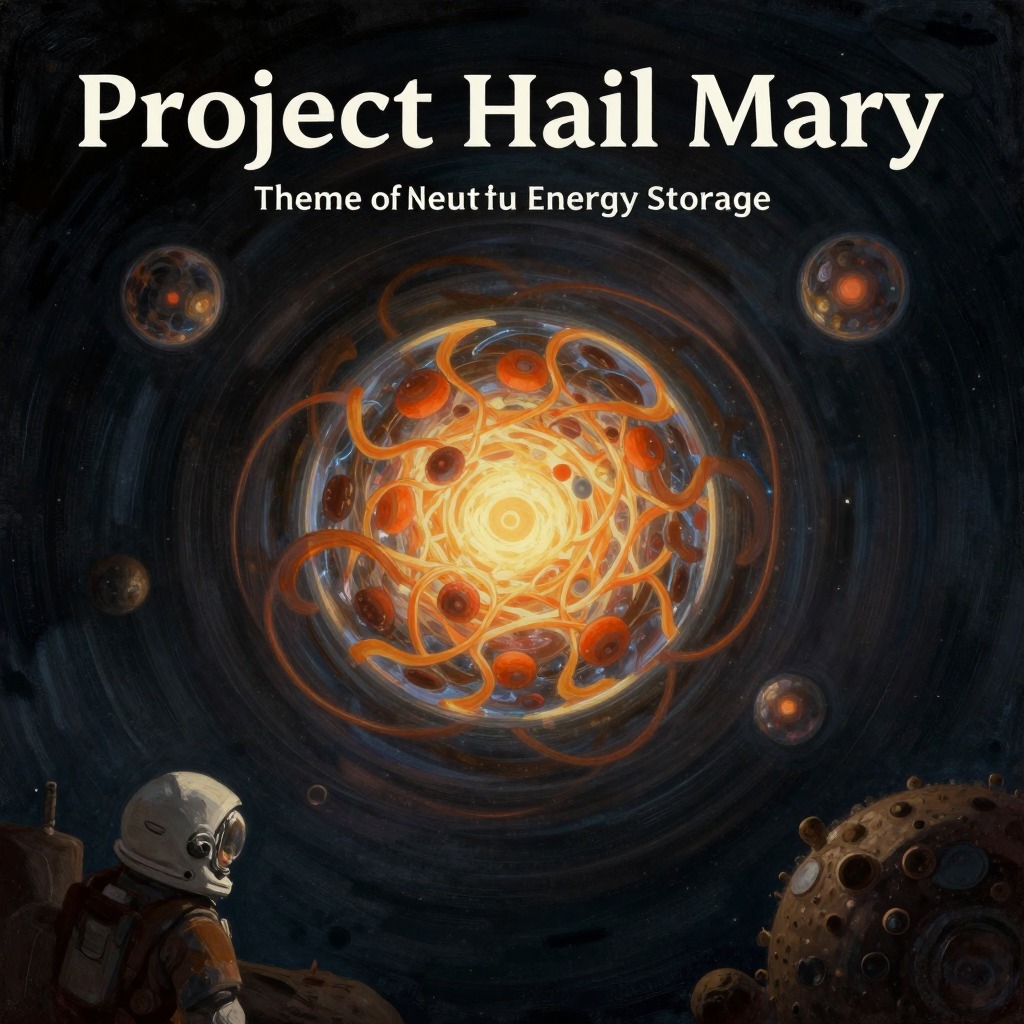
Komorov's most significant contribution is his experimental demonstration of Astrophage's energy-storage mechanism. He explains to Grace that his team pointed a tight-focus one-kilowatt laser at a single Astrophage cell. As usual, the cell did not get hotter, but after twenty-five minutes, light began to bounce off it—the Astrophage was "full." It had consumed 1.5 megajoules of light energy. Crucially, Komorov's team measured the cell before and after the experiment and found it was now seventeen nanograms heavier. "You can see where this goes, yes?" he asks Grace, who immediately grasps the implication: E = mc². The Astrophage converts heat energy directly into mass, storing it with absurd efficiency. When it needs the energy back, it converts that mass back into energy in the form of Petrova-frequency light, which it uses for propulsion. Grace is ecstatic, exclaiming, "That's…! Dimitri, I want to hang out with you. Like—can we hang out? I'll buy you a beer. Or vodka. Or anything." Komorov's discovery is not just a scientific curiosity; it is the key that unlocks interstellar travel, proving that Astrophage is a perfect energy-storage medium and a perfect spaceship engine rolled into one.
Personality and Relationships
Komorov is characterized by his infectious enthusiasm, his warmth, and his distinctly Russian sense of humor. When Grace asks if he understands where the heat goes, Komorov replies, "We have figured this out, yes. With lasers. It was very illuminating experiment." When Grace asks, "Was that a pun?" Komorov gleefully confirms, "It was!" and they both laugh, much to Eva Stratt's irritation. This shared moment of scientific joy establishes an immediate rapport between the two men. Komorov is also the one who, with a darkly comic shrug, contextualizes the immense danger of their work. When Grace realizes that setting off all two grams of an Astrophage sample at once would vaporize them all, the carrier, and create a small tsunami, Komorov simply shrugs and says, "And I would owe you drink in afterlife, yes?! Ha-ha-ha-ha!" This gallows humor, delivered with a slap on the back, reveals a man who is fully aware of the stakes but refuses to be paralyzed by fear. He is a key member of Stratt's inner circle, present at the most critical meetings, and his expertise is treated with the utmost respect.
Narrative Significance
Komorov's discovery is the narrative linchpin that transforms the Hail Mary from a desperate gamble into a physically plausible mission. Without his understanding of mass conversion, the ship would have no viable engine. His work also provides the scientific basis for the ship's radiation shielding, as the Astrophage's ability to absorb all forms of energy makes it the perfect material to line the hull. He is a figure of pure, unadulterated scientific competence and good-natured camaraderie in a story filled with immense pressure and personal sacrifice. His friendship with Grace provides a brief, bright moment of intellectual kinship before the mission's true costs are fully realized.