Sahara Desert
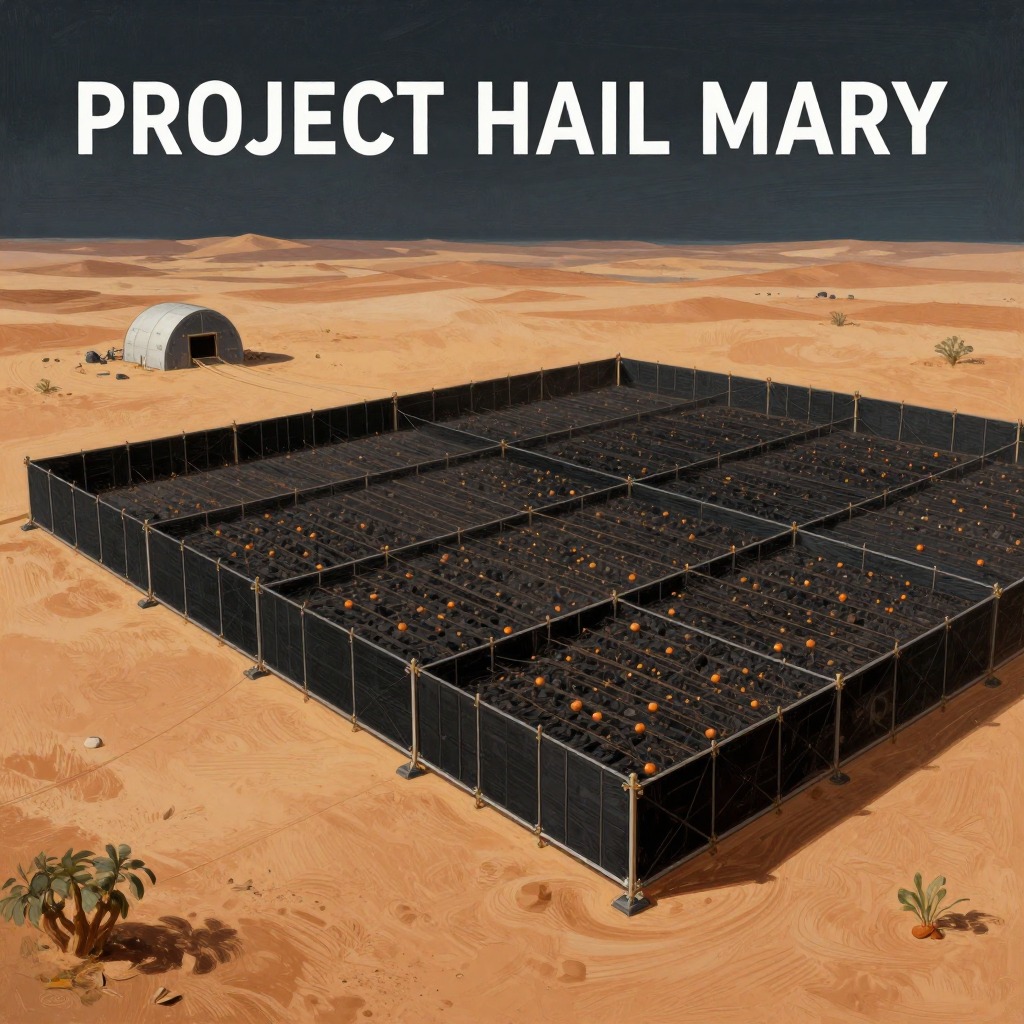
Project Hail MaryThe Sahara Desert, the vast North African desert spanning nine trillion square meters, becomes the site of the largest industrial project in human history: the Blackpanel Astrophage-breeding farm. Conceived by the imprisoned engineer Bob Redell and executed under the absolute authority of Eva Stratt, the project involves paving a substantial portion of the desert with trillions of black-anodized metal panels designed to absorb sunlight and breed Astrophage on an unprecedented scale. This farm is the only means to produce the two million kilograms of enriched Astrophage required to fuel the Hail Mary interstellar mission to Tau Ceti.
Conception and Design
The Blackpanel idea originates from Bob Redell, a disgraced engineer serving a life sentence in Auckland Prison for culpable homicide and embezzlement related to a failed solar thermal plant in New Zealand. While incarcerated, Redell anonymously emails Stratt with his concept. When Stratt and Ryland Grace visit him in prison, Redell explains that a black-anodized metal foil square, covered with clear glass and sealed with insulating materials, will absorb sunlight and reach an equilibrium temperature well over 100 degrees Celsius—hot enough to enrich Astrophage. He calculates that while a single one-square-meter panel produces only about half a microgram of Astrophage per day, the sheer scale of the Sahara Desert—nine trillion square meters—makes it feasible. "You'd need two trillion square meters to get a thousand kilograms per day," Grace calculates, to which Redell replies, "The Sahara Desert is nine trillion square meters." The design incorporates a static magnet to simulate the sun's magnetic field, an IR filter to emit the carbon dioxide spectral signature that triggers breeding, and a small pinhole for air exchange to replenish CO2. Grace, despite his initial skepticism, admits the design is "a sound concept" optimized for scalability rather than efficiency.
Implementation and Consequences
Stratt immediately drafts Redell into the project, and the Blackpanel farm is built across the Sahara. The farm successfully generates Astrophage at the promised levels, with Redell managing the operation from the aircraft carrier Stratt's Vat. However, the project has severe environmental repercussions. The climatologist François Leclerc, brought in to track the climate effects of Astrophage, directly blames the Blackpanels for contributing to bizarre weather phenomena. He tells Stratt, "Partially, it's because of shifting weather patterns. And partially it's because some lunatic decided to pave the Sahara Desert with black rectangles. As if a massive disruption of heat distribution near the Mediterranean Sea wouldn't have any effects." Leclerc reports that the Sahara farm has caused tornadoes in Europe, shifted cyclone seasons by two months, brought snow to Vietnam, and created a "maelstrom" of disrupted jet streams. Despite these consequences, Stratt dismisses the ecological damage as unavoidable, stating, "I knew there'd be weather effects. We just don't have any other choice."
Narrative Significance
The Sahara Desert, transformed into a global industrial engine, embodies the central moral tension of the Hail Mary project: the willingness to inflict catastrophic environmental damage on a planetary scale in order to avert an even greater extinction event. The desert, once a symbol of natural vastness and emptiness, becomes a manufactured landscape of salvation and destruction simultaneously. It is the physical manifestation of Stratt's ruthless pragmatism—the belief that any cost is justified to save humanity. The Blackpanel farm also serves as a key plot mechanism, providing the necessary fuel for the Hail Mary's interstellar journey, and its environmental fallout becomes a recurring point of conflict between the science team members, highlighting the impossible choices forced upon them by the Astrophage crisis.