Steve Hatch
Project Hail MarySteve Hatch is the Canadian engineer from the University of British Columbia who designed and built the beetle probes—the small, self-contained spacecraft that carry data from Tau Ceti back to Earth. His boundless optimism, Beatles-themed naming scheme, and deep reverence for the physics that make interstellar travel possible mark him as one of the most distinctive supporting figures in the Hail Mary project.
Identity and Background
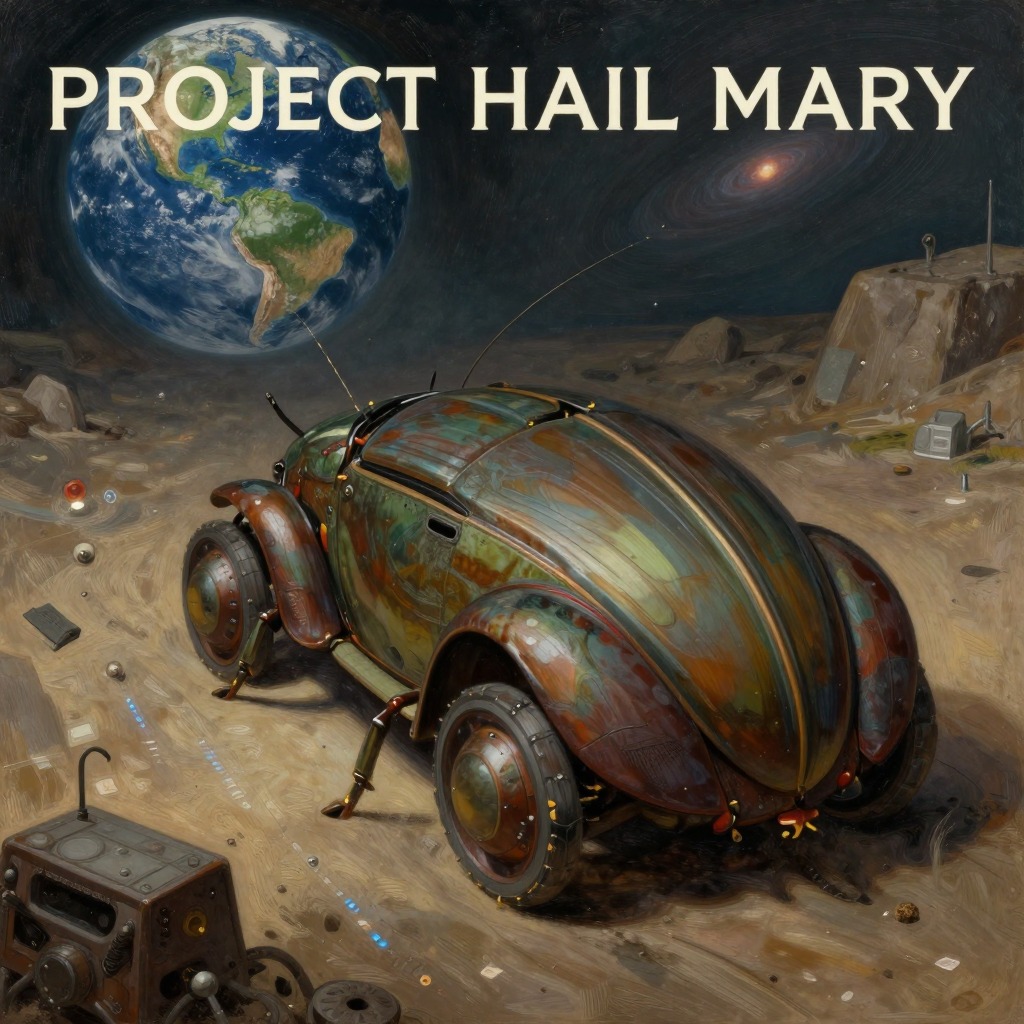
Hatch is introduced as a short, somewhat disheveled man who arrives on the aircraft carrier carrying a bulbous metal object—a prototype of the beetle probe. He is immediately energetic and talkative, launching into a rapid-fire explanation of his work without waiting for formalities. He describes himself as a fan of the Beatles, naming the four flight-ready probes John, Paul, George, and Ringo, and even names his test prototype Pete after Pete Best, the band's drummer before Ringo. His enthusiasm for the mission is matched only by his fascination with Astrophage itself: he calls it "the coolest thing ever" and imagines a future where Astrophage powers households, cars, and entire power grids, calling it "clean, renewable energy." When Grace points out that Astrophage is causing an extinction-level event, Hatch waves off the concern, insisting that humanity will pull through and that the beetles will succeed.
Role in the Hail Mary Project
Hatch's primary contribution is the design and construction of the beetle probes. Each beetle is a self-contained spacecraft that will automatically navigate back to Earth from Tau Ceti using visible-light star identification. The probes carry a redundant RAID array with more memory storage than anyone would ever need, and they are powered by a spin drive based on Russian designs. Hatch explains that the beetles accelerate at five hundred g's—far beyond what a human crew could endure—until they reach a cruising speed of 0.93 c, allowing them to cover the twelve-light-year journey in about twenty months of experienced time. He marvels at relativity, calling it "God's invitation to explore the universe." The probes are designed to broadcast their location upon arrival within radio range of Earth, where the Deep Space Network can then guide them home. Hatch is confident that even if the navigation is imprecise, the data will be transmitted first and the physical probe can be collected later.
Key Actions and Interactions
Hatch's most significant interaction with Grace occurs when he arrives on the carrier to test his prototype. He asks Grace for a hundred milligrams of Astrophage for testing, then negotiates down to one milligram. Grace is struck by Hatch's relentless optimism, calling him "the most optimistic person I've ever met." Hatch responds with a double thumbs-up. Later, during the crisis following the explosion at Baikonur that killed DuBois and Shapiro, Hatch is present in the meeting where Stratt announces that Grace will be the new science specialist. He sits quietly, typing on a calculator, the only person in the room who does not look awkward. His presence there underscores that he is a core member of the project's leadership, even if his role is narrowly focused on the beetles.
Thematic Significance
Hatch embodies the tension between technological wonder and existential threat that runs through the entire novel. He sees Astrophage as a gift—a perfect energy storage medium that will end the concept of power grids and usher in an era of clean, renewable energy. Grace, by contrast, sees it as an extinction-level event. Hatch's refusal to dwell on the apocalyptic implications of the mission, his insistence on naming the probes after the Beatles, and his childlike glee at the prospect of testing his creation all serve as a counterpoint to Grace's anxiety and Stratt's ruthless pragmatism. He represents the pure, unadulterated joy of scientific discovery that persists even in the face of global catastrophe.