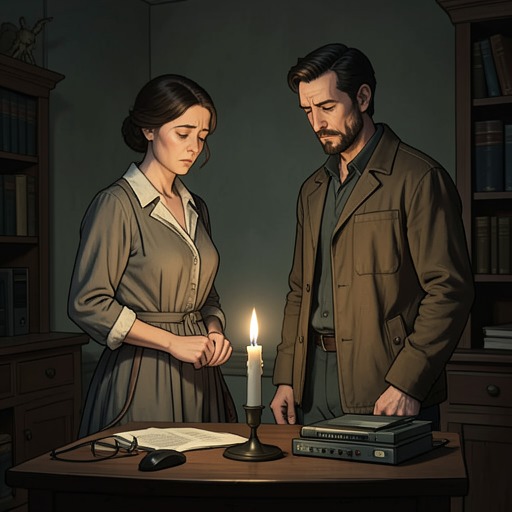
A promise whispered at dawn
Promise at DawnA promise whispered at dawn is the intimate pledge at the heart of Romain Gary’s memoir: his mother’s whispered vision of her son’s future greatness becomes a lasting source of purpose, courage, and emotional refuge. The promise gives a child a world in which love can answer injustice; the adult narrator’s return, years after her death, reveals both its power and its cost.
Origin in maternal love
The promise begins in a relationship shaped by sacrifice. His mother is alone and poor, yet fiercely determined to give her son the very best. Gary presents their shared world as a secret, private planet: a wonderland formed by a mother’s words and filled with anticipated triumph, justice, and love. The promise is not simply a forecast of personal success. It joins his imagined future to a moral task—to help restore the earth to people whose courage ennobles it and whose love makes it warm.
That ideal takes shape before the child can fully understand the enemies his mother names. In the memoir’s account, she points them out one by one, and he grows from fear and bewilderment toward a determination to challenge them for her sake. The promise thus gives private affection a public direction: the child’s imagined victories are bound to a world freed from the forces that threaten them.
The promise under the sign of war
On the day war is declared, his mother makes a five-hour taxi journey to see him, then a gunnery instructor at the Air Force Academy (Salon-de-Provence). She wishes him a hundred victories in the sky. The farewell brings the private promise into the setting of military service, where victory is no longer only a child’s dream but an immediate hope attached to danger and combat.
At first, Gary is conscious of his Air Force companions’ mockery and of the toughness he has laboriously assumed. His mother’s accusation that he is ashamed of her breaks through that pose. He puts an arm around her shoulders, holds her close, and makes an obscene gesture toward the soldiers. The gesture marks a change in allegiance: their shared world matters more to him than the watching men’s ridicule. Holding her, he looks toward the empty sky and imagines returning victorious, having given meaning to her self-denial and sacrifice by helping free the world from the enemies she had taught him to recognize.
The adult frame and its longing
The memoir opens from a later moment on the beach at Big Sur, where the forty-four-year-old narrator lies among sea birds and seals and still longs for universal tenderness. A seal, emerging from the water with a fish, appears as a devoted parent; the scene echoes the maternal care that has shaped his idea of love. The adult’s yearning does not simply repeat the boy’s confidence in future triumph. It shows that the need for tenderness survives the battles and achievements through which he once hoped to repay his mother.
The frame also gives the promise a retrospective tension. Even after the battle is over, the narrator says that he can still see the enemy legions watching for submission. The promised struggle has not been erased by victory. The sea’s solitude offers a place from which to tell the story, while the memories and old adversaries remain present within it.
Delayed knowledge and the failed homecoming
The promise’s language of love and justice stands beside a later, devastating discovery about Gary’s father. In 1958, while in Paris to receive the Prix Goncourt for The Roots of Heaven, Gary receives a letter concerning his father’s death. He had believed that his father died in a gas chamber during the war, together with his wife and two children, after being persecuted as a Jew. The correspondent instead reports that his father died of fright, apparently of a heart attack, only a few yards from the entrance. Gary sits with the letter, feeling nothing and finding his mind empty. The delayed revelation gives the memoir’s retrospective account of war a sharply personal instance of terror and loss; it does not undo the promise, but makes the world it addresses harder to reconcile with justice.
When Gary finally returns to the Hôtel-Pension Mermonts after liberation, no one is there to greet him. His mother has been dead for three years and six months, having died a few weeks after his departure for England. He then learns how she arranged for nearly two hundred and fifty undated letters, written in the last days of her life, to be sent to him at intervals through a friend in Switzerland. She had meant him not to know that her support had ended, because she believed he was still too weak to stand on his own and fight as a Frenchman should without her.
The letters had carried him onward to victory without his knowing that their author was gone. In the memoir’s final image of their bond, the symbolic umbilical cord continues to function across her death. The dawn promise therefore has no simple completion in a homecoming: it remains a source of strength, even as the son reaches home too late to share his victory with the mother for whom he imagined winning it.