Africa
Promise at DawnAfrica is not a single base in Romain Gary’s wartime narrative but a vast, changing theater reached by sea and crossed by air. It becomes the setting for his escape from France, his service with the airmen, a series of crashes and deaths, and the stubborn return to duty that gives the place its recurring force in the memoir.
Routes into Africa
After departing Bordeaux-Mérignac Airfield, Gary’s squadron received orders to proceed to Meknès, but at Salanque its pilots learned that aircraft had been forbidden to leave the ground. Believing that the new restrictions meant surrender, Gary and a sympathetic pilot set out for Algeria at dawn without waiting for further authorization. Their Potez lacked supplementary fuel tanks, making the crossing risky: its engines might fail before the African coast. Gary nevertheless felt protected by his mother’s love and imagined himself destined to return to her victorious; Warrant Officer Delavault, less reassured, brought two tires to use as lifebuoys if they had to ditch.
The sea crossing was one route among several. Gary later describes a fifteen-day voyage to Africa aboard the Arundel Castle, whose passengers included about a hundred English women volunteering in a drivers’ corps. A strict blackout was maintained throughout the passage. These journeys place Africa at the far end of an escape from a collapsing European war effort, but arrival did not mean safety or settled purpose: the continent opened into a scattered network of postings, airfields, and uncertain missions.
An air route across the continent
When crews outnumbered available aircraft, Gary applied to transfer to a Royal Air Force unit ferrying planes along the route from the Gold Coast through Nigeria, Chad, and Sudan to Egypt. Aircraft arrived in crates at Takoradi, were assembled there, and were flown across the continent toward the Libyan battlefields. The scale of the route made Africa an operational corridor as much as a destination: Gary made only one such ferry trip, and his Blenheim never reached Cairo, crashing in the bush south of Kumasi. The New Zealand pilot and navigator were killed; Gary survived and had to take part in burying them before rescue aircraft arrived.
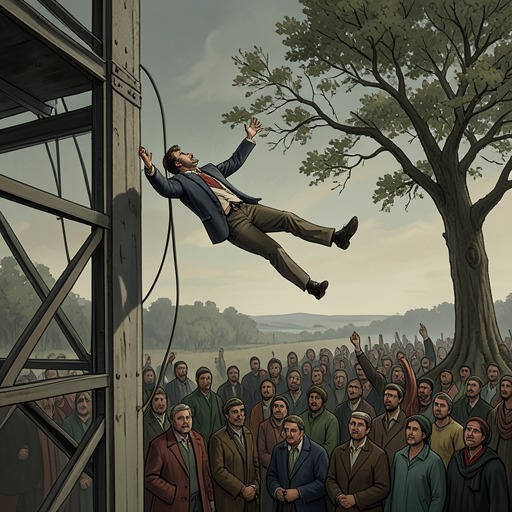
Other flights brought further reversals. At Kano, a sandstorm drove an aircraft into a tree and into a crash landing; Gary and the others emerged unhurt. The next day, in a different Blenheim, the aircraft overturned during takeoff and caught fire, but the crew again escaped without serious injury. The recurrence matters to the memoir’s image of Africa: a route intended to carry machines toward the front repeatedly became a place where aircraft and plans were thrown back to earth.
Postings, frustration, and danger
During his African tour, Gary was posted with three Blenheims to Bangui in French Equatorial Africa. Their assignment was to provide air cover for a territory where, as he wryly puts it, mosquitoes were the chief threat from the sky. Frustrated by routine flights and their distance from combat, the airmen dropped light exercise bombs on the Governor’s Residence as a protest, then arranged for local civilians to carry banners calling for the airmen to be sent to the front. The gestures did not bring punishment; they made visible the tension between the men’s desire to fight and the inactive work they had been given.
That frustration also found expression in dangerous flying. During a low pass over elephants, an aircraft struck one of the animals and crashed, killing the pilot and the elephant. Gary survived the wreck. The incident brought him fifteen days’ close arrest and made plain the human and animal costs of treating danger as an outlet for boredom. In another episode, the crashes were not the result of a stunt: during a sandstorm at Kano, aircraft collided during takeoff, killing six French airmen and nine English fliers. Gary was not flying that day; at the time, he was gravely ill in a military hospital in Damascus.
Survival and return to duty
The African postings repeatedly place Gary’s survival beside the deaths of others. After the crash south of Kumasi, he remained for thirty-eight hours before being found in the aircraft fuselage, unconscious but alive. Across the tour, he describes being thrown back to earth again and again, then rising and trying once more. His mother’s last letter, which spoke of his heroic deeds with complete confidence, was in his pocket when he sat beside a fallen aircraft. The letter turns a private bond into a counterweight to the repeated humiliations and dangers of military service.
Typhoid and internal hemorrhages in Damascus nearly ended his service while his comrades were dying in the Libyan collision. Five transfusions failed to stop the bleeding, and his recovery was prolonged: fever and delirium gave way to lasting facial paralysis, heart damage, and difficulty speaking. Yet when he could speak, he wanted to know when he and his mother could return to battle. The doctors believed the war was over for him, but three months later he was back in a Blenheim hunting submarines above the eastern Mediterranean. Africa thus remains more than a backdrop to military movement: it is where the memoir’s repeated contrast between bodily vulnerability and the will to resume action becomes especially stark.