Art as a defiance of absurdity
Promise at DawnArt as a defiance of absurdity is the narrator’s belief that a life can be shaped into something meaningful rather than accepted as proof of human insignificance. Art is not confined to literature or sculpture: it becomes a way to resist death, to pursue justice, and to imagine a form for experience that otherwise appears chaotic and wasted.
The artist’s task in the face of death
During a near-fatal illness in Damascus, the narrator understands survival as part of an unfinished work. His life, he insists, is not simply his own; it is an instrument of justice, bound to promises he has yet to keep. He imagines returning home with victories, writing War and Peace, becoming an ambassador of France, and making his mother’s talent manifest. These ambitions are not separate from the crisis: they are the shape he gives to a future that illness threatens to erase.
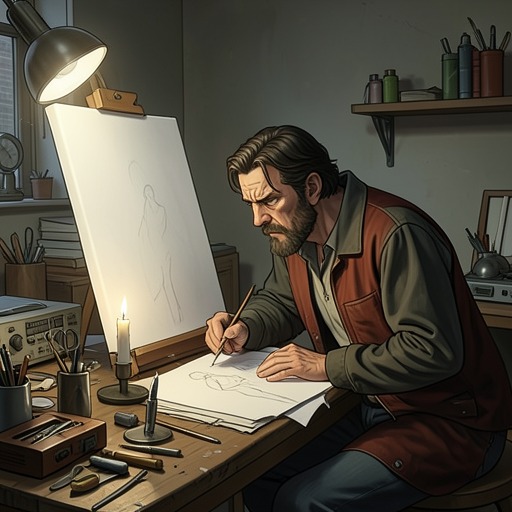
The refusal to accept death becomes an explicitly artistic resistance. A true artist, in his account, does not let the material defeat the inspiration; even life itself can be worked upon, its formless mass given shape, meaning, and expression. His refusal is therefore more than a wish to live. He rejects the conclusion that human existence is insignificant and absurd, as though death had handed him a document endorsing that verdict. To abandon his unfinished life would be to leave its meaning unmade.
That argument takes place against bodily suffering, not outside it. A week after receiving extreme unction, the narrator is still gravely ill: sores cover his body, serum needles remain in his veins for hours, his tongue is rotting, a bone fragment has pierced his gum, and fever and internal bleeding continue. Doctors also discover a tapeworm. The contrast between the language of artistic mastery and the body’s painful disorder makes the defiance costly rather than abstract. Art cannot spare him from physical vulnerability; it gives him a reason not to treat that vulnerability as the final meaning of his life.
Life imagined as a work of art
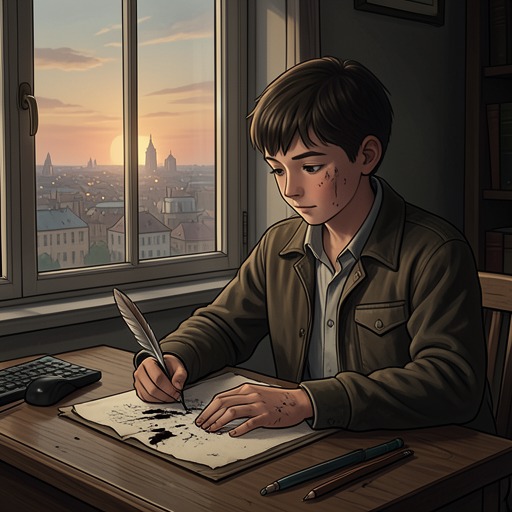
The artistic idea returns in the narrator’s recurring image of life as a block of marble awaiting a sculptor. Alone on an airfield, lying in the grass with his head on his parachute, he describes the frustration of wanting to transform life into a masterpiece while feeling his spirit batter against its limits. The image joins creative ambition to constraint: the material can be shaped, but it resists the artist, and the desire to impose form does not dissolve that resistance.
His comparison with the ocean sharpens the tension. He regards it as a brother that feigns infinity, though it too meets bounds and answers them with fury and roar. The sea is neither a simple emblem of limitless freedom nor a passive backdrop. Like the artist, it presses against limits; its apparent vastness contains its own frustration. The comparison complicates the hope of mastery: even a powerful act of creation takes place within boundaries.
The homecoming as a finished composition
On his return to Nice after liberation, the narrator gathers the details of his arrival into an image of accomplished meaning. He has the green and black ribbon of the Liberation, military decorations, a novel in French and English, press cuttings, and a letter intended to open the doors of the diplomatic career. His captain’s stripes and facial paralysis are visible signs of a life marked by service and injury; the Mediterranean Sea and the welcoming shore complete the scene. He presents himself not merely as a survivor returning home, but as someone who has made the experience legible—as though suffering, sacrifice, and love have all found their place in an intelligible design.
That triumphant composition answers the earlier fear of an absurd ending. The young man who refused to let his life remain formless now imagines that he has demonstrated the world to be honorable and given form and meaning to existence. The claim is an act of artistic defiance, not proof that pain or loss has disappeared. Its force lies in insisting that what has been endured can still count: the life that seemed on the verge of ending without shape can be narrated as a work directed toward justice, return, and a kept promise.