Avord Flight School Denies Him an Officer’s Commission
Promise at DawnThe denial of an officer’s commission at Avord airbase was both a conspicuous institutional rejection and a turning point in Romain Gary’s understanding of French identity. Although nearly three hundred trainees passed through the course, he alone received no commissioned rank; the decision exposed how an ostensibly neutral assessment could be used to exclude a recently naturalized man, and it changed how he understood the country he had long imagined as his own.
Circumstances and Eligibility
The stated obstacle was Gary’s birthplace and the recency of his naturalization. He had been born in Russia and had been naturalized only three years earlier. An eligibility rule barred a flying officer from the Air Force unless the candidate’s parents were French or the candidate had been naturalized for more than ten years. The rule was reportedly not normally enforced; it had already provoked parliamentary criticism as undemocratic, discriminatory, and racist, yet it could still be brought to bear against Gary. The institutional process had kept him waiting at Salon-de-Provence for six weeks while officials considered whether to admit him to the Air Force or direct him into the infantry. The Air Ministry agreed to take him, but the officers at the school opposed the decision. The rejection therefore did not simply reflect an initial refusal by the military as a whole: the Air Ministry’s acceptance was overridden at the point of training.
The Assessment and Its Use
The mechanism was the general aptitude mark, known informally among the trainees as the good-looks mark. Instructors used it as an all-round judgment of personality and suitability for officer rank. Academic performance could not protect a cadet from a low score: even the course’s top student could fail if the mark went against him. Since the score concerned character and fitness as well as study, it gave politically minded officers a way to make exclusion appear procedurally regular. Gary’s account identifies the groups vulnerable to that discretion: Jews, left-wingers, and other naturalized outsiders. In his description, the mark became a dependable weapon against them and was later perfected under the Vichy regime. The decision thus joined a particular insult to a broader institutional practice: the rules could be followed in form while being used to deny equal standing in substance.
The Public Rejection
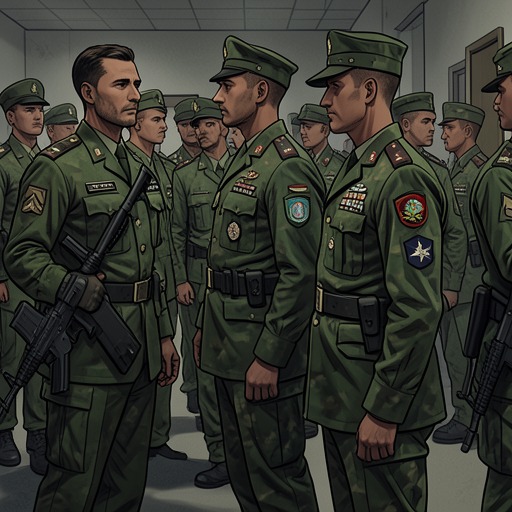
The outcome was stark. Of close on three hundred trainees, Gary was the sole cadet not to receive commissioned rank. He was not made a sergeant or even a corporal; contrary to custom and regulation, he barely passed as a lance corporal. The distinction between passing the course and being granted an officer’s place made the decision especially humiliating: he had cleared one threshold only to be held below the rank ordinarily expected of a successful trainee. For hours afterward, he struggled to maintain composure on parade among companions who were silent and appalled. He concentrated on appearing detached and untroubled, trying not to cry or break into sobs; he believed he even smiled. The outward performance concealed the force of the blow rather than diminishing it. The rejection remained physically vivid in later recollection, returning as cold sweat when he thought of the moment.
Aftermath and Change
An officer explained the nationality issue and the maneuver involving the aptitude mark, but offered sympathy awkwardly rather than as a direct consolation. Gary thanked him and lay silent. The explanation clarified why the decision had been made without making it easier to contest: because the school could claim to have applied its rules, there was no simple public objection that would undo the result. The rejection also altered Gary’s understanding of assimilation. He came to feel, unexpectedly, that the painful blow had made him truly French—not because it confirmed France as a nation above reproach, but because it showed him that French people could be foolish and unjust like anyone else. He ceased to imagine them as a separate, superior race and instead understood humanity as a shared condition. France appeared to him as a multitude of contrasting faces, from which he would have to choose those closest to the ideal his mother had taught him. He began, imperfectly, to take political sides and choose loyalties rather than allowing a flag alone to determine his allegiance. The decision was also difficult to carry home. Gary could not bring himself to tell his mother what had happened and spent a week’s leave dreading her reaction. On the journey toward Nice, he considered abandoning his plans, working passage on a cargo ship, or disappearing into the Foreign Legion. The thought of facing his mother’s bewilderment overwhelmed him; he was sick from Marseille to Cannes. Five years later, he encountered the officers who had rejected him. They were still captains, while he had become a decorated captain. He felt anger at the old injustice but no animosity toward them, and spoke with them about Avord as though their shared memories were harmless. In retrospect, the denial remained a wound, but it had also become part of the experience through which he defined both his French belonging and his political judgment.