Bangui
Promise at DawnBangui is a wartime station in French Equatorial Africa where the narrator’s military service is marked less by combat than by frustration, risky attempts to escape idleness, and a brief personal happiness. Its small-town streets, bungalow, and colonial club frame a posting that tests the airmen’s patience while bringing the narrator into a relationship that ends in separation.
A Wartime Posting in French Equatorial Africa
The narrator was posted to Bangui with three Bristol Blenheim bombers to provide air cover for the territory. In his account, the assignment offered little opportunity for the work the airmen expected: mosquitoes, rather than enemy aircraft, were the principal threat from the sky. The routine soon left the squadron exasperated, and its members looked for ways to express their frustration and make themselves noticed.
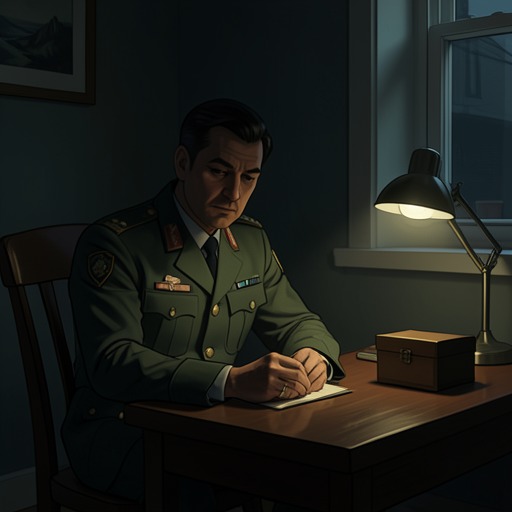
Bangui is described as a small town beside a broad equatorial landscape. The narrator lived alone in a small bungalow concealed among banana trees, while the colonial club stood high above the river, looking across forest toward the Belgian Congo. In the evenings he sat on its terrace listening to the only record left there, Remember Our Forgotten Men. The detail joins an isolated posting to the airmen’s sense that their service had become a waiting game.
Protest and Dangerous Diversions
The squadron’s discontent took the form of a direct but limited act of protest: its airmen dive-bombed the Governor’s Residence with light exercise bombs. The narrator presents the attack as a way to signal their mood to the authorities, and says they were not punished; such behavior, he adds, was apparently expected of them. They also arranged a street procession in which Bangui residents carried banners calling for the airmen to be sent to the front. The gesture turned the squadron’s private frustration into a public appeal, using the town’s civilians to deliver its message.
Boredom also fed more dangerous games. During one low pass over a herd of elephants, the narrator’s aircraft touched an animal and crashed. The elephant and the pilot were killed, while the narrator climbed out of the wreckage without a scratch. A Belgian game warden struck him with a rifle butt, condemning the treatment of life as a game. The narrator was sentenced to fifteen days’ close arrest; he spent the confinement clearing the garden at his bungalow. After a further period of boredom, Colonel Astier de Villatte secured his release, and the narrator rejoined the squadron as it moved to the Abyssinian front.
The Bungalow and Louison
Bangui was also the setting for the narrator’s relationship with Louison. He first saw her walking along the road beside his bungalow, carrying a basket of fruit. Louison was sixteen. The narrator went to her parents, and their union was celebrated according to the rites of her tribe; Prince Stahremberg, a pilot in the squadron, acted as his witness. Louison then came to live with him.
The narrator remembers this period as a rare experience of happiness, conveyed through watching and listening to Louison, who spoke no French. That happiness was interrupted when he noticed her cough and sent her to be examined by the squadron’s medical officer, Dr. Vignes. Although the cough was judged harmless, a mark on her arm led to a diagnosis of leprosy. Dr. Vignes told the narrator that they would have to part. The bungalow and its surroundings thus hold two sharply contrasting memories: the frustration of an idle military posting and a private joy that could not continue.
Significance in the Narrative
Bangui concentrates the contradiction between the narrator’s desire to serve at the front and the inactivity imposed by his assignment. The squadron’s protest, its reckless diversion, and the death resulting from the elephant incident show how enforced idleness could become destructive rather than merely tedious. The warden’s rebuke and the narrator’s arrest make the consequences concrete, while his eventual return to the squadron closes this stage of the posting.
The place also marks a more intimate turn in the wartime narrative. The colonial club and its solitary record express the isolation of the station; the bungalow becomes the setting for the narrator’s short-lived life with Louison. Their separation following her diagnosis gives Bangui a lasting association with both happiness and loss, rather than with military frustration alone.