Battle of France (1940)
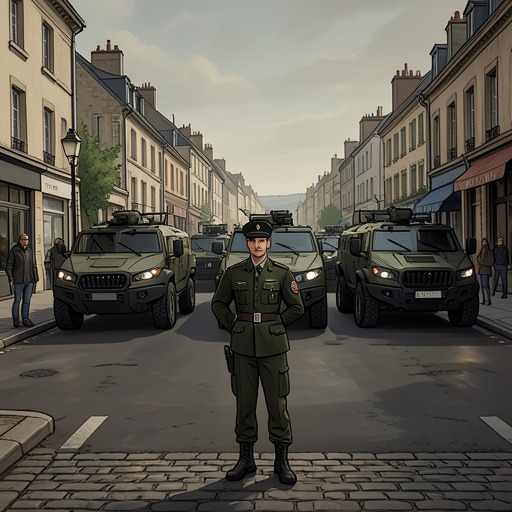
Promise at DawnThe Battle of France (1940) marks the rupture between the idealized homeland Romain Gary inherited from his mother and the military defeat that tested it. The memoir does not recount the campaign as a sequence of battles; instead, it presents the fall of France as a personal and political turning point. Gary’s childhood faith in France as the country for which Gary served and fought had been formed far from it, through stories and images. When defeat came, that faith did not simply disappear: it became the emotional ground from which he answered Charles de Gaulle’s appeal to continue fighting.
A Homeland Made from Stories
Gary recalls that his mother taught him to imagine France while they lived in the Lithuanian forest. Her stories gave the distant country the shape of a fairy tale: Joan of Arc, the taking of the Bastille, the fables of La Fontaine, and lead soldiers gathered on the nursery floor. Through her, French became his mother tongue in a cultural as well as linguistic sense. The country’s history reached him as an intimate inheritance, reflected in his mother’s delight and affection, rather than as a record of political setbacks and contradictions.
That imagined France helped shield him from doubt. Gary writes that even a prolonged residence there could not undo the vision formed in childhood. The contrast became especially clear in the years before the war. On the eve of the Munich crisis, while he was in sentimental exile on Björkö in the Stockholm archipelago, a letter from his mother declared her confidence in French victory. Looking back, he sees the certainty as a striking expression of how unprepared the country was for defeat. The letter preserved her faith; hindsight reveals the distance between that faith and the coming collapse.
Defeat and the Appeal to Continue
Before the fall, Gary says, he paid little attention to events in Europe. His mother’s patriotic assurances had formed what he describes as a Maginot Line of certainties around him. The silence of France as Adolf Hitler made threats seemed to him a sign of composure and strength, and he trusted the French Army and its leaders. He had not even learned of the French defeat of 1870 until he attended the lycée in Nice; his mother had not told him about it. His confidence was therefore not grounded in a full knowledge of national history, but in the selective, sustaining picture she had given him.
The defeat of 1940 brought that protected view into collision with events. Yet, in Gary’s recollection, the decisive response was not a repudiation of his mother’s France. After the fall, he heard Charles de Gaulle’s appeal of 18 June and rallied without hesitation. In the general’s call, he heard not only a political summons but also the voice of his mother, the woman who had sold hats at Number 16, Grand Pohulanka. The appeal joined public resistance to the private language through which he had learned to love his country. The ideal that reality had contradicted now supplied a reason to act against defeat.
Belonging Tested by Institutions
Gary’s account also sets patriotic attachment beside the question of who was officially permitted to belong. At the French Air Force flight school, he learned that his recent naturalization counted against his eligibility for a flying-officer commission. The restriction, as it was explained to him, applied to those who were not born French unless they had been naturalized for more than ten years; Gary had been naturalized for only three. Although the rule had been criticized in Parliament as discriminatory and was reportedly not usually enforced, it was being applied in his case. He answered that he was French, but the claim could not prevent the institutional rejection.
Gary presents the blow as producing an unexpected change in his own understanding. Rather than confirming an image of the French as a distinct or superior people, the exclusion helped him recognize that they could be foolish, ridiculous, and unjust like anyone else. France was made up of many different kinds of people, not a single idealized type. He came to understand belonging as a choice among competing values and allegiances: he would not let a flag decide what to think, but would judge the people who held it. This recognition complicates the patriotic faith formed in childhood without erasing it. His attachment survives, but it is no longer identical with unquestioning reverence.
Family Vulnerability and the War’s Longer Shadow
The memoir’s surrounding recollections place political conviction within a family life marked by illness and fear. After scarlet fever, Gary suffered an acute kidney inflammation, and doctors judged his condition desperate. His mother refused to allow the proposed operation to his right kidney, despite the advice of a specialist summoned from Berlin. Gary later connects her refusal to her hopes for his future, while recalling his own distress at the thought of leaving her unsupported. These memories reveal the personal obligations that accompanied the future she had imagined for him; they are not presented as consequences of the Battle of France.
His mother’s own vulnerability also became visible when she collapsed after an insulin injection that had caused hypoglycemia. The episode revealed to Gary that she had diabetes and had been treating it in secret while continuing her demanding daily work. His terror at the prospect of losing her intensified his sense that the future she expected of him mattered. The private bond that had helped construct his image of France was therefore also a source of responsibility and apprehension.
The fall of France did not end the war in Gary’s account. In 1941, while he was in Damascus, he contracted typhoid and nearly died; after a prolonged illness he recovered, although lasting health problems remained. The episode belongs to the later course of his wartime service, not to the 1940 campaign itself. Read beside the moment when he rallied to Charles de Gaulle, it shows how the appeal to continue fighting opened onto a longer, uncertain commitment. The Battle of France is thus remembered both as a national defeat and as the point at which a childhood inheritance became a decision to resist.