Cats
Promise at DawnCats in Romain Gary’s memoir are at once hungry animals, companions, and emblems of the fragile comfort that can interrupt loneliness. Their most consequential appearance is a mangy tom that finds the young Gary in a wooden shelter and licks his face, changing the mood of a desperate moment. Later recollections of beloved cats extend that brief encounter into a meditation on affection, memory, and the company that remains after loss; elsewhere, cat whiskers enter a boyhood recipe for making wishes come true.
The Tom in the Woodpile
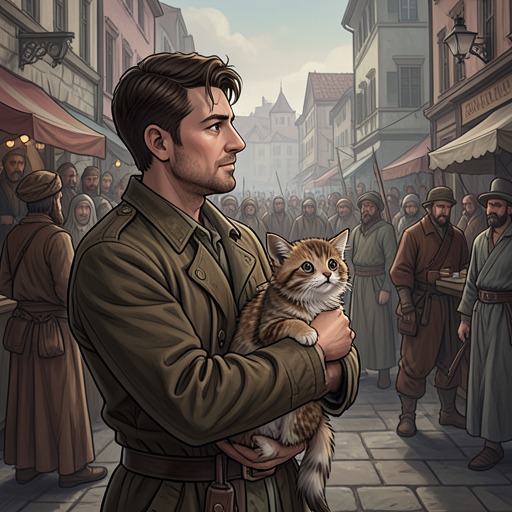
The central cat is a skinny, mangy, marmalade-colored tom with torn ears and an alert, knowing expression. Gary catches sight of its face between two logs. The animal studies him, then begins licking his face. The gesture is not presented as pure generosity: crumbs of stolen poppy-seed cake remain on Gary’s cheeks and chin, and he understands that the cat has found a possible meal. Its attentions are self-interested, but that knowledge does not spoil them. The warmth and roughness of the cat’s tongue make Gary smile, and he closes his eyes and accepts the moment.
The scene turns on a distinction between the cause of affection and its felt effect. Gary does not need to believe that the tom has acted from disinterested kindness in order to receive comfort from it. What matters in the telling is the friendly muzzle and the warmth of the animal’s persistent attention. The encounter offers companionship without requiring either participant to conceal hunger or need: the cat licks the crumbs from Gary’s face, while Gary takes pleasure in being touched.
When the licking ends, Gary feels better and again sees the world as full of possibilities and friendships. The tom rubs against his face and purrs; Gary imitates it, and the two compete to make the louder sound. He scrapes the last cake crumbs from his pocket and offers them to the animal. The tom accepts, leans against his face with its tail held straight, and nibbles his ear. The sequence is comic in its barter and tenderness, but its consequence is plain: Gary climbs out of the wooden shelter and walks toward the house whistling, with the cat following at his heels.
Affection, Appetite, and Memory
Gary later reflects that a few crumbs of cake are useful if one wants to be loved in a truly disinterested way. The joke preserves the ambiguity of the encounter rather than resolving it. The tom’s appetite is visible, yet its company still matters; the humor arises from the gap between an ideal of unconditional affection and the small, material bargain that makes this particular tenderness possible. For Gary, need does not cancel affection, and affection does not have to be pure to offer relief.
The tom also belongs to a longer recollection of animals that have shown Gary devotion. In a later passage, he remembers his cat Mortimer, buried in a Chelsea garden, and his cats Nicholas, Humphrey, and Gaucho, all of whom have long since left him. He recalls them alongside Gaston, his mongrel dog. The list makes companionship cumulative: the remembered animals are individually named, but their absence gathers into a continuing sense of loss. When an old craving for friendship and company returns, Gary touches the tip of his nose and feels that he is not entirely alone. His nose had been reconstructed in a Royal Air Force hospital after a flying accident; in the passage, the surviving body becomes a means of feeling accompanied by memories of those who are gone.
Cats in Childhood Imagination
Cats also enter Gary’s account of childhood through an attempted magical recipe. A younger boy known as Melon tells him that his wishes will be granted if he assembles a bottle containing, among other ingredients, a cat’s whiskers, rats’ tails, live ants and flies, and bat’s ears. Gary searches for the required materials. Flies are plentiful, and he says that dead rats and cats are never lacking in the yard; the most difficult ingredient proves to be living ants, which escape as he tries to collect them.
The episode places cats in a different register from the comforting tom. Here the animal is not a companion but one item in a child’s list of difficult, bodily ingredients for a talisman. The contrast is not explained away: cats can be present in the practical, sometimes gruesome surroundings of childhood and also become objects of tenderness and remembrance. Across these recollections, their significance lies less in any single symbolic meaning than in the changing relations Gary describes—an animal that offers comfort while seeking crumbs, remembered pets whose absence still shapes his sense of company, and a whisker imagined as part of the machinery of a wish.