Cross of the Liberation
Promise at DawnThe Cross of the Liberation is a wartime decoration awarded to Romain Gary and later pinned to his tunic by Charles de Gaulle beneath the Arc de Triomphe. In Promise at Dawn, its green-and-black ribbon marks public recognition, but its most intimate significance lies in the return it seemed to promise: Gary expected to bring the honor home to his mother, who had taught him what his country meant, only to discover that she had died years earlier.
Award and Distinction
Gary learned of the award by telegram at Hartford Bridge, where he had returned after an air sortie. The telegram bore Charles de Gaulle’s signature and announced that the Cross had been awarded to him. The news followed a BBC interview about the sortie and an article in the Evening Standard, but Gary describes the decoration itself as belonging to a far smaller circle than the publicity surrounding his flight might suggest.
He recalls the ribbon as green and black and emphasizes how few among the living had received it. He was unsure whether the total number of recipients, living or dead, exceeded six hundred. Its scarcity gave the honor a collective weight: Gary associated it not simply with his own efforts but with the dead comrades whose service and memory, he believed, the ribbon preserved.
Presentation and Public Meaning
Some months after the telegram, Charles de Gaulle pinned the Cross to Gary’s tunic beneath the Arc de Triomphe. Gary presents that ceremony as closing the episode at Avord, a difficult earlier chapter in his military career. The decoration thus represents more than a new distinction: its formal presentation resolves, in his telling, an old grievance about recognition and status.
Gary resists treating the award as proof of personal greatness. He says he could find little in his own efforts to warrant such an honor and measures them instead against what his mother had expected of him and taught him about France. His account redirects the decoration’s prestige away from individual self-congratulation and toward the ideals and familial expectations that had shaped his service.
The Ribbon on the Journey Home
After receiving the news, Gary sent a telegram to Switzerland so that his mother would hear of the award. He also arranged for a cautiously worded letter to be forwarded to Nice. He hoped to return with two forms of achievement she had long imagined for him: artistic recognition through his book and the Cross, the greatest French military honor he believed he could present to her.
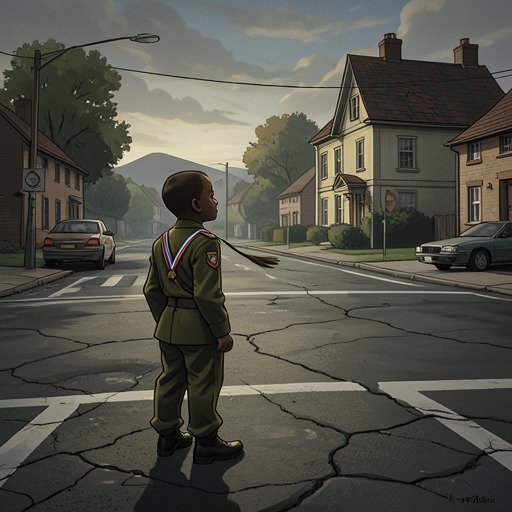
On his journey home, he wore the green-and-black ribbon prominently on his chest, above the Legion of Honor and other decorations, with his captain’s stripes on his uniform. He carried editions of his novel and press cuttings as well. The Cross therefore appeared within a carefully assembled image of arrival: military service, literary accomplishment, and the expectation that his mother would see the son she had urged him to become.
Meaning Altered by Loss
At the Hôtel-Pension Mermonts, no one was waiting to greet Gary. He learned that his mother had died three years and six months earlier, a few weeks after his departure for England. Her absence changed the meaning of the return and of the honor he had wanted to show her. The Cross could attest to his achievement, but it could not deliver the recognition to the person for whom he had most wanted it.
Gary’s mother had arranged for nearly two hundred and fifty undated letters to be sent to him at intervals after her death, concealing her absence while he continued the war. In retrospect, he understood that he had carried on receiving the strength he needed from her messages. The Cross belongs to that same story of belated arrival: its public recognition came, but the hoped-for reunion did not. In the memoir, the ribbon consequently signifies both a national honor and the painful distance between fulfilling a mother’s expectations and being able to share that fulfillment with her.