Exile and refugee status
Promise at DawnExile and refugee status are not a single passage in Romain Gary’s childhood but the circumstances that organize it: a westward journey from Russia, an unsettled life in Vilna, and the hope of reaching France as a permanent home. His mother gives displacement a destination and a story, but the child’s experience includes cold, illness, insecure shelter, and suspicion of refugees. The contrast between her imagined France and the precarious life they actually lead becomes one of the memoir’s defining tensions.
A Childhood in Transit
The westward movement begins in a life already marked by temporary residence. The family is stranded in Vilna, described as Polish at the time of the recollection, formerly Lithuanian, and then Russian. His mother insists that this is only a halt on the way to France, where her son is meant to grow up, study, and become somebody. The destination is therefore more than a place on a route: in her account, it is the answer to the uncertainty of their present.
The journey itself is slow and difficult. The family travels west in a cattle-and-goods train for three weeks, with typhus accompanying the refugees. At Lida, on the Polish frontier, they are kept in quarantine. Romain remembers the practical and bodily details of the passage: his mother rubbing his numbed fingers, the camphor beads she has him wear against lice, and his insistence on keeping hold of a chamber pot. These memories place the migration not in the abstract language of borders but in the intimate routines by which a child tries to preserve familiarity while adults move him through an uncertain world.
Before the journey, the family’s attachment to Russia is already complicated by movement and loss. His mother was born in the Russian steppe, and the narrator recalls being carried between theatrical environments and temporary homes before the westward trek. In Vilna, he is still a child whose future is described for him by his mother; he does not control the route, the household’s prospects, or the meaning of the places they pass through. Refugee status is thus both a public condition and a family reality, shaped by dependence on his mother’s decisions and endurance.
Vilna: Temporary Home and Precarious Livelihood
In Vilna, his mother tries to keep the family afloat by designing women’s hats in their flat. She advertises the venture as a Paris fashion house and uses false labels presenting the hats as the work of Paul Poiret. The scheme reflects the combination of invention and necessity that governs their life: France is the imagined center of fashion and promise, while survival depends on selling hats in a cold town where the family has little security.
The business brings no dependable relief. Their last family jewels have been sold, the hats sell badly, and the building owner threatens to put them out if the rent is not paid within a day. Yet the rent is somehow met, the stove is lit, and food is set before Romain. His mother returns from her rounds exhausted and cold, but her pride in him remains undiminished. The episode shows displacement as a condition in which ordinary shelter and meals cannot be taken for granted, even as his mother works to make their temporary home feel protected.
Their foreignness also makes them vulnerable to suspicion. Neighbors report his mother’s comings and goings to the Polish police, who suspect Russian refugees, and she is accused of receiving stolen goods. The accusation is cleared, but the episode leaves shame and distress in its wake. Her response is forceful and public; the narrator remembers the confrontation as painful. Refugee status here is not only a matter of having left one country for another. It also determines how a family may be watched and judged in the place where it has stopped.
France as Promised Refuge
His mother’s answer to the instability around them is to make France vivid before they arrive. In the flat in Vilna, beside the stove and the hats bearing forged Paris labels, she speaks of France as a land of marvels. Earlier, during the journey, she has described a place where people are free and equal, artists are welcomed, and dreams come true. She fills the child’s imagination with French history, celebrated figures, grand public places, and abundance. These descriptions give the journey a purpose, but they also make the destination difficult for reality to match.
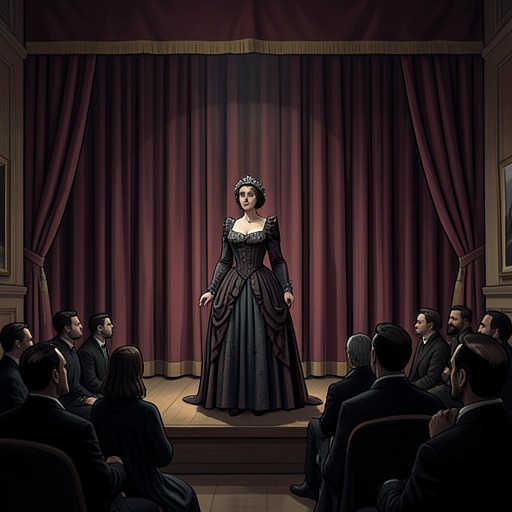
The force of the promise comes partly from his mother’s own performance and artistic past. Romain remembers her work in the Russian theatre and the stage name Nina Borisovskaia written on her dressing-room door. Ivan Mosjoukine later suggests that circumstances prevented her talent from developing and that, after Romain’s birth, he mattered more to her than anything else. The child’s future in France is accordingly bound up with his mother’s hopes for herself as well as her hopes for him: the journey carries a family’s ambition, not just a change of address.
When they eventually reach Nice, the promised land does not simply become the reality his mother had described. Fifteen years after the journey, the narrator recalls that she still saw the country through the vision she had carried with her, while he gradually confronted the distance between the fairy tale and lived experience. His account does not dismiss that vision as useless. He presents it as a force that shaped his own effort to make the imagined France real, even though no actual country could fully contain the ideal his mother had created.
From Displacement to Ongoing Dependence
Arrival in Nice marks the end of the westward trek, but not an uncomplicated end to insecurity. His mother works intensively in the family business and conceals her diabetes from him; he learns of it only after she collapses from an insulin-related episode. The revelation renews his fear that she might die before he has fulfilled what she expects of him. The scene belongs to a later, more settled phase of their life, yet it echoes the earlier pattern: his mother protects him while carrying burdens he does not fully see, and his sense of security remains bound to her survival.
The memoir also places that childhood dependence beside the bodily precarity of Romain’s later life in wartime service. In Damascus he contracts typhoid and is gravely ill; after a slow recovery, lasting effects remain, including paralysis on the lower left side of his face. When he can speak again, he asks when he and his comrades can return to battle, and, despite the doctors’ doubts, he is back flying with his unit three months later. These episodes do not make him a refugee again, but they show how movement, danger, and dependence on others continue beyond the original migration. The child carried west by his mother becomes an adult whose survival also depends on care and whose return to action is uncertain.
Narrative Meaning
The account preserves the difference between reaching a destination and finding secure belonging. France becomes the family’s intended home and, in the narrator’s memory, his mother’s most enduring creation: a place made of stories, history, and promises before it is encountered as ordinary life. The memoir’s movement from the train and quarantine to Vilna and then Nice lets the reader see both what the ideal gave the family and what it could not remove—poverty, suspicion, illness, and the vulnerability of relying on a single determined parent.
That tension also explains why the narrator treats his mother’s vision as more than an inaccurate description of a country. Her imagined refuge gives direction to a childhood otherwise defined by temporary stops and uncertain prospects. Once in France, he cannot simply inhabit her fairy tale; he must reckon with the gap between ideal and reality. His account of exile therefore ends not with a claim that displacement has been erased, but with a lasting task: to work toward the country his mother had taught him to expect.