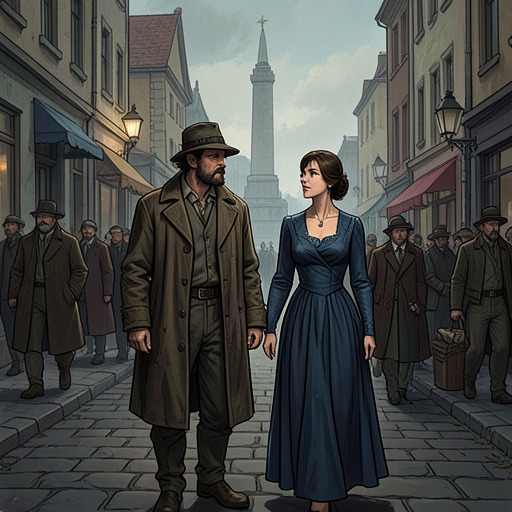
France in the Mother’s Imagination
Promise at DawnFrance in the Mother’s Imagination is the idealized country that Romain Gary’s mother fashioned for her son through stories, symbols, and fierce confidence in his destiny. It is at once a private fairy tale and a public ideal: a land of beauty and justice whose hold on Romain Gary helps explain why he rallies to France in defeat, and why he later recognizes that the real country is neither perfect nor exempt from injustice.
A country made from stories
The vision begins in childhood, far from France, in the depths of a Lithuanian forest. His mother’s descriptions turn the country into something a child can encounter through her face, voice, and affection. In the silence of a snowy evening, France reaches him as if it belonged beside nursery tales such as Puss in Boots and Red Riding Hood. The setting matters: the country is not first known through political institutions or personal experience, but received through an intimate act of telling.
The stories give the imagined country a history that the child can play. With lead soldiers, he commands an army; with a wooden sword, he takes the Bastille and attacks weeds as though liberating the world. The words and images of French culture accompany this play: the pyramids become witnesses to history, and La Fontaine’s fables help him learn to read. French becomes, in feeling, his mother tongue. These are not simply lessons about a foreign country. Together, they make France part of the emotional world his mother has built around him.
Romain Gary later recognizes that this education shaped his own Francophilia before he could choose it. His mother’s smile and loving whisper joined the idea of France to the experience of being loved. Even prolonged residence in the country could not simply undo that childhood inheritance. When the imagined France eventually collided with the tumultuous reality of the country, the collision came too late to free him from the fairy tale: the ideal remained part of how he understood both France and himself.
Patriotism as shelter and inheritance
His mother’s patriotic certainty also functions as protection against fear. In difficult periods, she invokes revered French military leaders to reassure him, including during financial anxiety and episodes connected with her insulin reactions. Romain Gary describes the confidence she built around him as a Maginot Line of patriotic images and certainties. It lets him believe in the French Army and its leaders, and in the country’s calm strength even when Hitler’s threats intensify.
That shelter narrows his view of history as well as steadying him. He says he learned only at the Nice lycée about France’s defeat by Germany in 1870, a defeat his mother had not mentioned. Before his first encounter with the enemy, he had paid little attention to events in Europe; he connects this distance, in part, to being surrounded by a woman’s love and to his difficulty sustaining hatred. The country his mother presented seemed secure enough that France’s silence under threat appeared to him a sign of strength, not a reason for alarm.
When France fell, the inherited vision became a call to act. On hearing Charles de Gaulle’s appeal on 18 June 1940, Romain Gary rallied not only to the General’s words but also to the remembered voice of his mother, who had sold hats at 16 Grand Pohulanka. The parallel is revealing: for him, the national appeal and the maternal voice are not competing authorities. The country he is prepared to defend has already been made intimate through her way of speaking about it.
Defeat, resistance, and the public fairy tale
His mother’s resistance began before Charles de Gaulle’s broadcast. On 15 or 16 June, at the Buffa Market, she stood on a chair among the vegetables, brandished her cane, and called on those present to reject the armistice and continue the war from England and North Africa. Romain Gary did not witness the scene himself; he later heard it described by about twenty people. In his account, she presented her son as a famous writer and diplomat already striking mortal blows against the enemy, then showed the crowd a newspaper page containing one of his short stories.
Her performance makes the private ideal public, and exposes the distance between her story of her son and his actual circumstances. She speaks from a vision in which France must continue fighting and her son already embodies its greatness. Romain Gary feels shame at the thought that people may have laughed, but directs his self-reproach toward what he sees as his own lack of talent and stature. The episode is comic in its grandiosity, yet it also shows how completely her imagined France and imagined son have become bound together.
At Meknès, while he wanders through the Medina trying to escape his distress, her call remains present to him. He remembers her urging resistance with a force that seems to take over where his own resolve is weak. He describes her traits—dramatic intensity, aggression, and a refusal of moderation—as coming to prevail in him, and connects them with the reputation for hotheadedness he later acquires among comrades and superiors. The mother’s idea of France is therefore not only a belief he recalls; it becomes a pressure that changes how he acts.
Exclusion and a revised French identity
The ideal meets a sharper test when Romain Gary is denied the officer status he seeks at Avord. He is told that he has been failed because he was born in Russia and his naturalization is too recent. The rule described to him restricts eligibility to those born French or naturalized for more than ten years, although it had been criticized in Parliament as discriminatory and was said not to be applied. His personal attachment to France now confronts an institution that treats his belonging as conditional.
The painful rejection changes what being French means to him. He says that it makes him feel truly French, not because it confirms the country’s perfection, but because it reveals that the French can be foolish, ridiculous, and unjust like anyone else. France is made up of many faces, beautiful and ugly, noble and repellent; he must choose which of them most resembles the France his mother described. Instead of allowing a flag to decide his loyalties, he resolves to look at the people who hold it. The ideal is not discarded, but becomes a standard against which actual conduct can be judged.
On the journey home, he cannot bring himself to tell his mother the truth about the outcome at Avord. He considers leaving rather than facing her disappointment, then decides that the image of France as a land of beauty and justice must be protected from a blow she could not bear. When he reaches Hôtel-Pension Mermonts, he sees that she has raised a tricolor for the homecoming of a son she believes has become a second lieutenant. He chooses a plausible lie that will preserve her confidence. The scene shows the burden of the fairy tale as well as its tenderness: he has begun to understand France more realistically, but still acts to shield his mother’s version of it.
An ideal sustained by correspondence and memory
The vision continues to shape Romain Gary after he leaves. His mother’s letters, sent secretly through Switzerland and forwarded to London, sustain him during his wartime absence. In them she imagines him performing extraordinary deeds in the air over German cities and credits him with victories by British fighters. He understands how she constructs this heroic account: whenever the Royal Air Force attacks, she sees him in the action. Her certainty that he can fulfill miraculous ambitions continues to drive his own efforts in literature and life, and keeps his belief in beauty and justice alive against growing cynicism.
The ideal also clarifies the difference between his mother’s willingness to risk everything and the caution of people who did not share her attachment to France. Romain Gary acknowledges that those who saw the country more calmly had no obligation to defend a nursery tale lodged in an old woman’s heart. For him, however, the tale had become a reason to resist, not because it described France accurately, but because it embodied a vision of what France ought to be. In this account, maternal imagination is both a source of political commitment and a way of measuring the cost of resignation.
Years later, his mother’s wish remains unchanged: there is nothing more beautiful than France, and she wants her son to be a free Frenchman. His reply that he already is one does not settle the matter for her. The exchange leaves a distinction between legal or stated identity and the freedom she imagines for him. Across childhood stories, wartime appeals, exclusion at Avord, and letters written in his absence, France in the Mother’s Imagination persists as a country he inherits, questions, and tries to defend without pretending that its real people are flawless.