Free France movement
Promise at DawnThe Free France movement is presented through the authority of Charles de Gaulle and the narrator’s decision to rally to his call after France’s defeat. In the memoir, it is at once a wartime commitment and the political embodiment of a France the narrator had learned to love through his mother’s stories—a national ideal that would collide with the realities of military service and citizenship.
Leadership and Wartime Presence
The movement enters the narrator’s account most distinctly through Charles de Gaulle. When the narrator heard his call to arms on 18 June 1940, he recognized in it not only the General’s words but also the voice of his mother, who had sold hats at Number 16, Grand Pohulanka. Their likeness was not physical: the narrator describes them as otherwise profoundly different. What connected them was the tone in which each spoke of France. He says he rallied without hesitation, making his response both a wartime choice and the culmination of a childhood shaped by his mother’s devotion to the country.
By 1941, the narrator was serving in a squadron stationed at Bangui, in Oubangui-Chari, and in charge of three Blenheims when Charles de Gaulle came to inspect the unit. The squadron prepared a revue to honor the leader of Free France. Its young performers intended the light, comic show to project morale and optimism during a period of military disasters. The account establishes the movement’s presence not through an organizational description but through this encounter between its leader and serving airmen who sought to honor him.
A Leader’s Effect on an Audience
The revue succeeded at its tryout, but the performance attended by Charles de Gaulle was a failure. In white tropical uniform, he sat rigidly in the front row, arms crossed and képi on his knees, showing almost no visible reaction. The narrator recalls one possible flicker of his mustache during a can-can, but immediately allows that he may have imagined it. The uncertainty matters: the General’s effect is conveyed less by an overt response than by the performers’ awareness of his concentrated attention.
The larger audience also fell silent. Around two hundred spectators who had laughed and applauded at the rehearsal gave the revue no smile during the General’s visit, although most could not see his face. The narrator takes their shared response as evidence that Charles de Gaulle could communicate feeling to a crowd without an obvious gesture. Years later, watching a rehearsal of Louis Jouvet’s Don Juan, he remembered the Bangui performance when the statue of the Commander appeared. The recollection preserves the episode as an encounter with the leader’s authority, but also as a comic humiliation: the narrator swore he would never again act, dance, or sing before him.
The France Behind the Movement
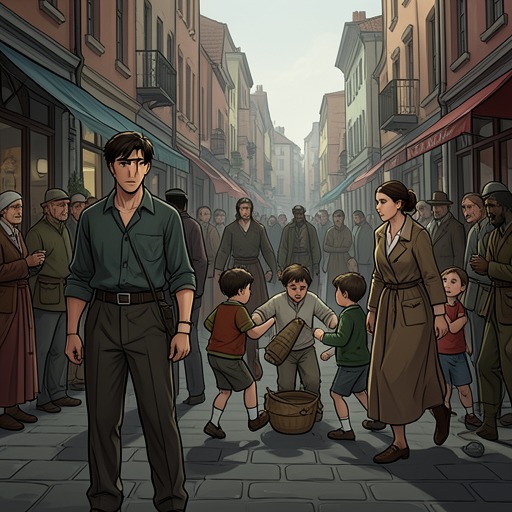
The narrator’s readiness to rally to the movement grew from a childhood national imagination. His mother presented France through legends, literary and historical references, and scenes of play: the child learned French through La Fontaine’s fables, imagined taking the Bastille with a wooden sword, and heard France described as though it belonged to a fairy tale. The narrator says that this upbringing made his Francophilia feel unavoidable. The ideal was emotionally powerful precisely because it was inherited through his mother’s love, not acquired through a detached assessment of political events.
That imagined France was not the same as the country’s changing reality. The narrator acknowledges that his theoretical vision eventually collided with France’s contradictions, but says the fairy tale had already taken hold. Before the war, his mother’s patriotic certainties had also left him unprepared to understand the danger posed by Hitler and the Nazis: he trusted the French Army and its leaders, and even learned of France’s defeat in 1870 only at the Nice lycée. The later call from Charles de Gaulle could therefore revive the emotional France of his childhood even as events exposed the distance between that ideal and political reality.
Belonging and Its Limits
The narrator’s wartime attachment to France did not protect him from exclusion within its institutions. After he was rejected for advancement as a flying officer, he was told that his Russian birth and recent naturalization counted against him. The stated eligibility rule required an applicant’s parents to be French or the applicant to have been naturalized for more than ten years, though the speaker said that the rule was not consistently applied and had again been raised. This episode concerns military eligibility, not a stated policy of the Free France movement; it nevertheless reveals the gap between the France for which the narrator fought and the legal tests by which his Frenchness could be questioned.
The rejection changed his understanding of national identity. He came to see the French not as a separate or superior people but as people capable, like anyone else, of folly and injustice. France, in his account, comprised many different kinds of people, and belonging required choosing among its competing faces rather than being carried along by a flag. Set beside his immediate rallying to Charles de Gaulle, this later recognition gives the movement’s place in the memoir a double meaning: it represents a France he was willing to defend, while the narrator’s experience insists that patriotic attachment and institutional acceptance are not the same thing.