French Air Force officer’s uniform
Promise at DawnThe French Air Force officer’s uniform is at once a garment, a family promise, and a contested sign of belonging. For Romain Gary’s mother, it embodies her son’s future service to France, the country for which Gary served and fought, and the public recognition she believes he deserves. As Gary approaches military training, the imagined uniform becomes increasingly concrete: it is pictured before hotel guests, paid for with borrowed money, and prepared for a graduation parade. But the officer’s status it represents is denied to him on grounds of nationality. The uniform thus gathers together maternal hope, patriotic idealism, social display, and the painful difference between feeling French and being accepted as French.
A uniform imagined as destiny
From childhood, Gary’s mother presents an exalted image of France, and the uniform belongs to the future she has written for him within that image. She repeatedly predicts that he will become an ambassador; when he later imagines a French officer’s uniform, it offers another way to fulfil her ambition, even if he never becomes an ambassador or wins the Nobel Prize for literature. Military service is not an incidental career choice in this family picture. It is a visible proof that the son raised on his mother’s stories of France has a place in the country she taught him to admire.
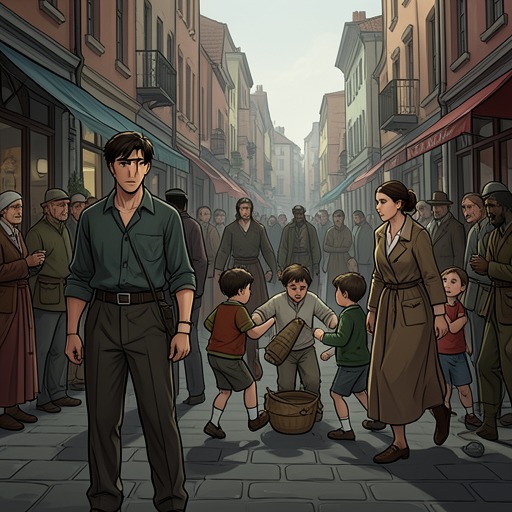
The imagined scene is deliberately ordinary as well as grand. Gary pictures himself dressed in blue and gold, covered with wings, and walking through the Buffa Market, Nice, with his mother on his arm. The audience would be the traders and even the vegetables; the triumphal arch would be made of sausages and onions. This comic display gives the uniform its intimate purpose: it would let mother and son appear together before the people who know their precarious circumstances, with her dream made visible on his body.
Public defiance and maternal anticipation
The uniform also supplies Gary’s mother with an answer to insult. When an exasperated tradesman calls her a foreigner, she summons the market as witness and declares that her son is an officer of the French Air Force. Her response treats the future as though it were already accomplished. Gary observes that she draws no distinction between what he is and what he will be; under the force of her certainty, the gold stripe of a second lieutenant briefly matters more to him than his former dreams of literary laurels. What he wants is no longer an abstract triumph but the modest, shared outing in uniform that would vindicate her before the market.
As Gary prepares to enter military service, that future seems close enough for his mother to show guests an illustrated magazine picture of a military parade and point out the handsome uniform that would soon be his. She is using three packets of Gauloises a day, repeatedly stubbing out cigarettes and lighting fresh ones, and injecting insulin twice daily, yet continues to supervise the hotel and try to accommodate its visitors. She refuses to let Gary help with restaurant work or carry breakfast trays because she considers such tasks incompatible with his imminent standing as an officer. When new guests arrive, she carries their suitcases herself and pushes him aside. Her cheerful, grateful look expresses how near she believes victory to be: the long-awaited return to the Hôtel-Pension Mermonts in uniform.
From picture to prepared outfit
Gary is inducted at Salon-de-Provence, where he joins the special train carrying conscripts. Among the relatives and friends at the station, his mother alone has brought a tricolor flag; she waves it continuously and shouts her support, drawing hostile looks and mocking remarks. The episode makes the uniform’s promise public before Gary has earned the rank associated with it. His mother’s conspicuous patriotism stands against the other recruits’ lack of enthusiasm, and one young man objects that she is not French. The uniform is already being asked to settle a question that the surrounding crowd insists on raising.
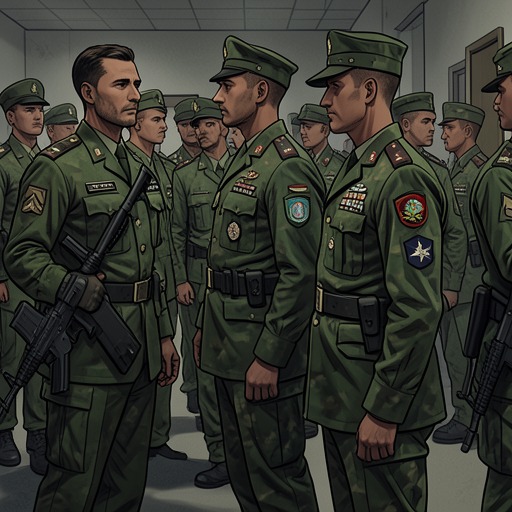
By the approaching graduation parade, the outfit itself is no longer merely an image. A military tailor has visited the barrack rooms, and the uniforms are ready. Gary’s mother has sent five hundred francs for his clothing, borrowed from Pantaleoni, an old friend from the Buffa Market, Nice. Gary frets over the cap: its long visor seems rakish, while the short one suits him better. After many unsuccessful attempts, he manages a small moustache then considered fashionable among fliers. With gold wings on his chest, he thinks he looks tough enough for the little boy beneath the uniform to pass unnoticed. The details reveal how carefully he tries to inhabit the role: the purchased clothing, the visor, the moustache, and the wings are all parts of a public identity he is still learning to wear.
At the graduation parade, cadets are to learn their ranks and choose postings according to their marks. The available stations are listed on a blackboard, including Paris, Marrakech, Meknès, Maison-Blanche, and Biskra. Gary hopes for a posting in the south of France so that he can visit Nice and appear with his mother at the market or on the Promenade des Anglais. The uniform’s imagined destination remains domestic and relational: before it signifies an independent military career, it promises a return to his mother’s side.
The limit imposed on belonging
The officer’s uniform cannot by itself confer the status it represents. Gary learns that he has been failed because he was born in Russia and his naturalization is too recent. The rule cited to him bars someone from becoming a flying officer unless the person’s parents were French or the person has been naturalized for more than ten years. Although the restriction had been criticized in Parliament as undemocratic, discriminatory, and racist, it is being applied again. Gary’s protest that he is French meets a bitter rebuke from the man explaining the decision. The obstacle is not a failure of affection for France or of effort at training; it is an institutional test of origin and time that overrules his self-understanding.
The rejection changes the meaning of the uniform rather than erasing it. Gary later says that the blow unexpectedly made him feel truly French, as though the painful impact had finally assimilated him. He recognizes that French people are not a separate or superior race and that they, like anyone else, can be foolish, ridiculous, or unjust. France is made of radically different faces, and he must choose which ones resemble the country his mother taught him to love. The uniform’s promise therefore becomes more complicated: it had seemed to offer a clear passage from devotion to recognition, but its denial exposes the gap between a national ideal and the rules used to police membership.
Narrative significance
The garment’s recurring force comes from the way private longing and public symbols meet in it. In the mother’s imagined parade through the market, a uniform turns hardship into a scene of shared pride. In the actual preparation for military service, borrowed money and small decisions about a cap make that hope material. At the point of exclusion, the same promise is measured against a nationality rule. The uniform never means only military advancement: it carries a son’s wish to please his mother, her refusal to treat his future as uncertain, and his own developing understanding that French identity cannot be guaranteed by patriotic feeling alone.
That tension echoes the stories through which Gary’s mother had made France a kind of fairy tale in the Lithuanian forest. Her faith gives him an enduring attachment to the country, but her certainty cannot prevent its institutions from rejecting him. The officer’s uniform is powerful precisely because it remains caught between those forces: a lovingly anticipated sign of acceptance, a real outfit prepared for service, and an emblem whose promise is tested—and altered—by exclusion.