French Equatorial Africa
Promise at DawnFrench Equatorial Africa, and especially Bangui, is where Romain Gary’s wartime service meets the frustrations of a remote posting and a brief, intensely remembered happiness. Assigned to provide air cover in a sector where mosquitoes were described as the principal danger from the sky, he encountered not steady combat but boredom, reckless diversion, and a personal life abruptly altered by illness.
Wartime Posting and Isolation
Gary was posted to Bangui with three Blenheim bombers to provide air cover for French Equatorial Africa. The assignment left the airmen far from the fighting they wanted to join. Their exasperation rose until, in a gesture meant to register their discontent, they dive-bombed the Governor’s Residence with light exercise bombs. They were not punished; Gary presents the authorities’ tolerance as evidence that this sort of provocation had become expected. The airmen also staged a procession through the town, persuading local residents to carry banners calling for the airmen to be sent to the front. The episode shows how their frustration spilled into public space, while the memoir’s description makes clear that the participants did not know the message they were carrying. Bangui thus appears both as a military outpost and as a place where the men’s dissatisfaction shaped their dealings with civilians.
Recklessness and Its Consequences
With little to occupy them, the airmen turned to games and dangerous flying. During one low pass over a herd of elephants, their aircraft struck an animal and crashed, killing both the elephant and the pilot. Gary climbed from the wreckage without injury, but a Belgian game warden struck him with a rifle butt and rebuked the airmen for treating life carelessly. Gary was sentenced to fifteen days’ close arrest. The crash and punishment puncture the men’s attempts to make boredom bearable: their diversion had caused a death and brought an outside judgment on their conduct. During his confinement, Gary cleared the garden at his bungalow. The monotonous task became another measure of the posting’s tedium, until Colonel Astier de Villatte intervened and secured his release. Gary then rejoined his squadron, which had moved to the Abyssinian front. Bangui is therefore a temporary station in a larger wartime trajectory, but one whose idleness leaves lasting consequences and an uncomfortable moral lesson.
Bangui as a Private Setting
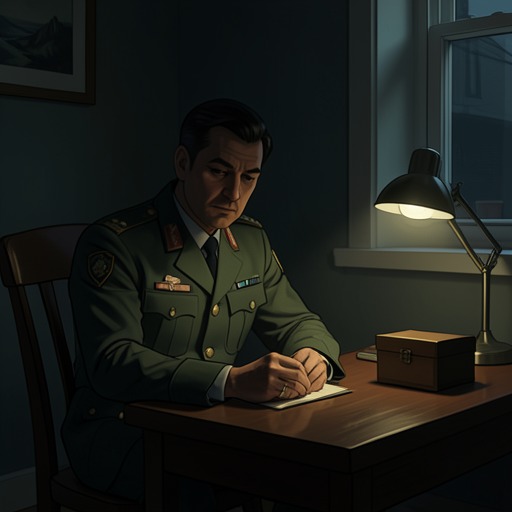
Gary’s account of Bangui shifts from military frustration to solitude. He lived alone in a small bungalow hidden among banana trees, and spent evenings on the terrace of the colonial club above the river, looking toward the forest on the opposite bank. The club had only one record, Remember Our Forgotten Men; its repeated presence makes the scene of isolation concrete without turning the outpost into a place of combat. It was near his bungalow that Gary encountered Louison, who was sixteen. He describes their union as a period of extraordinary happiness: they formalized it according to her tribe’s rites, with Prince Stahremberg as witness, and Louison came to live with him. Gary recalls that she did not speak French and that he could not understand her speech, even as he found joy in listening to and watching her. The account therefore presents their intimacy as powerful but also marked by a profound language difference and by the narrator’s idealizing perspective.
Illness and the End of the Interlude
Gary grew concerned when Louison developed a cough and arranged for Dr. Vignes, the squadron’s medical officer, to examine her. The doctor judged the cough harmless but noticed a mark on her arm and later told Gary that she had leprosy. He said that they would have to part. The passage establishes the diagnosis and the impending separation, but does not describe its subsequent course in the evidence presented here. French Equatorial Africa consequently holds two contrasting strands of Gary’s wartime experience: the frustration and reckless conduct of a squadron far from its desired front, and a short-lived happiness in Bangui that illness threatens. The posting ends when Gary rejoins his squadron on the Abyssinian front; the personal interlude remains bound to the place through the bungalow, the river-facing club, and the memory of Louison.