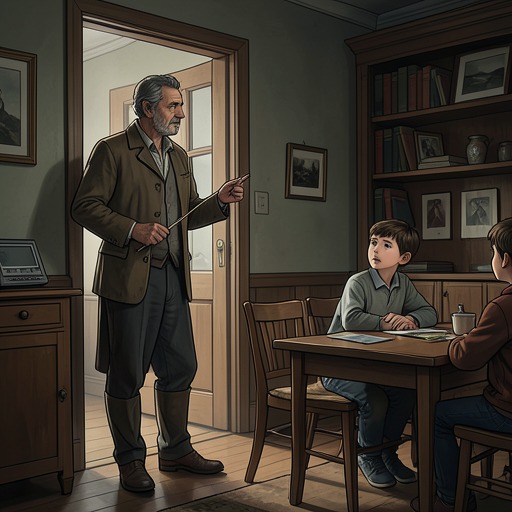
Josef Zaremba
Promise at DawnJosef Zaremba, the Polish painter who stays at the Hôtel-Pension Mermonts, becomes central to a delicate triangle of longing between himself, Nina Borisovskaia, and her son, Romain Gary. His attempt to marry Nina seems to offer Romain both material security and relief from the pressure of his mother’s consuming devotion. But Zaremba’s own desire is not simply for a wife: the narrator sees in the distinguished adult a lonely child seeking the maternal affection he has never had, and recognizes, in retrospect, an unsettling likeness to himself.
Identity and Background
Zaremba arrives one day at the Hôtel-Pension Mermonts in white tropical clothes, wearing a panama hat and carrying expensive-looking suitcases covered in labels from faraway places. He asks for a room for a few days and stays for a year. Tall, gaunt, gentle, and somewhat withdrawn, he presents himself as a prosperous, well-traveled man, with elegant manners and a composed air. His appearance gives little sign of the loneliness that the narrator believes has deepened within him over time.
The painter’s history helps explain that loneliness. His parents died young of tuberculosis, and he visits their graves in the Russian cemetery at Menton. He was raised by a bachelor uncle on a rich estate in eastern Poland. In conversations with Romain, he speaks of his life as nearly over and of wanting someone who would care for him, even if he occupied only a secondary place in her affections. He insists that he is not demanding, and that he is well off enough to share his material success. His wealth and travel have not, in the narrator’s reading, displaced the child who still longs for attention.
A Guest Becomes a Possible Suitor
Romain notices that Zaremba is seeking Nina’s company with discreet but unmistakable persistence. The painter’s sad, romantic appearance reminds him of Don Quixote in a drawing by Dora. Romain visits Zaremba’s neighborhood studio, though he makes clear in retrospect that his renewed interest in the painter had less to do with art than with the possibility that the courtship might change their lives. His mother, meanwhile, treats Zaremba with ironic pity and appears wary of his influence on her son, including the possibility that the sight of a prosperous painter might revive Romain’s own desire to paint.
Zaremba’s wish for affection has a distinctively maternal cast. Romain concludes that the painter has not fallen for Nina merely as a man falls for a woman: the child within the sophisticated, aristocratic figure has been stirred by the mother’s generous, visible love for her son. When Nina embraces Romain or brings fruit, cakes, or tea into the little garden outside the hotel, Zaremba watches with hurt reproach, leaning on an elegant walking stick with an ivory and silver head. He seems, to the narrator, like an outsider trying quietly but desperately to enter a family intimacy already in progress.
The distinction becomes explicit when Zaremba warns Nina that it is dangerous for a boy to grow up as an only son and the only loved one. Nina replies that she does not intend to adopt another child. Romain observes that the painter looks physically far removed from childhood, with an appearance of mature nobility and poise, yet seems like a boy knocking at a closed door. The scene brings the character’s central contradiction into focus: his adult dignity cannot conceal the need for affection that organizes his approach to Nina.
Romain’s Hopes and Zaremba’s Courtship
Zaremba’s courtship also opens a possibility for Romain. He is not, he says in retrospect, trying to escape the responsibilities created by his mother’s devotion; he remains determined to fulfill her dreams. Yet that love can feel crushing, and he longs for someone to share the burden while he goes out into the world and returns with his achievements for her. Zaremba’s presence suggests the chance of respite, though the hoped-for change carries its own emotional costs.
Once Zaremba decides to court Nina through her son, gifts draw Romain into the arrangement. He receives a crocodile-skin wallet containing fifteen American dollars, then a camera and a wristwatch. A Waterman fountain pen follows, along with cinema tickets, and Romain’s small library prospers. He even raises the prospect of a sailboat for their mutual use. He acknowledges the tactical element in his welcome of these gifts, but frames it through the understanding that he is not yet eighteen, has never had a father, and has begun to see Zaremba as a father figure while encouraging the painter to see him as a son.
The intimacy is made tangible by the things they share. When Zaremba finally raises the subject of marriage, Romain is in bed with a slight cold, wearing the painter’s pajamas and dressing gown, with Turkish slippers beside him. Zaremba brings fruit, tea and honey, and Romain’s favorite Les Petits Beurres Lulu biscuits on a tray. The arrangement that they should share everything has given Romain free access to the painter’s belongings, and he is especially well disposed toward him. Zaremba, in gray tweeds, sits beside the bed, visibly embarrassed: he swallows hard and nervously presses a handkerchief in his hand.
The Proposal and Refusal
Zaremba asks Romain whether he thinks his mother will marry him. The question catches the son unprepared even though he has been angling for this outcome for months. He does not want to make Zaremba feel that the result is already settled, and answers gravely that he does not know, adding that Nina has already had several offers. His calculated response also reflects the future he imagines for himself: if he is to enter the French Diplomatic Service, he thinks, he might as well begin preparing for it now.
Romain’s decisive mistake is to underestimate Nina’s youth of heart and her womanhood. He tells her that Zaremba respects her and will always treat her like a gentleman. Nina’s eyes fill with tears. She acknowledges that she is old and that parts of her life are gone, but says she once loved a man deeply and still loves him. He did not respect her and was not a gentleman, she explains, but he was a man; she remains a woman with memories. She has one son and considers him enough, and will not adopt another. Her answer rejects the future Romain had tried to arrange while asserting a past and a desire that his plans had failed to reckon with.
Departure and Narrative Significance
Romain understands that Nina sees his wish for Zaremba’s marriage as a dream of escape. In the narrator’s recollection, the exchange leaves no escape, only loneliness: his mother’s and his own. He must then tell Zaremba that the proposal has been rejected. Wanting to spare the painter, he decides to return the possessions that had come to seem part of their shared life. He gathers the blue silk tie with silver horses, camera, silk shirts, pajamas, fountain pen, and other treasured things, and removes the watch from his wrist.
Zaremba receives the returned gifts without asking questions. Pale and motionless in his chair, he watches as Romain places the objects gently on the bed. Their silence marks the end of the arrangement more plainly than an argument could. Zaremba leaves on an early train the next morning without saying goodbye. The blue tie, carefully wrapped in white paper, is left behind and given to Romain by the maid when he returns from school. He still has it years later, though he seldom wears it because it makes him look older than his age.
The episode’s final turn lies in the narrator’s retrospective recognition. Zaremba had seemed a premonition: beneath the manners and adult achievement, a child remained in the dark, wanting attention. Romain later sees a strong likeness between that condition and his own. The thwarted marriage therefore matters not only as a failed plan for changing the household, but as an early image of the loneliness and unmet need that the narrator will recognize in himself. The gifts, the returned watch, and the tie preserved after Zaremba’s departure give that failed intimacy a material afterlife.