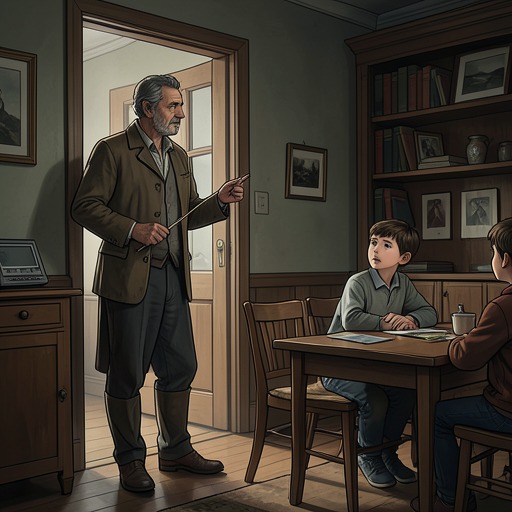
Joseph Zaremba’s Proposal to Nina Is Rejected
Promise at DawnJosef Zaremba’s proposal to Nina Borisovskaia is rejected in a scene that turns Romain Gary’s long-held hope for his mother’s marriage into an encounter with the limits of his own plans. Gary wants Nina to have a companion and imagines that marriage might lighten his responsibility toward her; Nina hears instead a wish to be rid of her. The refusal ends the possibility of a shared future for the three of them and leaves Gary responsible for telling Zaremba that he has lost the woman he hoped would become his wife.
The Proposal and Gary’s Expectations
Zaremba asks Gary directly whether he thinks Nina will marry him. The question catches Gary unprepared, despite his having hoped for this outcome for many months. He conceals his uncertainty behind a formal answer, saying that Nina has already received several offers. His response also reflects his awareness that the conversation has consequences beyond the immediate question: if he is to enter the French Diplomatic Service, he thinks, he may as well begin practicing its tact.
When Zaremba leaves, Gary feels that the man has left his anxiety and doubts behind in the room. Gary already suspects that Nina will be difficult to convince, but he decides to approach her after her return from the market, when she is usually in a better mood. He prepares with unusual care: he puts on his best clothes, gets a haircut, borrows a painter’s blue silk tie embroidered with silver horsemen, and buys an expensive bouquet of red roses called “Velvet Dawn.” At about half past ten, he waits in the lobby, acutely conscious that the conversation may alter his life.
His motives are mixed. He wants Nina to stop working so hard and believes Zaremba could help provide for her. He also admits that the prospect of easing some of his own burden of responsibility plays a part in his wish. He understands, moreover, that Zaremba seems to be seeking a mother as much as a wife. Gary nevertheless hopes to see Nina supported by a man who is kinder and more courteous than the hardships she has faced. His faith in Zaremba is not unqualified: the painter’s commercial success gives him doubts about his artistic ability, though Gary jokes inwardly that one great artist in the family is enough and reserves that distinction for himself.
Nina’s Refusal
Nina finds Gary waiting with the bouquet, which he presents without speaking. She is delighted at first, then apprehensive when she recognizes how much the flowers must have cost him. She sits with them on her knees, silent and suspicious, expecting bad news. When Gary begins by calling Zaremba a gentleman, Nina immediately understands the purpose of the gift and the conversation. She throws the bouquet across the room; it strikes a vase, which breaks. The maid briefly enters, sees Nina’s expression, and leaves again.
Gary tries to explain that Zaremba has a house in Florida and that he could spare Nina the burden of working so hard. Nina replies that Gary wants to get rid of her. Her accusation gives voice to the thought Gary has been struggling not to express: that Nina cannot remain the center of his life forever, and that he will eventually go his own way. He also recognizes that, beneath his concern for her, he may be trying to escape the force of her consuming love and emotional demands. He cannot say these thoughts aloud and falls back on the more modest explanation that Zaremba could help her financially.
Nina distrusts the match. She refuses the idea of adopting a middle-aged son with a graying mustache and regards the success of Zaremba’s paintings as suspicious. Gary counters with his manners and distinction, but his appeal that Zaremba will always treat her like a gentleman becomes the decisive mistake. Gary sees that he has misjudged Nina’s youth of heart and her womanhood: his argument treats respectful behavior as a sufficient substitute for what she wants from a husband.
Nina explains that she once loved a man deeply and still loves him, although the relationship belongs to the distant past. He was neither respectful nor a gentleman, but she remembers him as a man she loved. She acknowledges her age and the losses in her life without accepting Gary’s assumption that she should therefore settle for a convenient marriage. She has one son and does not want to adopt another. Her refusal is not simply distrust of Zaremba; it also asserts that her memories and desires remain her own.
The Rejection and Its Aftermath
Gary and Nina understand the painful implication of the exchange without resolving it in further argument. Nina knows that he has been dreaming of escape, while he sees no escape from the loneliness that would follow. He describes that loneliness as hers and his, linking the immediate rejection to a separation neither of them can prevent. The scene leaves the proposal unanswered in practical terms but emotionally settled: Nina will not marry Zaremba.
Gary then has to tell his friend. He feels for Zaremba, for Nina, and for himself, and worries about how to communicate the rejection without hurting a man he likes. The difficulty is sharpened by the thought that Zaremba has, once again, lost a mother. Rather than find words for the news, Gary gathers the possessions he had shared with him: the blue silk tie with silver horses, a camera, silk shirts, pajamas, a fountain pen, and other treasured belongings. He also removes his watch. Carrying these things upstairs, he knocks on Zaremba’s door.
Zaremba is pale and still. He asks no questions as Gary places the objects gently on the bed. They avoid each other’s eyes and remain silent, with nothing more to say. This return of shared possessions serves as Gary’s indirect announcement of Nina’s decision; their silence makes the rejection legible without requiring him to state it plainly.
Zaremba takes an early train the following morning and leaves without saying goodbye. He does not keep everything Gary returned: the blue tie, carefully wrapped in white paper, is left behind. The maid gives it back to Gary when he returns from school. Gary says that he still has it somewhere but seldom wears it because it makes him look older than his age. Recalling the episode much later, he notes that he is still several years younger than Zaremba had been at the time.
Meaning of the Failed Match
The proposal brings into the open a tension already present in Gary’s hope for the marriage. He genuinely wants Nina to have support and companionship, yet he also imagines a future in which he will no longer bear the full weight of caring for her. Nina’s response exposes the difference between his practical account of the match and her understanding of what it means: she hears his effort to arrange her future as a desire to leave her behind. Gary’s own recognition that he may be trying to escape her overpowering love prevents the episode from presenting his intentions as purely selfless.
The scene also refuses to reduce Nina to a mother whose future can be planned by her son. Gary believes that a gentleman’s manners and economic security would make Zaremba suitable; Nina insists that a woman’s past love and continuing desire matter even when she is old. Her decision preserves her agency, but it does not offer a simple resolution. Gary anticipates loneliness, and Zaremba departs without a farewell. The returned belongings, especially the tie that comes back to Gary, give the failed match a material afterlife: what had helped him dress for the conversation becomes a keepsake of the painful moment when his hopes for his mother collided with her own account of her life.