Moscow
Promise at DawnMoscow is a formative setting in the narrator’s childhood memories: a city of theater, crowded domestic life, and wintry departure. Before it became the point of origin for a three-week journey west, it was where he watched his mother perform and where her stories began to make France seem like a land of wonders.
Theatrical Childhood
The narrator recalls accompanying his mother through the world of Russian theater. At five or six, he rode beside her in a sleigh, nearly hidden beneath a heavy blanket, as they returned from performances for workers in freezing factories or for soldiers and sailors in barracks. These journeys connect the performance spaces of his childhood to a wider, precarious life on the road, though the memories do not identify every venue as being within Moscow itself.
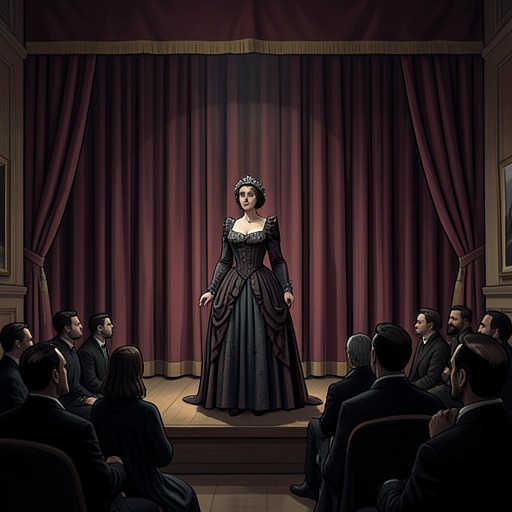
In a Moscow theater, the child sat on the floor of his mother’s dressing room and tried to arrange scraps of colored fabric into harmonious patterns—an early, tentative act of artistic expression. He remembers the smell of wood and paint, the empty stage with its sham forest, and the sudden shock of the dark auditorium. Actors in painted faces and fantastic costumes held him on their knees while his mother performed. A Soviet sailor lifted him onto his shoulders so he could see her play Rosa in The Shipwreck of Hope. Her stage name, Nina Borisovskaia, was written on the dressing-room door; it was the first Russian name he learned to spell.
Home Among Actors
The theater was not separate from family life. In Moscow, the narrator and his mother shared a flat with three other families of actors. Of the residents, he remembers an old man named Svertchkov; a young nursemaid, Aniela, looked after him. Alongside the dressing room and stage, the crowded flat forms part of his earliest picture of the theatrical community surrounding his mother.
His memories also leave open the exact shape of her career. The narrator remembers her pride in having been a dramatic artist, and his childhood recollections of performances support the sense that she had a substantial place in the small Russian theater world around 1919–1920. Yet Ivan Mosjoukine, who had known her earlier, spoke of her stage career evasively, suggesting that she should have studied at the conservatory and that circumstances had kept her talent from developing. Moscow is thus remembered through the child’s vivid scenes, while the adult narrator acknowledges that the full history of his mother’s artistic life remains obscure.
Departure and the Imagined West
Moscow is also the starting point of the family’s escape west. The narrator recalls a cattle-and-goods train journey that lasted three weeks, with typhus among the refugees. His mother knelt beside him, rubbed his numbed fingers, and spoke of the country where his future lay: a place where dreams came true, men were free and equal, and artists were welcomed into the best houses. The account carries the city’s theatrical world into the journey; France is introduced not as a known destination but as a promise narrated by his mother.
The journey’s physical details counterpoint that promise. The child wore camphor beads said to protect against lice carrying typhus, clung to a chamber pot he refused to leave behind, and was shaved and given an anti-cholera injection. At Lida, where the refugees were quarantined on the Polish frontier, he lay with his mother on a straw mattress among a hundred others. She continued to describe French heroes, performers, landmarks, and shops, while he tried to see the imagined world beyond the dirty wall. Moscow’s place in the narrative therefore extends beyond the city itself: it is the remembered beginning of a passage in which maternal storytelling offers a vision of refuge amid disease, displacement, and hardship.
Narrative Significance
The Moscow memories are shaped by the contrast between stage illusion and lived circumstance. Painted scenery, costumes, and the child’s scraps of colored cloth belong to a concrete theatrical environment; the France his mother describes becomes a larger imaginative stage, populated by cultural figures and promises of freedom. The narrator later recognizes that this childhood vision was a fairy tale that reality could not encompass. Moscow matters as the place where the performance and the promise first meet: the theater gives his mother’s voice its remembered force, while the departure from the city carries that voice and its imagined France into his adult life.