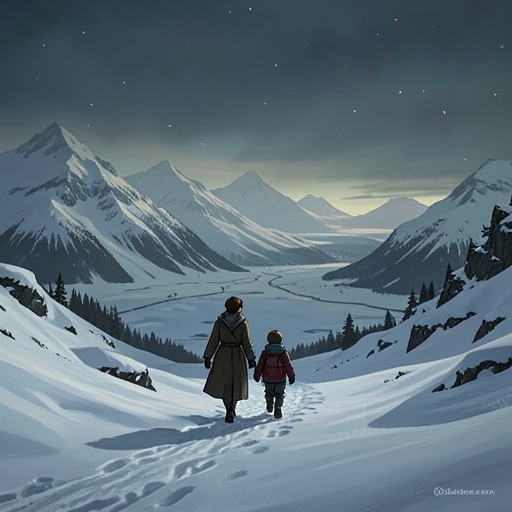
Move from Vilnius to Warsaw
Promise at DawnRomain Gary and his mother’s move from Vilna to Warsaw follows the collapse of their household’s security and marks a shift from trying to preserve their former life to making a new start. The decision is shaped by dwindling money, the loss of customers and possessions, his mother’s refusal to part with the family silver, and her determination to keep a French education within reach. Their departure also separates them from Aniela, whose farewell remains one of the narrator’s most emotionally charged memories of leaving Vilna.
Causes and circumstances
The move takes place after the family’s circumstances in Vilna have sharply deteriorated. As their rooms are emptied and the chandelier, once a sign of their former prosperity, is taken down, Gary and his mother confer about where they can go next. Staying in the city is no longer realistic: customers who had once courted his mother now avoid them in the street. Gary recalls that many of these people also owed the family money, so their avoidance served to spare them repayment as well as social embarrassment.
Nice, which might otherwise have offered a destination, is beyond their means. There is not enough money left to settle there, but his mother will not sell her precious silver. Gary presents that refusal as consequential: he understood the silver to be bound up with his future, not simply an asset to be exchanged for immediate relief. The family therefore leaves without converting its last important reserve into cash. The move to Warsaw is made under constraint, but the decision protects a longer-term hope even as it narrows their immediate choices.
Choosing Warsaw
The family has saved only a few hundred zlotys from what Gary likens to a shipwreck. They decide to go first to Warsaw, a choice his mother justifies as movement westward and therefore in the right direction. She also has friends and relatives there. Above all, she points to the presence of a French lycée: the prospect of French schooling makes Warsaw more than a temporary refuge and gives the journey a purpose beyond simply escaping Vilna.
The plan is carried out with almost nothing of the household’s former luggage. The silver is secretly placed in a secure hiding place, while the remaining belongings are bundled together. Gary’s description of this small, improvised load evokes the compact baggage of a fairy-tale departure; the image gives their material loss a narrative shape without disguising its practical severity. Their possessions are reduced to what can be carried, but the bundle also preserves objects through which the boy’s ambitions and attachments travel with him.
The farewell and the bundle
Aniela does not accompany them. She is to join her fiancé, a railway worker who lives in a discarded railway carriage with its wheels removed. The families part there, and Gary remembers a prolonged farewell in which they repeatedly embraced and separated before returning for another embrace. He says he has never cried so much since. The memory gives the departure a second cost: the move is not only a change of city but a sudden break in the daily world of people who had shared the family’s life.
Gary later tried more than once to find out what became of Aniela, but the railway carriage was an uncertain address, especially as the wider world was being overturned. He remembers her fear that he would contract tuberculosis and wishes he could have reassured her that this had not happened. The recollection preserves both her concern for him and the uncertainty created by their separation; the move leaves no dependable means of keeping in touch.
Among the belongings they take are La Fontaine’s fables, a volume of Arsène Lupin, and Gary’s Lives of Illustrious Frenchmen. Aniela has also rescued the Tcherkesse uniform he once wore to a fancy-dress ball. It is already too small for him, and he says he never again had occasion to wear it. These particular objects make the bundle more than a record of what survived materially: books associated with French culture and history accompany a boy whose mother is directing him toward French schooling, while the impractical costume carries a trace of an earlier childhood into the unsettled journey.
Significance and retrospective meaning
The move begins as a response to immediate hardship, but its destination reflects his mother’s insistence that displacement need not cancel the future she imagines for her son. Warsaw offers family connections and a French lycée; the hidden silver remains, in her eyes, a resource reserved for that future. The choice thus joins economic necessity to a deliberate educational and cultural direction, without making the family’s prospects secure.
In later life, Gary recalls that visits to Paris couture houses bring to mind the directrice of Maison Nouvelle, his mother. That retrospective association gives the loss of their former life in Vilna a lasting personal resonance: the move belongs not only to a change of address but to the memory of his mother’s work and authority. The episode also establishes a recurring tension in his story between material vulnerability and the future his mother insists on imagining. Its immediate outcome is modest and uncertain—a few hundred zlotys, a hidden reserve, a bundle, and a journey to Warsaw—but the French education she identifies as the decisive reason gives the departure its forward direction.