Poverty
Promise at DawnPoverty in Romain Gary’s account is not simply a shortage of money: it is the precarious arrangement by which his mother keeps the household alive, and the childhood helplessness that this arrangement leaves in her son. Its most persistent measure is food. A beefsteak served at noon stands for her daily victory over adversity; years later, hunger in Paris becomes the occasion for a story and a political conviction about the right to eat. Yet the memoir does not reduce their lives to deprivation. His mother’s labor creates a small, fiercely defended world of care, while the boy’s inability to repay that care becomes a lasting source of guilt and ambition.
Work and survival
When the family lived in Vilna, his mother designed hats to order, advertising by mail and with notices in shop windows in the city’s better districts. She presented the business as a Paris fashion salon and used false labels to persuade customers that her work came from the famous designer Paul Poiret. The trade brought little security: the hats sold badly, the winter was bitter, and the building owner threatened to put mother and son out unless the rent was paid within twenty-four hours. Somehow, it was always paid. The stove was lit, and tea, bread, butter, and eggs appeared for the boy; after returning from her rounds, his mother kissed him and met his gaze with pride.
After their arrival in Nice in 1928, the hat-making venture failed, and his mother shifted from one precarious occupation to another. She made lampshades and costumes for dolls sold to tourists, gave beauty treatments in a hairdresser’s back room, and then offered the same service to dogs at a kennel. At night she read palms in restaurants, relying on confidence and performance rather than knowledge of the art. Later she sold jewelry from hotel to hotel, held an interest in a taxi and a vegetable stall at the Buffa Market, and rented a small showcase at Hotel Negresco. Each scarf, belt, clip, or sweater sold there brought a ten-per-cent commission; she commonly charged above the agreed price and kept the difference. The showcase kept her seated and alert to possible customers all day, with a two-hour break at noon for her son’s lunch.
These enterprises were not stages in a stable rise from poverty. They were repeated attempts to make the next rent, meal, or school expense possible. His mother worked without a husband or lover and, as the memoir describes it, without friends; she had spent more than a decade trying to meet the costs of bread, rent, school fees, clothes, and shoes. In Nice, nobody saw the boy poorly shod or poorly dressed, because she treated those visible signs of hardship as things he should not have to bear. The contrast between her ceaseless activity and his dependence is central: he understands what she gives, but as a child he has no effective way to help secure it.
The meal as care and revelation
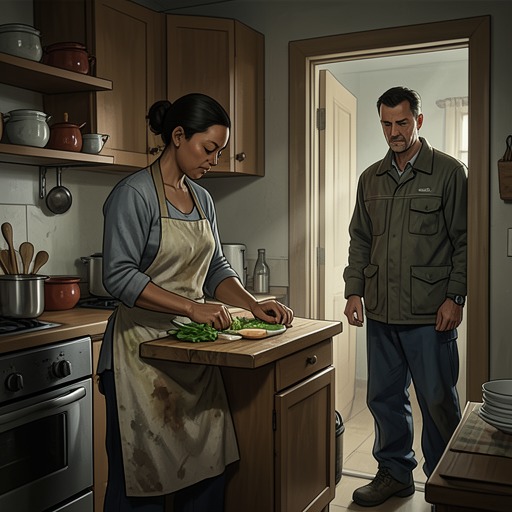
The beefsteak at noon concentrates that contradiction. His mother set it before him with a proud, happy smile, making the meal seem like the emblem of her success in keeping adversity at bay. She watched him eat, but claimed that she herself was dieting and could not have animal fats. One day, after leaving the table for water, he found her in the kitchen with the frying pan on her knees, using small pieces of bread to soak up and eat the fat left from his steak. She tried to conceal the pan, but he had already understood why she avoided the meat.
The discovery turned a familiar act of care into evidence of what that care cost. He stared at her embarrassed expression and ran away in tears. At the far end of Avenue Shakespeare, beside the railway embankment, he took refuge under a mimosa tree. The thought of throwing himself beneath a train briefly crossed his mind; what followed instead was a determination to set the world right. The episode fixes a lasting pattern in his recollection: his mother’s protection makes his own material security possible, but it also shows him that the security is purchased through her self-denial. His shame and helplessness deepen into a craving that, he says, neither art nor a woman could satisfy.
His mother’s work continued to define their relationship even when he was old enough to try to contribute. She sometimes came home carrying a faded carpet or a secondhand lamp to resell and watched him practice juggling in his room. She understood the practice as an act of love, though not as practical assistance; she expected him to become an artist, while the practical work of household survival remained hers. His own memory links that expectation to an earlier sense of failure: he felt he had disappointed her as a child prodigy and could not forgive himself for lacking musical genius. Decades later, after presenting Jascha Heifetz with the Grand Cross of the Legion of Honor as French Consul General in Los Angeles, he found himself whispering that he had not had the ability. The career he achieved did not erase the childhood measure of himself against the hopes his mother had sustained.
Hunger, dignity, and the right to eat
The memoir’s later scenes carry the material force of those childhood meals into a broader account of dignity. In Paris, after a friend failed to answer the door, he waited on the stairs for hours rather than remain until midnight begging for food. Walking back through the city, he saw a diner eating steak and potatoes through the curtain of the Brasserie Médicis and fainted. The account distinguishes hunger from the cause of the collapse: what overwhelmed him was humiliation, indignation, and rage at the position in which a person could be placed. He judged political systems by the nourishment they could guarantee, and rejected a world where a person could eat only by submitting to political conditions.
That principle emerged from an experience of deprivation, but the memoir also gives ordinary food a more intimate role. Pickled cucumbers, eaten in the sun or by the ocean, offered him moments of happiness and a way of feeling that the world could be taken in and loved. He could buy a pound and eat it without reserve. Set beside the childhood beefsteak, the cucumbers show that food is both a physical necessity and a form of attachment: a meal may record another person’s sacrifice, expose social humiliation, or offer an immediate pleasure that poverty cannot wholly abolish.
Even the small exchange at the Capoulade turns food into a scene of negotiation. Jules, seeing the nearly empty basket, agreed to sell him two coffees and a croissant for seventy-five centimes. Gary left transformed by the food and became the café’s best customer, while Jules occasionally protested that the arrangement might get him into trouble with his employer. The moment is comic, but it does not cancel the vulnerability behind it. Food remains something to be obtained through limited means and other people’s concessions, rather than an abstraction detached from everyday life.
Precarity and endurance
Poverty also forms the background to a household in which care depends on a mother’s physical endurance. While running the business at the Hôtel-Pension Mermonts, she climbed repeatedly between the restaurant and kitchens, supervised meals and supplies, dealt with visitors and tradespeople, and managed the accounts. One day she collapsed after giving herself too strong an insulin injection. The incident disclosed that she had been diabetic for years and took insulin each morning before beginning work. The memoir does not present poverty as the cause of her illness; it shows instead how her concealed condition existed alongside the labor on which the household and business depended. For her son, the sight of her collapse became inseparable from fear that she might die before he had fulfilled what she expected of him.
A similar sense of obligation appears when he himself fell gravely ill as a boy. He worried that his death would leave his mother without anyone to support her and that he would fail the future she had imagined for him. When doctors proposed an operation on his kidney, she forbade it, partly because she associated a man’s kidneys with sexual capacity and wanted more than a merely normal future for her son. The episode is not evidence that the operation was unaffordable; its relevance to poverty lies in the larger bond it reveals. Their lives are organized around his mother’s effort to sustain him and his fear of leaving her unsupported.
In the memoir’s retrospective perspective, later achievement and survival do not make the early hardship disappear. The boy who could not help at the showcase, pay the rent, or keep his mother from exhausting herself becomes an adult who treats the right to nourishment as a test of political decency. Poverty gives that conviction its concrete beginning: a mother’s many jobs, the meal she places before her son, and the bread she uses to gather what remains in the pan. It also supplies the emotional pressure behind his ambition. He wants to become someone worthy of the future she promised, but the story’s lasting tension is that no success can fully repay the care on which that future was built.