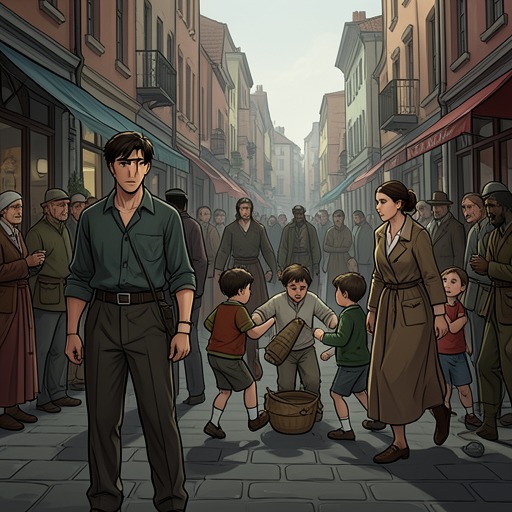
Romain Gary Is Slapped by His Mother After She Is Insulted in Warsaw
Promise at DawnRomain Gary Is Slapped by His Mother After She Is Insulted in Warsaw is a formative episode in which a schoolyard humiliation becomes a test of loyalty between mother and son. After boys in Warsaw attack Nina Borisovskaia’s reputation, Gary turns away from them for the first and, as he later insists, the only time in his life. He expects comfort when he tells his mother what happened; instead, she demands that he defend her, and soon begins arranging for their admission as residents in France. The episode turns a child’s retreat into a defining command and links his mother’s wounded dignity to the future she has long imagined for him.
The Dream of France and the Schoolyard
Before the confrontation, Gary’s classmates have been making sport of his claims about the life awaiting him in France. He answers their questions about French schooling with elaborate confidence: its curriculum is harder than Poland’s, sport is important, and he will study fencing and Greco-Roman wrestling. He describes an imagined uniform, including a blue jacket with gilt buttons and a sky-blue képi, and says that pupils sing La Marseillaise each morning. When they ask him to sing, he performs the anthem with conspicuous enthusiasm. Though he recognizes that the boys are laughing at him, their mockery does not initially dislodge his belief in the dream; he feels protected by the greatness he attributes to France.
The teasing changes when a group of older boys asks whether he is still among them, since France is supposedly waiting so eagerly for him. Gary prepares to repeat his usual explanations, but one boy interrupts with a sexualized insult about his mother. The allegation has no basis in her past. Gary recalls that Nina Borisovskaia had performed in Moscow theatres and that people who knew her described her as proud and exceptionally beautiful, not as someone led astray by her looks. The contrast is sharp: his imagined future in France had made him impervious to ordinary ridicule, but an attack on his mother reaches him where the jokes about his own ambitions did not.
The Retreat and the Expected Comfort
The insult leaves Gary stunned. His confidence collapses, his eyes fill with tears, and he turns his back on the boys. In retrospect, he marks this as a singular failure to face an opponent: he says that he never again turned his back on anything or anyone. At the time, however, he is too surprised and disoriented to respond as he believes he should. The episode records not a triumphant defense of family honor but an involuntary retreat that becomes a lasting point of comparison in his account of himself.
When Nina Borisovskaia returns, Gary runs to her and tells her what happened. He expects her familiar affection and consolation. Instead, she grows silent and distant. She takes a cigarette, prepares his supper in the shared kitchen, and makes his bed without offering the response he anticipated. She remains awake through the night, sitting in a pale-green leather armchair with a cigarette, while Gary experiences her withdrawal as abandonment. In his later recollection, he imagines that she was measuring his response against the sacrifices and hopes she had invested in him, and wondering whether he might become like the man who had once treated her badly. This is his retrospective interpretation, not a thought she explains to him at the time.
A Command and a Change of Direction
The next morning Nina Borisovskaia returns to familiar care in practical form: she boils Gary three eggs and makes him chocolate, watching while he eats. He understands her tenderness to have softened when she remembered that he was only twelve. Yet as he gathers his books for school, her expression hardens again, and she tells him he will not go back there. She insists that he continue his education in France and asks him to sit down. The decision is no longer only an answer to the boys’ insult; it redirects the immediate course of his schooling toward the future that had until then been sustained largely by his own confident talk.
Gary objects, and Nina Borisovskaia answers his complaint by emphasizing that their journey to France would have no purpose unless he understood what she was asking of him. She strikes him repeatedly. The account presents this as the first time she has raised a hand against him, and Gary’s response is stunned silence. Her instruction is that he must defend her from then on: physical blows against him matter less than the injury of failing to stand up for her, and he must be prepared to risk his life if necessary. Gary initially pretends not to understand, sheltering behind the fact that he is a child, but he recognizes that she knows he has understood. The scene binds her demand to an explicit change in his role, from the protected son to the person expected to protect her.
From Family Wound to Practical Action
After giving the instruction, Nina Borisovskaia drinks tea with a lump of sugar, then takes her handbag and goes directly to the French Consulate. She energetically begins arranging for the two of them to be admitted as residents. The application, drawn up by M. Dieuleveut-Caulec, presents Gary’s intention as settling in France, studying, and growing into a man. In his later account, Gary observes that this formal declaration may have gone beyond what his mother had fully considered in the moment. The concrete action nevertheless follows the morning’s confrontation: France shifts from a boy’s imagined destination, described through uniforms and school rituals, to a place for which his mother is actively seeking admission.
The episode’s reversal lies in the gap between what Gary expects and what he receives. His mother does not soothe him after the insult; she treats his retreat as a failure to recognize what her suffering means to him. Her severity is inseparable from care: the same morning brings the familiar eggs and chocolate, a directive about his education, and a demand for lifelong defense. Gary’s later narrative also gives the moment a lasting consequence in his self-understanding. He remembers turning away only once, and remembers his mother’s response as the point at which his imagined journey to France acquired a personal obligation. The story does not resolve the larger move here, but it shows the family wound and the practical preparations for France converging in a single day.