Romain Hides in a Woodpile and Is Comforted by a Cat
Promise at DawnRomain Hides in a Woodpile and Is Comforted by a Cat is a childhood episode in which a refuge built from logs becomes the setting for a crisis, and a stray cat’s practical, physical affection interrupts the boy’s resolve to disappear. After being humiliated in public, eight-year-old Romain withdraws into his secret hiding place, where despair briefly becomes a plan. He emerges not through argument or rescue by an adult, but through contact with an animal whose motives he recognizes as self-interested and whose comfort he accepts anyway.
The Woodpile as a Private Kingdom
The woodshed stood in the courtyard of the block, its stacked logs rising two floors high. Children had been strictly warned away: a disturbed log or accidental push could bring the fragile pile down and bury anyone inside. Romain nevertheless made the danger his territory. By shifting particular logs, he created galleries, burrows, and narrow passages, learning which pieces to move to open a route and replacing them behind him. The damp timber soaked the bottom of his pants, but the enclosed maze offered security and a sense of command unavailable in the world outside it.
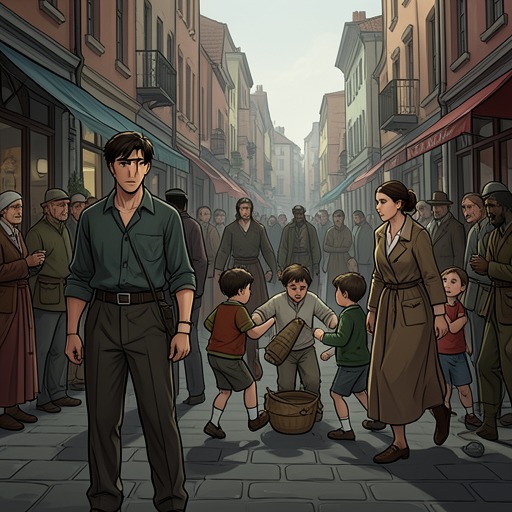
That refuge followed the public humiliation in which Romain had stood with his mother while others jeered and insulted them. He did not leave her to face the crowd alone; they remained together until the end and were the last to withdraw. Only when he could make his departure without seeming to abandon her did he slip away toward the woodpile. The sequence makes his retreat more than a child’s game of hiding: after standing beside his mother in public, he sought a place where the hostile audience could no longer reach him.
From Shelter to Despair
Romain worked his way into the heart of the logs and replaced them behind him. With fifteen or eighteen feet of wood between himself and the outside world, he began to cry. The burrow that had ordinarily made him feel safe now became a place from which he imagined there could be no return. He examined the logs and selected those that, if he pushed them with his feet and back, would bring the structure down on him. He touched them one by one with gratitude, finding comfort in the thought that humiliation and unhappiness might end with his death.
He positioned himself to carry out the plan, but remembered a piece of poppy-seed cake in his pocket. He had stolen it that morning from the back of a pastry shop while its owner served customers. Romain ate the cake, then returned to position and prepared to push. The small interruption does not erase the seriousness of his intention; it introduces an ordinary, bodily appetite into the moment at which he is imagining an end to life. Before he can act, however, a face appears between two logs.
The Cat’s Intervention
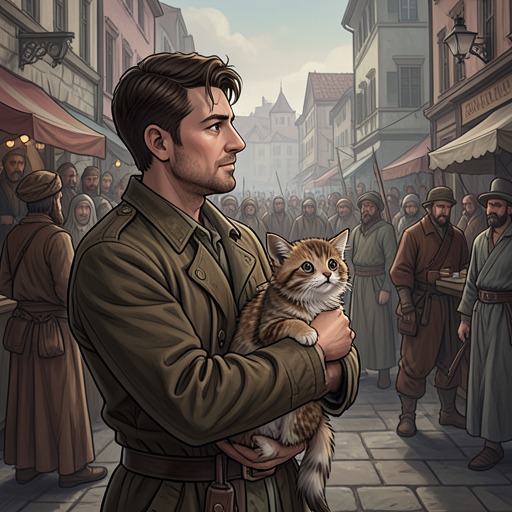
The visitor was a very thin, mangy, marmalade-colored tom with torn ears and an appraising expression. The two stared at each other in astonishment. The cat then studied Romain and licked his face. Crumbs from the cake remained on his cheeks and chin, and Romain understood that the animal’s attentions were prompted at least partly by food. He did not demand a purer motive. The rough warmth of the cat’s tongue made him smile, and he let himself receive the affection without resolving whether it was compassion, appetite, or both.
As the cat rubbed against his face and purred, Romain tried to purr too; the two made a game of seeing which could purr louder. He scraped the remaining crumbs from his pocket and offered them to his visitor. The cat leaned against his face, held its tail straight, and nibbled his ear. These gestures, small and without speech, changed the immediate meaning of the hidden space: the woodpile had contained not only a route to self-destruction but also an unexpected companion. Romain’s sense of possibility returned, and he judged life worth living again.
A few minutes later he climbed out and headed for the house with his hands in his pockets, whistling, while the cat followed at his heels. The ending marks a sharp reversal from the boy who had arranged the logs to bury himself: he leaves the shelter under his own power, accompanied by the animal whose arrival interrupted his plan. The danger of the woodpile remains, but Romain no longer treats its collapse as an escape.
Affection, Appetite, and Survival
In retrospect, Romain draws an amused but unsentimental lesson from the encounter: a few crumbs of cake can help when someone wants to be loved in a truly disinterested way. The joke depends on the mismatch between the ideal of unconditional affection and the cat’s evident interest in food. Yet the episode does not dismiss the comfort as false. Romain knows why the cat licked him and accepts the warmth all the same; the animal’s motive matters less than the friendly contact he experiences in that moment.
The episode’s rescue is therefore neither a miraculous transformation nor a tidy explanation of the boy’s suffering. Its force lies in a sudden interruption: after isolation, tears, and a deliberate preparation for death, another living creature enters the narrow passage and responds to him bodily. The cat’s purring, rubbing, and nibbling restore companionship in a scene where humiliation had made the world feel intolerable. Romain’s return to the house, whistling with the cat behind him, gives that modest contact a decisive consequence: for the time being, he chooses life and re-enters the world.